 Putin's Night
Of The Long Knives
Putin's Night

As I looked more deeply at certain documents about the beginning of the
revolutionary career of Feliks Edmundovich, I became, from day to day, more and
more proud, and more and more frightened. Yes, that was exactly the way it was;
I felt great pride in the first Chekist, pride in his great and broad open-
mindedness, in his transparency, in his ideological firmness, at the great
heights of his party loyalty, at his sensitivity and tenderness, his goodness,
his even-mindedness, but at the same time, I felt terror: could I at all even
reach for some understanding of such a person, could I in any way live up to
such great moral heights, heights which made up the substance of... Feliks
Dzerzhinsky..." - Yulian Semenov, author of "In 17 Moments of Spring", in the
book, "Chekisti"
The Night of the Long Knives has arrived in Moscow. Just look at everything
that's happened in the last few weeks, the last few days; it boggles the mind.
The Soviet national anthem, the theme music for a generation of death camps, was
restored in a sudden fait accompli. The Moscow tax police announced the
beginning of liquidation proceedings against the Media-Most empire, the last
real bastion of opposition press in the country. Worse, the Moscow mayor
announced that his government was not responsible for the move against Media-
Most, that the decision had been made at "another level". The local government
was, in his words, more or less helpless. Yuri Luzhkov, only a year ago the
second most powerful man in the country, is now, on his own territory, a mere
puppet. Someone Else is in charge now. And we know who.
Moscow's Vice-Mayor was
shot on Tuesday. Journalist Oleg Luriye, who appeared on television last Friday
to protest the liquidation of NTV and Media-Most, had been brutally beaten
outside his home by a gang of thugs the day before. He escaped only when his
wife managed to drive a car through his garage door in the direction of their
attackers. Luriye's beating came just a week after two other journalist from his
newspaper, Novaya Gazeta, were beaten in Ryazan. Correspondents Mikhail Komarov
and Yelena Denisova had been among the first journalists to uncover the story
about the "bomb scare" in Ryazan last year. eXile readers will recall that
affair, in which residents of an apartment building discovered a hexagen bomb in
their basement after the presence of a suspicious car with Moscow license plates
prompted a police search.
That story had hurt Vladimir Putin badly. It had
raised the question of whether or not he had been behind the notorious apartment
bombings of last summer. Now, suddenly, it was apparently decided that the coast
was clear for these journalists to be hurt in return. Komarov was attacked on
December 12. Denisova, the editor of the Ryazan version of the paper, was
attacked on December 14. She had surgery a day later. The paper's offices were
ransacked on the 16th. On Monday, December 19, the Moscow paper swore to defend
their journalists "by any means necessary, including the toughest ones" - but the
announcement came in a tiny editorial, and the threat seemed hollow.
The violence and the strong-arm tactics have appeared in an uncannily harmonious
proportion to ambitious new state offensives on the ideological and cultural
fronts.
Alongside the restoration of the national anthem, and against the background of
the depressing seduction of Alexander Solzhenitsyn earlier this year, the Putin
regime has apparently been preparing to score a stunning political victory over
the country's last democratic holdouts. According to various reports, including
one made last week in the pages of our Russian partners, Stringer, the Putin
regime has been courting Yabloko leader Grigory Yavlinsky, offering him a
position in the government.
Yavlinsky, who repeatedly refused to collaborate
with the corrupt Yeltsin regime, is
reportedly considering this invitation from the far more sinister Putin
seriously. He is said to be under pressure both from the Putin administration,
and from his own fellow party members, who have been publicly threatening to
mutiny if their party continues to refuse its share of the pie. This is all
coming at a time when Yavlinsky's allies in the press - Novaya Gazeta has long
been known to be a creature of Yabloko - are being brazenly, physically attacked.
Of all the things that have happened in this country of late, the capitulation
of Yavlinsky would therefore come as, perhaps, the most depressing news of all.
That it is even being rumored is a shock.
The move against Media-Most came just
a few days after its chief, Vladimir Gusinsky, was arrested in Spain. In a
detail that sheds some light on the queer and unnerving sense of humor of this
new regime, this latest and probably last move against Gusinsky's media holdings
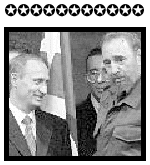
was made while the Leader himself was in Cuba, warmly visiting with, of all
people, Fidel Castro.
This appears to be the style of Vladimir Putin, to mix not-
so-oblique public symbolism with energetic off-camera ruthlessness and violence.
This tightrope act is maintained with an almost pathological care and attention,
with every last detail thought out very carefully by some person or persons, and
every step punctuated with the keen timing and choreographic flair of an
experienced stage director (in itself an ironic and chilling proposition, given
that this was Gusinsky's actual former profession).
For example: Putin's
geographical "dis-tance" from the move against Media-Most was carefully balanced
with a bloody reminder that, in a larger sense, he never left and never leaves.
When the tax police made their announcement about the liquidation of Media-Most,
Gusinsky's flagship television station, NTV, held a special edition of the talk
show "Glas Naroda" ("Vox Populi") to discuss the news. At one point, Novaya
Gazeta's Luriye suggested that the move against NTV might actually have been
made by someone in Moscow as a means of setting Putin up for a political fall
while he was away in Cuba. As he was making this point, the show's host,
Svetlana Sorokina, interrupted Luriye to read out loud a bulletin that had just
been handed to her from the Interfax wire.
The news story was datelined from Cuba and quoted Putin as saying that he was
fully aware of what had happened in the Media-Most case, and that, in general,
he did not approve of "business figures who attempt to influence the unfolding
of political events", i.e. Putin.
Luriye listened to Sorokina's comments and
shook his head. "Okay, in that case, I take back what I just said. I take it
back completely," he said.
When Putin came back from Cuba, Luriye was beaten
in his garage. Nothing was overlooked, nothing went unrecorded while the
leader was away.
There is a certain economy that must be observed in the sending
of messages. Russia's new president in this sense blows away the "whiz-kid
economists" of the old reform team, the Chubaises and the Gaidars and the
Kiriyenkos.
Speaking of Putin-the-economist: there was another edition of "Vox
Populi" last week which made public the following story. Sergei Dorenko, the
disgraced ex-pit-bull of the defanged ORT propaganda machine, rose from the dead
to tell a story about meeting Putin at an airport earlier this year. Dorenko
said he presented Putin with the results of an opinion poll which showed that
Russia's people considered Putin the country's finest economist.
"I told him
this with a little laugh," said Dorenko. "I said, `Vladimir Vladimirovich, this
is going to a lead to a situation in which you'll be named the country's best
poet, its best soccer player. It's just silly.' He was quiet the whole time. I
said, `The people are strange.' To this phrase he responded. `Our people are
correct, Sergei, correct.'"
"The people are correct." The Leader has become so
smug, he can allow himself the luxury of refusing the pop-laurels offered to him
by foreign journalists as Russia's new Caesar. Here is a question posed to him
in all seriousness by the Ottawa Globe and Mail in an interview, and here is his
deliciously self-satisfied answer:
Globe and Mail: [Vladimir Vladimirovich],
many write and say, and some people have even called
you the sexiest man in your country. How do you feel about it?
Putin: It goes
with my present job. I endure it.
Oh, it's tough running things, it's a trial.
So many problems, so many repsonsibilities. Fortunately, in these dark times,
one can count on the support of a few patriots. Like film director Svetlana
Druzhina, for instance. She appeared opposite Dorenko on the Vox Populi show to
argue in support of the restoration of the Soviet anthem. Her abject power-
worship amounted to no less than a modern version of the old argument in favor
of the divine right of kings. It was a beautiful
 elucidation of the the efficient psychology of authority, spoken from the point
of view of the thankful subject:
elucidation of the the efficient psychology of authority, spoken from the point
of view of the thankful subject:
Druzhina: If such a wonder had happened that I
had been asked by Vladimir Vladimirovich, "Svetlana Sergeyevna, what do you
think of the symbolism?" I would have said, "My dear Vladimir Vladimirovich!
You're in such a difficult position! The country is in a state of collapse!
There is the great Glinka! [the author of the Yeltsin-era hymn. - ed] Such great
music! Music that is of the people to an improbable degree! It's improbably
powerful! God from the cosmos sends such notes!" But it did-n't happen that way.
And nonetheless, not doubting for a moment, feeling for and cheering for our
president (to whom I gave my vote most consciously), I am one of the first to write
him a letter of support! I wouldn't respect myself otherwise! Therefore I want
to say: I support the President in any situation!
The most remarkable thing
about the ascension of Vladimir Putin, and the circumstances surrounding his
Michael Corrleone-style blitz of power plays last week (Good God, they even
happened while Putin was in Cuba - meeting with Hyman Roth, I suppose, and
plotting the attack on Frankie Pantangelo - there are so many different maddening
and irresistible angles on this story, it's impossible to catch them all at
once) has been the lack of history in the air. Putin has been swinging a very
heavy hand of history in the past few weeks, centralizing power and increasing
control over dissent by geometric degrees with each passing day. But the
response has not been proportional.
In the midst of all of these massive events,
other news somehow continues to make it onto the front pages of local
newspapers, leaving the great changes reported without alarm. That is, the news
is reported, but without perspective or public appeals to reason.
RAO-UES is
being restructured. Media-Most is to be liquidated. The President of Ukraine
beheads some journalist. The Soviet hymn is restored, with the support of the
Russian Orthodox patriarch. The Mabetex case is suddenly closed. Tatiana
Dyachenko is mysteriously pushed as a Duma candidate for the Chukotka province.
Roman Abramovich is set to take over as Chukotka governor. The governor of Mari-
El is being forced off the ballot in favor of a Kremlin candidate...
Gleb Pavlovsky announces that a new state informational center, drawing upon the
resources of FAPSI, will be created to address media "attacks" on the President.
Pavel Borodin, fresh from his final exoneration, announces his plans to
participate. A purge of uncooperative detectives from the Prosecutor's office is
reported in Moskovsky Komsomolets. Gusinsky, Luriye, Komarov, Denisova, Most and
Yabloko. The local Unity Party office in St. Petersburg announces that it is
making a series of bronze Putin busts. Bronze Putin busts! This is all happening
so fast, with the speed of an avalanche,
and there's not a hint of an organized opposition or outcry. Each object of the
government's recent attention appears as just another pylon that, having been
weakened and tired out by the Yeltsin years, can now be casually pushed over. In
the midst of all this apathy, a new phenomenon is appearing. The principle of
conservation of energy must be maintained always. Where there once would have
been revulsion and outcry, there now must be, logic dictates... something else.
That something else is Svetlana Druzhina. It is love and slavish worship of the
Inevitable. When one is powerless to oppose, and is too tired to spare the
energy to evince disgust, and when one furthermore cannot simply die off, and
must still continue to live and put one's energies somewhere, one inevitably
begins building long bridges of flattery, cowardice, and collaboration.
Something has to fill up those hours, those years left until the end. This is
much of Russia's history from the last century, and it is repeating itself in
the new one under Putin.
This is why, for instance, the Patriarch Alexei changed
his mind on the hymn issue. You have to look at things from Alexei's point of
view. It is pleasant to drive in a chauffered car, wear a freshly-laundered
funny hat every day, and travel everywhere in a company of shuffling, self-
flagellating supplicants. In the absence of real beliefs or life goals, this is
certainly better than nothing. When the issue of the return of the Soviet hymn
first came up, Alexei opposed it. After all, as journalist Alexander Minkin
pointed out, in the Khruschev years alone, more than 25,000 churches were
destroyed in Russia.
But when Putin failed to respond to Alexei's opinion, he
did the logical thing: he changed it. Minkin quotes the well-known priest, otets
Alexander Borisov, in describing Alexei's conversion:
"The Patriarch at first
made it clear that he was not crazy about the hymn. But he wasn't listened to.
And he understood. Therefore the Patriarch decided not to forfeit his good,
kindly relations with the President, just so that he could voice his opinion a
few extra times... Why repeat it, if it brings you nothing?"
Right, exactly.
What's the point? The point, after all, is to stick to the point. For
Alexei, it's the life of a religious leader. For Western businessmen, it's money
and waiting out the next deal. More global political and moral issues are
apparently not the business of Business, ours or theirs. In the past this was
understood tacitly. Now, in the age of gross flattery and political
homogenization, in the age of George Bush and Vladimir the Inevitable, this case
is being made openly, by the very highest priests of our business community.
Here are a few quotes from Michael Carter, the World Bank's country director for
Russia, in a statement about Russia's progress. The first goes as follows:
"The
second thing is that I think that in many ways a lot has changed in the last
five years," he says. "Whatever the indicators say, I believe that Russia is in
fact substantially better off today than it was five years ago. I think that
that is reflected, for example, in the political situation. When I first came
there were major fears of a complete reversal back to a centrally planned
system. I don't think that that is what most people consider to be a major risk
today."
Russia is better off today than it was five years ago because Putin is
not a communist. On the contrary, his party is called the Unity party. And
they've changed the words to the song.
Carter goes on later to address the
"moral" issue", and brush it aside:
"It is evidently true that any country's
economic process has to be rooted in its own values and systems. And that those
values and systems in Russia itself are in transition. There has been a tendency
at times in the West to see things in simple terms - sometimes in terms of
standards that Western countries don't apply to themselves. That really comes
back to what I said earlier - it's going to be a messy process with setbacks as
well as progress.'' This is such a deeply cynical set of statements that it is
not inappropriate to classify them with the pronouncements of Druzhina, or with
those of Yulian Semenov - the above-mentioned author of "In 17 Moments of Spring"
and praiser of Dzerzhinsky. Think about it: when the World Bank came to Russia,
it applied its standard playbook for privatization and 21.12.00 structural adjustment to Russia, not taking 11.01.01
into account Russia's www. specific cultural situa- #25/106 exile. tion. This
has, after ru P.3 all, been the central criticism of the Bank's performance
here. The Bank always brushed aside those criticisms, saying it knew better.
Now, when it is convenient for the Bank to ignore a growing political
catastrophe in the name of retaining a client - and that's exactly what foreign
governments are for the Bank, clients who keep the money flow going - it cites
the principle of individual national identity and self-determination as its
defense. This Michael Carter doesn't care about Russia's own "values". He
doesn't care about anything - probably not even about the World Bank. He just
wants to keep his job. He wants his funny hat and his chauffeur and his
supplicants, or their fuddy-duddy Western fiscal-conservative equivalents. So he
says what he needs to say to make it happen, even as the Stalinist theme song is
revived and the whole principle of the free press is buried. He would stare Oleg
Luriye in the face and tell him that Russia is better off today than it was five
years ago.
In life you either speak your mind or die. When you cease to think
for yourself, you cease to exist. To embark on a life of permanent flattery and
cooperation, for the sake of it, is to transform your living body into a
lifeless pylon to be turned over. The difference between physical existence and
nonexistence then becomes merely a matter of whether or not it is your turn.
Russia is apparently so tired - from poverty, from failure, from sinking
submarines and exploding TV towers, from mobsters and cholera and darkness and
huge messes of roaches - that a majority of its citizens are consciously
embarking on this life of the Living Dead. This is the eternal contract that the
vampire Putin has offered his country. And the people are accepting, because
they feel less pain that way.
But what's our excuse? What are we tired of? Being
rich? Business as usual. A great code to live by. Merry Christmas, Moscow.