 By John Dolan
A long time ago Nietzsche asked, "What in us really wants truth?" This question hangs over many of the books purporting to tell what went wrong with Russia in the nineties.
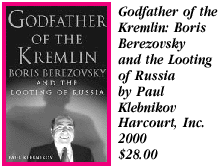
Telling the truth is by no means a simple matter. There are important questions involved, such as, "When did you decide to tell the truth?" and "Why did you start telling it?" Both "when?" and "why?" apply to recent attempts to tell the truth about Russia. "When?" should be asked of the many American academics who shilled for the thieves right up to the '98 crash, and then, when no more bluffing was possible, suddenly began decrying the horrors they'd helped to create. In Klebnikov's case, the key question is "Why?" - why has Klebnikov, a fervently pro-capitalist journalist, written such a vitriolic attack on the leading figure in Russia's transition to capitalism? Klebnikov, after all, writes for Forbes, the proud "Capitalist Tool," most militant of the the counterrevolutionary journals. And when he talks about capitalism in the West, Klebnikov shows the rah-rah spirit one would expect from a Forbes reporter. This is the ideological anomaly at the heart of the book: Klebnikov writes about Berezovsky and his "reformist" front men with real hatred, in the language of a far-left activist. He details their looting of Russia, freely quoting Yavlinsky's bitter attacks on Gaidar and Chubais, and concludes that capitalism in the absence of a strong state is no more than robbery. There is real hatred in his descriptions of Gaidar and Chubais - though oddly enough, no such hatred for Yeltsin, who surely deserves as much blame as any of his minions. Another anomaly, another clue that there is something odd going on in this book.
Klebnikov actually goes much further in his attacks on the Yeltsin regime than have many supposedly leftist journalists. He accepts Lebed's claim that the first Chechen war was undertaken by the Kremlin thieves in order to punish their Chechen accomplices for witholding oil-transport profits, and was prosecuted eagerly by the Russian army because inflated combat losses allowed Russian officers to write off armored vehicles they had already sold to Balkan customers. In summarizing the Yeltsin era, Klebnikov is more blunt than any but the most radical Russian leftists:
"Russia was ravaged and destroyed. Millions of Russians died premature deaths....[Under Yeltsin] democracy became a curse word - to be called a democrat was synonymous with being labeled a crook. The two concepts that were supposed to lead Russia to a Western- style future - privatization and democrati-zation - were discredited. On the streets of Moscow, people began to speak of democratization as 'grab-it-ization' (prikhvati-zatsiya) and of democracy as 'shitocracy' (dermokratizatsiya)."
This is bitter and impressive truth. But it begs Nietzsche's question: to what end does Klebnikov, this right-wing business reporter, tell these cruel truths? What, for him, is the point? It almost seems that he is willing to transcend his Forbes ideology:
"Perhaps the problem is that the American model, both as presented by American policy makers and as understood by the Russians, was a perverted version of the real thing. Western policy makers and advisers mistakenly believed that all it would take to propel Russia from Communism to a Western-style future was to dismantle the old state command system and open up the economy to free markets and private ownership. They overlooked the need to prepare the state and society for this change. Private property or [sic] free markets alone do not guarantee a high level of civilization. Even the most impoverished countries have private property and free markets. What they lack is a healthy state and a healthy society. Today, these are the two essential preconditions for civiliza-tion."
Very odd, to find the Forbes man writing like the ghost of Olof Palme, calling the dominant American paradigm "pervert-ed." But Klebnikov is uneasy in this no-man's-land, so far from his own lines. He quickly makes it clear that he does not want to pursue the question of "perversion" in American capitalism. The method Klebnikov uses to deflect the question is a common one: he quotes Berezovsky's self- serving defense that the Russian oligarchs are no worse than the American robber barons of the nineteenth century, then refutes the parallel:
"The old American robber barons may have bent the rules occasionally, but they were neither criminals nor looters. On the contrary, the robber barons, whatever their moral flaws, helped turn the United States into the strongest economic power in the world....No, Berezovsky and his colleagues could in no way be compared to the robber barons of American history."
It is indeed unfair, not to mention intellectually sloppy, to compare the contemporary Russian oligarchs to the dim figures of "American history." But why trawl all the way back to the nineteenth century? Why not compare Yeltsin and Reagan? If Klebnikov really aspired to a rigorous comparison of the effects of kleptocracy in late-twentieth-century economies, he would have compared Berezovsky to the great American robbers of the Reagan era, the oligarchs who looted the S & Ls and manipulated phony stocks using techniques remarkably similar to those employed by the Russian oligarchs.
But that's not what Klebnikov wants to do. Remember, the key question here is "why?" - why does Klebnikov want to crawl so far into an ideological no-man's-land to bring back Berezovsky's head? He is not really brave enough to defect from the Forbes lines. He has instead found a way of attributing blame for the horrors of Russia in the nineties to certain people, certain individuals. And his choice of individuals is rather odd, and in the end quite revealing. It's not Yeltsin who gets the blame; in Klebnikov's book, Yeltsin hardly seems sentient at all. He is a dupe, a front - and thus, for Klebnikov, almost innocent. (Just as the pig Reagan is "innocent" for most Americans by virtue of sheer callous indifference.) In Klebnikov's view of history, only a few people in Russia can be considered sentient actors. The rest of the country becomes that old, familiar body which can be acted upon, but can never act. In Klebnikov's narrative, there is only this dumb peasant body and the parasites who cause it to suffer:
"The disintegration of Russia allowed Berezovsky a unique chance to realize his designs on a grand scale. And as he grew stronger, Russia grew weaker."
Listen to that simple, fairy-tale version of the nineties! In this story, there are only two characters: the menaced damsel Russia and the vampire Berezovsky, feeding on her blood. When you review books, you end up sifting through the strange, often embarrassingly primitive narratives by which human minds are organized. In Klebnikov's mind, one finds a thin layer of neo- capitalist cant overlaying something much older, darker, and simpler: a tale of innocent peasant Russia colonized and parasitized by cruel aliens like Berezovsky. Why is Yelstin innocent? Because he is of "Russia," and thus helpless before Berezovsky. By dividing his characters in this way, Klebnikov is able to recount the horrors of Yeltsin's Russia and still draw a paycheck from Forbes - still crawl back to the Capitalist lines, rather than defect and bring his whole world down around him.
One can't help but be reminded of Engels' brilliant line: "Anti-Semitism is the socialism of fools."