In Moscow, these things can be arranged. If you're a journalist, they can even be arranged legitimately. That's how I got into this morgue. The visit was arranged by a friend of mine, a Western journalist who is, I suspect, even sicker than I am. I never tell him this to his face, but I suspect him of being a serial killer at the most and a dangerous pervert at the very least- the kind of person who would eat the foot off a corpse just to see what it tastes like. Whatever: he has a press card that he isn't afraid to use, and in the eyes of most of the world, he's legit. Normally that wouldn't be good enough for me, but since he's kind enough to bring me along on some of his sordid little trips, I make it a point not to pry.
I call him the Wraith, because he kind of looks like one. We met at his hip little apartment at eight in the morning. He was gulping down a cup of tea, but not enjoying it. "I made it a point not to eat," he said excitedly. "I wanted to go on an empty stomach."
"We're going to be late," I said. We hurried downstairs and piled into his car. The Wraith dresses in all black and drives a dark machine filled with whirring digital instruments. As we peeled out onto the still-dark and mostly-empty Moscow streets he filled me in on the situation. Through a friend of a friend he'd made contact with the chief doctor at one of the larger morgues in Western Moscow, and convinced him to let us come watch him work on the busiest day of the year-January 2. It's supposedly the busiest day because the morgues close for the New Year's holiday. The people who die in their jurisdiction during the holiday are simply dumped in the building haphazardly and not attended to until the morning of January 2nd, when the morgue staff returns to clean up the mess. Our chief doctor was going to give us a guided tour.
"He'll be doing two autopsies at a time," the Wraith explained. "There will be bodies stacked on top of each other. We'll be stepping over them in the halls."
I closed my eyes and imagined the scene. Fantastic! "Are we almost there?" I asked.
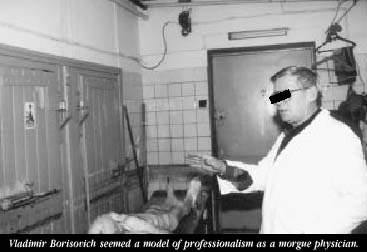
We eased the car into the driveway of a hospital and drove to the little gray morgue building in the back. Five minutes later we were sitting next to each other, dressed in morgue-issue white gowns, staring wide- eyed and frantically taking notes as we listened to Vladimir Borisovich Kh--, our authoritative morgue guide.
"I've got a lot of paperwork today, boys," said the regal-looking Vladimir Borisovich, heaving a sigh under his white coat. "We have 14 new bodies in there. It's going to be a busy day."
"Wow," I said, edging forward on my seat. "14 bodies!"
"Can we see them?" the Wraith asked, baring his teeth.
"All in good time," Vladimir Borisovich said, waving a hand, his voice full of importance. "First, let me explain to you how things work around here."
He leaned back in his chair and then slowly, theatrically, pulled out a cigarette and lit it. Vladimir Borisovich was a man of about fifty-five, silver-haired, carefully manicured, and generally reeking of a doctor's superior health and hygiene. It was hard also to escape the strong impression he made of being a man who'd achieved a certain high station in life. We were the lowest of gutter-dwellers, two perverts who'd dreamed up the thinnest of excuses to stare at a bunch of dead bodies, but Vladimir Borisovich was different: this was a man of science, a physician, an intimate participant in a critical area of human endeavor. He was a man who had a lot to teach us, and he made us aware of that fact from the very beginning.
"So then," he said, continuing a story he'd begun a half-hour earlier, "I gave up professional soccer, and decided to pursue a career in medicine. I probably would have kept playing if I hadn't torn up my knee. But then I might not have found my higher calling. These days I hardly exercise at all-on account of that heart attack I was telling you about."
"The one six years ago?" I gushed.
"Right," he said. "It's funny how that happened. I was on my way to work when I felt a pain in my chest. I knew right away what it was-or at least I thought I did. 'That feels like a coronary embollism,' I thought. So somehow I managed to drive myself to the hospital. I attached the plugs for the ekg myself and looked at the results with the staff cardiologist, who I knew well-he and his wife used to come over to our house to visit. He and I talked it over and we settled on a course of medication. He also prescribed some rest, and I took his advice-the hardest advice for any doctor to take. Since then, I've been fine."
As he was telling his stories, people were filtering in and out of the building. The standard morgue in Russia functions as a funeral home as well as a place of forensic medicine; after the autopsy, if an autopsy is done, the attendants wash and shave the bodies, dress them, replace their false teeth if they have them, place them in one of the many varieties of coffin that are sale on the premesis, and wheel them out into a bus to be taken to the cemetary. Families therefore gather at the morgue on the morning of the funeral, observe a final communion with the body as it lies on display in the entrance-hall, then travel en masse with their entourage to bury their loved ones.
The morgue's two tall, strapping, suspiciously well-groomed attendants had wheeled out the body of an old man early in the morning, and left it on display in a coffin right outside Vladimir Borisovich's office. By nine-thirty the man's family had gathered around the entrance. We could hear them mourning out there as Vladimir Borisovich told us his life story. After some time, an old woman from the funeral party poked her head in the door.
"Excuse me," she said. "I think we need some kind of document from you... we're about to go..."
"Just a moment," Vladimir Borisovich said, waving her off. She shrugged and stepped out of his office. He turned back to us. "Where was I?"
"So Andropov came to your morgue, just to say hello," I began.
"Right," he said. "he was always dropping by, you know, because he lived near here. And I think he had a particular interest in this work. He was concerned about it because he understood how delicate a matter it is, and how much it means to society for these things to be done correctly. So he came to me and he said, "Vladimir Borisovich, I've been told by the highest medical authorities that everything in our morgues is being handled in the most professional manner possible. Is that true?" And I said to him, 'No, Yuri Vladimirovich. I wish it were true. But the fact is, we're weighed down by incompetence at the upper levels. We don't have the funding to get the equipment we need. We need to work harder.'"
"So what happened?" I asked.
Vladimir Borisovich shrugged. "Well, ultimately, he took my advice. We got the funding we needed-in Moscow, anyway. But I never let on that the initiative had come from me."
The Wraith and I looked at each other and nodded in admiration. We were impatient to get in to see the bodies, but we understood that there is a time and a place for everything, and that we had to follow the protocol as long as we were guests. When Vladimir Borisovich excused himself suddenly to take care of the funeral party, we decided to take a break, go get some breakfast, and come back later.
Fifteen minutes later we were at the Starlite Diner, leaning over fat breakfast burri-tos and hashing out the possibilities.
"Maybe he'll let me shave one of the bodies," I said. "They're going to be preparing some of them for funerals anyway. Maybe if I'm really nice, he'll let me help out."
I sighed, drinking in the image of the glorious headline: "I Shaved a Dead Man, by Matt Taibbi."
The Wraith shrugged and slurped his coffee. "I just want to see an autopsy," he said.
"Let's get a check," I said, and flagged down the waitress.
We were back at the morgue in no time. Cutting in front of the Wraith, I explained to Vladimir Borisovich that we wanted to see the washing, dressing, and particularly the shaving of a body.
"Well," he said. "I suppose we can do that. We weren't planning to do that now, but we can arrange it for you specially. Sasha!"
One of the young attendants burst through the door. "Yes?" he said.
"They want to see us prepare a body," he said. "Can you fix it up?"
"Sure," Sasha said, smiling at us. It was not a dark or perverted smile, but the antiseptic, friendly smile of a person well-trained in the art of customer service. He listened as Vladimir Borisovich explained what he needed, then disappeared into the back room.
Soon afterwards, Vladimir Borisiovich led us back to where Sasha was working. It was a small area, half the size of an elementary-school classroom, and it was filled with the gruesome naked and half- naked bodies of poor old Russians, crammed into every available space. There were only about ten tables, and no refrigerators; the bodies were simply piled onto iron guerneys and left lying there. Some of them had half-sawed logs placed under their heads as pillows. Two of the tables had two bodies on them-the naked bodies of unrelated old men and women, squished next to each other. One old woman's legs were open, and her nasty dead beaver, practically worn to the bone, yawned into the center of the room. After a quick look around I turned to Vladimir Borisovich and whispered:
"Vladimir Borisovich-I only count 12 bodies."
He frowed. "Oh, you're forgetting about the ones who are sitting down," he said.
I looked around. Indeed, there were two bodies-both small old women, apparently- who were wedged into the corners of the room, seated in common desk-chairs. They were covered by sheets stained with an unidentifiable yellowish fluid.
Meanwhile Sasha had wheeled the emaciated body of an old man toward the exit. This was the body that was to be prepared for our benefit. From a pile he picked out the plastic bag full of effects that the man's family had brought, then withdrew a suit of clothes from the bag. Then he began cleaning out the man's mouth, shoving what appeared to be a yard or so of cloth down his throat. Sasha explained what the cloth was for, but I didn't catch it. Then he stuck in the man's false teeth, roughly yanking his jaws around with a tong-like instrument. Several times the plunged the instrument down the dead mouth and jabbed at the throat cavity in ways that would have made a living body sit up and shriek. From time to time-for instance, in order to put a shirt on the body- he'd pick up the man's head and drop it back on the table with an audible "thud". Finally he applied socks and underwear to the thinning body... it was getting down to crunch time to ask if I could help with the shaving. I decided to warm up Vladimir Borisovich a little more.
"What's the final diagnosis on this patient?" I asked.
"Him?" Vladimir Borisovich said. "Cancer." Then he flipped through a folder full of papers. "I don't remember the exact diagnosis... Oh, yes, here it is. Liver cancer. Yes, it's terrible."
"He looks so, uh, thin," I remarked.
"Well," Vladimir Borisovich said in a heavy voice. "Cancer doesn't improve any-body's looks."
Just then a voice rang out in the room.
"What's this? Who are these people?"
I looked up. Another man in a white coat, this one also carrying a folder full of papers, was standing over a body in the rear of the room. He was bald and had a beard and looked very official and threatening-he even had a vague resemblance to Alexander Voloshin.
"Who are you?" he shouted at me.
"Us?" I said. "We're journalists."
"Journalists! Good God! What are you doing here?" he barked.
What could I say? Just trying to shave a dead person? "We're just doing a story," I said, "about morgues."
"Who gave you permission?" he yelled. "You can't just come barging into a morgue."
The Wraith and I looked at each other. "Um," I said finally, "we were under the impression that we had permission."
His shoulders sank. "If you're referring to Vladimir Borisovich... Well, come into my office."
Vladimir Borisovich scurried away. We walked around to the other end of the building, coming finally to a door that bore the name: "V--, Pyotr Isaakievich. Chief physician." Even from the outside, the office looked much nicer than Vladimir Borisovich's, which, come to think about it, had featured a drain in the floor for the sanitary removal of god knows what fluids. We entered.
Pyotr Isaakiyevich sat behind his desk and glowered at us. "Look," he said. "There's something you have to understand. Vladimir Borisovich isn't a doctor. He's a janitor."
"A janitor!" I said.
"Yes," he said. Suddenly he relaxed, and his tone became distinctly less confrontational. "Look, I know you guys are just doing your jobs," he said. "But please, do me a favor, and go through the proper channels, and get permission to come back. Then I'll be happy to show you around. But otherwise... you understand, they'll have my hide for this."
"Yes," I said. "Of course. We had no idea..."
"Vladimir Borisovich has a bit of a mania about his position here," he said. "This isn't the first time this kind of thing has happened, either... Well, gentlemen, if you'll excuse me, I have work to do. Perhaps, if things work out, I'll see you again."
"Of course," we said. Then, in turn, we shook his hand and left, feeling like decent citizens.