|
SHOW TIMES
All films shown in Russian, except
those marked * (subtitled) and as
otherwise indicated.
AMERICA - Cinema
Radisson-Slavjanskaya Hotel
M: Kievskaya, 941-8747
(All films in English; Russian translation
by headphones Tues.-Sun.)
Dancer Jan. 27: 20.00; Jan. 28:
20.00; Jan. 29: 18.00; Jan. 30:
18.00; Jan. 31: 18.00
In the Mood for Love Jan. 26:
19.00, 22.00; Jan. 27: 22.00; Jan.
28: 22.0; Jan. 29: 22.00; Jan. 30:
22.00; Jan. 31: 22.00
Chungking Express Jan. 27: 14.00;
Jan. 28: 14.00
Happy Together Jan. 27: 16.00;
Jan. 28: 16.00
Fallen Angels Jan. 27: 18.00; Jan.
28: 18.00
Cast Away Jan. 29: 20.00; Jan. 30:
20.00; Jan. 31: 20.00
DOME CINEMA
18/1, Olympiysky prospekt
M: Prospect Mira, 931-98-73
Meet the Parents Jan. 28: 19.00,
23.30; Jan. 30: 21.00; Jan. 31:
21.00
The Grinch Jan. 28: 13.00, 15.00
Coyote Ugly Jan. 28: 17.00; Jan.
30: 19.00; Jan. 31: 19.00
PUSHKINSKY CINEMA
2 Pushkinskaya ploshchad
M: Pushkinskaya/Chechovskaya
229-2111; 299-7300
Being John Malkovich Jan. 26:
11.00, 13.30, 18.30, 23.00; Jan. 27:
11.00, 13.30, 18.30, 23.00; Jan. 28:
11.00, 13.30, 18.30, 23.00; Jan. 29:
11.00, 13.30, 18.30, 23.00; Jan. 30:
11.00, 13.30, 18.30, 23.00; Jan. 31:
11.00, 13.30, 18.30, 23.00; Feb. 1:
11.00, 13.30
Charley's Angels Feb. 1: 19.00,
22.00; Feb. 2: 10.30, 13.00, 15.40,
18.20, 21.00, 23.40; Feb. 2: 19.00,
22.00; Feb. 2: 10.30, 13.00, 15.40,
18.20, 21.00, 23.40; Feb. 3: 19.00,
22.00; Feb. 2: 10.30, 13.00, 15.40,
18.20, 21.00, 23.40; Feb. 4: 19.00,
22.00; Feb. 2: 10.30, 13.00, 15.40,
18.20, 21.00, 23.40; Feb. 5: 19.00,
22.00; Feb. 2: 10.30, 13.00, 15.40,
18.20, 21.00, 23.40; Feb. 6: 19.00,
22.00; Feb. 2: 10.30, 13.00, 15.40,
18.20, 21.00, 23.40; Feb. 7: 19.00,
22.00; Feb. 2: 10.30, 13.00, 15.40,
18.20, 21.00, 23.40
35 MM
47/24, Ul. Pokrovka
M: Krasnye Vorota, 917-54-92
Amores Perros Feb. 1: 22.15; Feb. 2:
9.00, 11.00, 13.00, 15.00, 17.00,
19.00, 21.00, 23.00, 01.00; Feb. 3:
9.00, 11.00, 13.00, 15.00, 17.00,
19.00, 21.00, 23.00, 01.00; Feb. 4:
9.00, 11.00, 13.00, 15.00, 17.00,
19.00, 21.00, 23.00, 01.00; Feb. 5:
9.00, 11.00, 13.00, 15.00, 17.00,
19.00, 21.00, 23.00, 01.00; Feb. 6:
9.00, 11.00, 13.00, 15.00, 17.00,
19.00, 21.00, 23.00, 01.00; Feb. 7:
9.00, 11.00, 13.00, 15.00, 17.00,
19.00, 21.00, 23.00, 01.00
Volaverunt Jan. 26: 9.00, 11.00,
13.00, 15.00, 17.00, 19.00, 21.00,
23.00, 1.00; Jan. 27: 9.00, 11.00,
13.00, 15.00, 17.00, 19.00, 21.00,
23.00, 1.00; Jan. 28: 9.00, 11.00,
13.00, 15.00, 17.00, 19.00, 21.00,
23.00, 1.00; Jan. 29: 9.00, 11.00,
13.00, 15.00, 17.00, 19.00, 21.00,
23.00, 1.00; Jan. 30: 9.00, 11.00,
13.00, 15.00, 17.00, 19.00, 21.00,
23.00, 1.00; Jan. 31: 9.00, 11.00,
13.00, 15.00, 17.00, 19.00, 21.00,
23.00, 1.00; Feb. 1: 9.00, 11.00,
13.00, 15.00, 17.00; Feb. 2: 9.00,
11.00, 13.00, 15.00, 17.00, 19.00,
21.00, 23.00, 1.00; Feb. 3: 9.00,
11.00, 13.00, 15.00, 17.00, 19.00,
21.00, 23.00, 1.00; Feb. 4: 9.00,
11.00, 13.00, 15.00, 17.00, 19.00,
21.00, 23.00, 1.00; Feb. 5: 9.00,
11.00, 13.00, 15.00, 17.00, 19.00,
21.00, 23.00, 1.00; Feb. 6: 9.00,
11.00, 13.00, 15.00, 17.00, 19.00,
21.00, 23.00, 1.00; Feb. 7: 9.00,
11.00, 13.00, 15.00, 17.00, 19.00,
21.00, 23.00, 1.00
|
Hello.
Yes, that's right. My name is Laurent Kabila. Yes, that's right. The recently-assassinated
leader of the Democratic Republic of Congo. You might think that being dead
would make it difficult to review newly-released films in Moscow, but there
you're wrong. For the first time in as long as I can remember, I now have enough
free time to enjoy the finer things in life and do what I always wanted to do
after retiring: reviewing films.
No movie could be more appropriate for me to
review than the new Tom Hanks vehicle, "Castaway". For in many ways I feel
myself to be a Castaway, alone as I am in a sort of eternal paradise, where I am
left to ponder man's place in the universe, and beyond.
Really, which of us,
while sitting at the edge of the ocean and gazing toward the horizon, hasn't
shivered to imagine being drawn out to sea, getting lost and ending up a tiny
forgotten speck in the middle of nowhere, shouting at the sky? As potentially
panic-inducing as this vision may be, there's also something alluring about it.
 It's like standing on the edge of a cliff and imagining that fatal leap into the
unknown, or like turning your back on your body- guards and imagining him firing
into your head. And in the heart-stopping ocean and desert-island scenes that
constitute the core of "Cast Away," Tom Hanks, in collabora- tion with the
director Robert Zemeckis and the screenwriter William Broyles Jr., bring those
visions thrillingly and hauntingly to life.
It's like standing on the edge of a cliff and imagining that fatal leap into the
unknown, or like turning your back on your body- guards and imagining him firing
into your head. And in the heart-stopping ocean and desert-island scenes that
constitute the core of "Cast Away," Tom Hanks, in collabora- tion with the
director Robert Zemeckis and the screenwriter William Broyles Jr., bring those
visions thrillingly and hauntingly to life.
With a bravura mastery of tone and
timing, "Cast Away" sweeps us out to sea and washes us ashore on a tiny deserted
island in the Pacific. We remain stranded there just long enough to be given a
deep, salty gulp of what it's like to have to restart civilization from scratch.
Just in time for dinner, however, we're whisked back to safety and to tables
piled high with super- market goodies and a life that oddly and sadly seems
banal and superfluous com- pared to what has gone before. Yes, even for me, life
at the palace in Kinshasa, wag- ing wars on all fronts while trying to sell
diamonds and uranium to corrupt first world brokers, became a predictable,
meaningless, empty routine. I was looking for a way out, an exit strategy, but
the daily grind and the constant barrage of worries never allowed me to step
back. For me, like the Tom Hanks character, it took a disaster to bring me to
the shimmering unknown.
When "Cast Away" is the farthest from civilization, it
is as compelling a cinematic adventure as any Hollywood has pro- duced. Back on
the mainland, however, it turns more formulaic and corny. But even in the wobbly
narrative bookends that hold a love story, interrupted by disaster, there are
flashes of a deeper metaphysical poignancy. at its best, "Cast Away," like
"Titanic," awes us with its sheer oceanic sweep and its cosmic apprehension of
human insignificance.
The center of the film is an unforgettably gripping,
heart-in-your-throat evocation of the unbearable loneliness and terror of
ultimate abandonment once its hero, stranded and presumed dead, gives up hope of
being rescued but still clings tena- ciously to life.
In one of the script's
pointed paradox- es, this modern-day Robinson Crusoe, Chuck Noland (Mr. Hanks),
is a voluble, time-obsessed efficiency expert for Federal Express. Shortly
before boarding a plane that plunges him into the Pacific, he and his
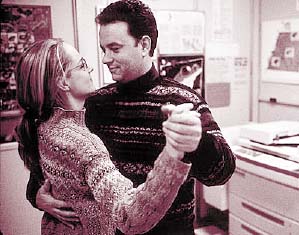
girlfriend, Kelly (Helen Hunt), exchange gifts: an engagement ring from Chuck,
her grandfather's pocket watch (with her picture inside) from Kelly. Marooned
with only the timepiece to remind him of home,
Chuck finds himself facing only one deadline, the race to survive in the face of
starvation, dehydration and natural disaster.
"Cast Away" is everything this
year's other man-against-nature blockbuster, "The Perfect Storm," was not. The earlier
film huffed and puffed to evoke a similarly elemental struggle in the
traditional Hollywood ways, with strenuously grandiose music and oversize,
patently unrealistic computer-generated special effects. "Cast Away" also has
its quotient of technological trickery, but one of the
movie's won- ders is that everything looks and feels so remarkably real. And it
never pushes us too hard.
It also knows when to turn down the volume. The most
devastat- ing sequences, instead of flooding us with music, suspend the
soundtrack and forgo even language to allow the sounds of nature to take over.
All we hear from Mr. Hanks are the grunts and howls of a man exerting himself to stay
alive against a backdrop of the roaring ocean and the wind eerily whistling
outside the cave Chuck adopts as a shelter. Ultimate isolation, the movie
reminds us, doesn't have a soundtrack except what the environment churns up
along with the ringing in our ears, our heartbeats and the voices chattering in
our minds. Even death, my friends, is a place without music, or
rather, a place with a music of silence.
Once again, Mr. Hanks portrays a
spirited Everyman, at once deeply likable and profoundly ordinary. If his wound-
up, globe-trotting character, who early in the film is shown haranguing Russian
employees at a FedEx depot in Moscow, isn't exactly like you and me in his
background and tastes (he happens to be an Elvis Presley fanatic, as I am too),
he embodies enough parts of other people to be utterly recognizable.
Mr. Hanks's
likability has everything to do with the ease with which he pours the childlike
side of himself into his performances. Even at moments of maximum stress, the
qualities that shine through are an infectious spontaneity, curiosity,
ebullience and native optimism, along with an
instinctive common-sense resourcefulness.
The screenplay's conceptual master
stroke has Chuck revert to childhood through the creation of an imaginary
companion so he can survive psychically. Painting a face (in his own blood) on a
white Wilson volleyball extracted from a FedEx package that washes up on shore,
he turns Wilson (as he calls the ball) into a fellow survivor,
confidant and collaborator in an escape plan. Anyone who recalls being a very
young child and clutching a doll that embodies comfort and companionship in
times of loneliness and insecurity will relate to the wrenching scenes in which
Chuck clings to Wilson for emotional support. at times here in the afterlife, I
have been known to rip the heads off of sleeping angels, place them on the
spikes of heaven's gate, and talk to them when I am lonely.
The volleyball is
one of many practical uses Chuck is able to make from the washed-up items (many
of them Christmas presents) in FedEx packages that at first seem useless but
become essential survival tools. A pair of figure skates becomes both a knife
and a tool for removing an infected tooth in an excruciating scene of do-it-
yourself dentistry. Videotapes become ropes for an escape raft, and the netting
in a fancy dress a fishing net. In the same way, car battery cables became for
me a form of autoerotic pleasure.
"Cast Away" doesn't begin working its spell
until its introductory scenes of its harried hero and his fiancée are out of the
way. But once Chuck is aboard a FedEx plane flying over the Pacific, an
escalating sense of dread takes over as the aircraft gives a warning shudder.
What follows is the scariest, most believable plane crash ever filmed as the
aircraft begins splitting apart and plummets in a whirling, vertiginous roar
amid a violent thunderstorm. It is so real you can almost feel the metal body of
the aircraft shaking violently as it is wrenched apart. I have never been in a
plane crash myself, but I have arranged several of them for my enemies, and I
used to listen to them personally through my ham radio as they went down. They
were so disturbing that I would often skip dessert after listening to one.
Therefore I can say that the crashes in this film are as harrowing as the real
thing.
Crashing into the ocean, Chuck is plunged underwater, his life-preserver
narrowly avoiding puncture by a shard on which it is momentarily caught. Rising
to the surface, he finds himself surrounded by pieces of the burning aircraft
illuminating utter blackness in a furious storm.
Once Chuck, close to
exhaustion, has drifted onto the shore of a tiny tropical island, the movie
makes each lesson in survival - from pounding open a coconut to building a fire
from scratch to a first frustrated attempt at an escape - an agonizing, often
bloody, sometimes life-threatening ritual. The world in which he finds himself,
a pristine island amid a turquoise sea, is as dazzlingly beautiful as it is
treacherous.
Finally, after a certain point, the movie fades out and a title
informs that four years have passed. In the intervening years, Chuck has
 metamorphosed into a gaunt, shaggy, nut-brown survivalist, camped in a lair
embellished with his own cave drawings. Mr. Hanks lost more than 50 pounds for
this section of the film (Mr. Zemeckis completed "What Lies Beneath" in the
interim), and the actor's physical transformation is as startling (and
dramatically effective) as the fattened-up Robert De Niro in the later scenes of
"Raging Bull." This is one part of the film I didn't find believable, for even
here in the afterlife, I find that I am still gaining weight, especially in my
neck and cheeks.
metamorphosed into a gaunt, shaggy, nut-brown survivalist, camped in a lair
embellished with his own cave drawings. Mr. Hanks lost more than 50 pounds for
this section of the film (Mr. Zemeckis completed "What Lies Beneath" in the
interim), and the actor's physical transformation is as startling (and
dramatically effective) as the fattened-up Robert De Niro in the later scenes of
"Raging Bull." This is one part of the film I didn't find believable, for even
here in the afterlife, I find that I am still gaining weight, especially in my
neck and cheeks.
Ultimately "Cast Away" has to end somewhere. And because it's a
Hollywood movie with an attenuated love story it needs to resolve, it couldn't
disintegrate into nothingness. Once Chuck is saved, he appears terminally
detached and wears the faraway expression of a man whose traumatic experience
has separated him from others. For the rest of his life, we sense, an essential
part of him will still be living alone on that island.
At the same time, Mr.
Hanks radiates the inappropriately sleek glow of someone who has just returned
from a luxury spa. And though his scenes with Ms. Hunt are well acted (the two
really are perfectly matched as a decent Mr. and Ms. American Everyperson), the
suds are too thick to be washed away. But in these later scenes, the movie also
plays with metaphysical uncertainty in effective, recurrent images of an actual
crossroads. Because the conflict between romantic convention and the movie's
angst is never resolved, "Cast Away" leaves us hanging.
But that final, lurking
ambiguity is a small price to pay for the primal force of what has come before.
|
