 The Moscow Times claims it was an accident. And maybe it was. In this world
anything is possible, and even in Russia, a place where conspiracy is
routine,the most awful things can happen for innocent reasons.
The Moscow Times claims it was an accident. And maybe it was. In this world
anything is possible, and even in Russia, a place where conspiracy is
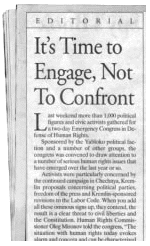
routine,the most awful things can happen for innocent reasons. But the fact of the matter is that on Tuesday, January 23 - exactly one week after its longtime editor, the feather- ruffling veteran journalist Matt Bivens, stepped down under ambiguous circumstances - the Moscow Times ran an editorial that would have made Joe Stalin blush. Under a headline "It's Time To Engage, Not to Confront", the paper argued that protesters who gathered at a recent human rights emergency congress to discuss abuses by the Putin regime had embarked on a dangerous and irresponsible campaign to undermine the government. "Taken literally," the paper wrote, "a "human rights state of emergency" is virtually a declaration of war by activists against the state."
The paper furthermore argued that the right course for these activists would be to work within the system, and not confront the sensitive and easily-wounded Putin. "Now is not the time to draw sharp battle lines," the paper wrote, adding: "Such rhetoric merely deepens the divide between the government and liberal forces in society, provoking confrontation rather than facilitating a dialogue that could lead to real improvements." Apparently, the Putin administration had been actively seeking a dialogue with liberal forces, only to be shunned by their "con-frontational tactics."
The same newspaper that just a few months ago was arguing voluminously that Putin was not a legitimately- elected president was now saying, in the bluntest terms possible, that the opposition should stay out of public view, roll over, and let the Leader have his way. Worse, it was saying this with its controversial editor very recently removed from the scene; it was also saying it just months after the Kremlin property administration more that tripled the rent at its offices in the center, forcing it to move; it was saying it a year after its parent company Independent Media had suffered a tax raid on its offices; it was saying it, moreover, at a time when one of Independent Media's chief shareholders, the giant Dutch conglomerate VNU, was publicly shopping its stake in the company; and it was saying it at a time when its Russian-language sister publication, the Wall Street Journal/Financial Times vehicle Vedomosti, was fast becoming a notorious den of see-no-evil, hear-no-evil reporting and obvious advertorializing. The Moscow Times, for years the only Òlegiti-mateÓ Western news voice in town, appeared to be finally giving in.
The editorial came as a shock to press people all around Moscow, and the response was immediate. The editorial was so embarrassing that one of the Times's own reporters, Sarah Karush, wrote a lengthy letter to the influential Johnson's internet list denouncing the piece as both pernicious and inaccurate. Another Times contributor, well-known columnist and dissident-journalist Yevgenia Albats, was thrown for the loop by the piece, and admitted as much to us when we called. "I was stunned," she said, adding that she planned to investigate the source of the piece herself.
Radio Liberty called the Times as well. They had earlier planned on doing a story about the fall of the paper on the basis of an article I had written for the Russian-language newspaper Stringer, but had been talked out of it after speaking to people at the Times, who assured them that reports of their editorial demise were both inaccurate and premature.
Then, when the "Engage, Not Confront" piece came out, Radio Liberty called back. Suddenly they wanted to do the story again. Former editor Bivens agreed to talk to them, admitting that the editorial had brought the heat on the paper all over again.
"It could not have come at a more inopportune time," he said.
Within the Times itself, staffers recoiled from the article as though from a bag of maggots. A call to new editor Lynn Berry resulted in a shrieking refusal to name the author of the piece. "No, you can't ask me who wrote it!" she said. Deputy editor Andrew McChesney also refused to talk. Editorial page editor Robert Coalson was conveniently out of touch and on vacation a day after the piece came out. I was surprised that the excuse wasn't more elaborate, that he hadn't been sent, for instance, on a fact-finding tour to Central Asia.
The following story is about the Moscow Times, but it is not exclusively about the Moscow Times. It's about the Times's competitors, the Moscow Tribune and the Russia Journal, who are also our competitors; itÕs about an emerging police state in Russia under Vladimir Putin; and it's about the state of modern media in general, where the printed word is influenced in a thousand ways by the demands of a largely tyrannical business world on the one hand, and the informal social pressures to conform to narrow standards of discourse on the other. It's objectively a small story, the Moscow Times being a small publication in relative terms. But even small stories can be painful, and they should be, since most of us live pretty small lives.
This is one such painful story - the tale of how even the littlest, most seemingly unimportant group of people can be pushed relentlessly toward a role as a mere pawn for much larger forces. It's about how hard it is to resist, how easy it is to give in, and how little chance most of us have of ever doing any- thing about it. Two great powers exert a tremendous influence over media everywhere: money and politics. It's a much-accepted axiom that the two powers are intimately intertwined, but there are ways in which they are separate as well. In the tiny English-language press community in Moscow, politics and money have each made their presence felt individu- ally, in their own separate ways, over the years. As far as politics go, no further proof that the Russian political world has an interest in local Western reporting is needed than the fact that Russian Aluminum very recently had a serious interest in the pathetic Moscow Tribune, a paper with an actual readership seemingly in the single digits. According to various sources, including one close to Russian Aluminum, the company made an investment in the paper after the devaluation a few years ago, only to pull out a year later, in March, 2000. Tribune publisher Anthony Louis, while declining to speak with the eXile, did issue this written statement about that period in the paper's history.
"While an approach was made to me, that group did not follow through with a proposed investment commitment. I am in no way associated with Russian Aluminum."
At the time, Russian Aluminum was not Russian Aluminum but Siberian Aluminum, headed by Oleg Deripaska, (again, at the time) a close ally of Anatoly Chubais. The Chubais/Deripaska group was preparing quite seriously for the 1999 Duma elections and for the presidential elections in 2000. Ultimately they would support the Union of Right-Wing Forces (SPS) in the Duma elections; they were also planning at that time to back Samara governor Konstantin Titov as a serious contender for the presidency.
 In Russia, running a
political campaign requires the assistance of friendly media-and the traditional
way to guarantee friendly coverage in this country is to buy it. It is therefore
not surprising that some 70% of Ren-TV was eventually bought by a subsidiary of
the Chubais-run RAO-UES, or that a similar stake was bought in the newspaper
Vremya-Novosti around that time. That Deripaska and Chubais were even interested
in the Tribune strongly suggests that some stock was still placed in the local
English-language media's ability to influence the Western audience abroad. That
they were interested in the Tribune specifically proves that there was no venue
too small or insignificant to escape the attention of Russian politicians. If
Chubais and co. were after the Tribune, it either meant that they were very
stupid, very desperate to get their hands on any English-language media they
could, or both-either way, it shows that a relative behemoth like the Moscow
Times could not have escaped anyone's radar.
In Russia, running a
political campaign requires the assistance of friendly media-and the traditional
way to guarantee friendly coverage in this country is to buy it. It is therefore
not surprising that some 70% of Ren-TV was eventually bought by a subsidiary of
the Chubais-run RAO-UES, or that a similar stake was bought in the newspaper
Vremya-Novosti around that time. That Deripaska and Chubais were even interested
in the Tribune strongly suggests that some stock was still placed in the local
English-language media's ability to influence the Western audience abroad. That
they were interested in the Tribune specifically proves that there was no venue
too small or insignificant to escape the attention of Russian politicians. If
Chubais and co. were after the Tribune, it either meant that they were very
stupid, very desperate to get their hands on any English-language media they
could, or both-either way, it shows that a relative behemoth like the Moscow
Times could not have escaped anyone's radar. And they haven't. The Times has long been observed closely by the powers that be in Russia, who throughout correctly identified the paper as a primary source of information for a large part of the international journalists in town. It was no accident when Independent Media was raided by the tax police in 1999, an incident which was reportedly followed up by a visit from Kremlin henchmen expressing their displeasure with the Moscow Times's coverage of the Chechen war. Sauer and Independent Media clearly felt a need to secure some political cover for the paper as far back as 1995, when they invited Bank Menatep to buy a 10% stake in their company (some sources say Sauer tried to sell a larger stake, but was unable to convince Menatep to buy).
I myself was working at the Times as a reporter when Menatep bought into the company, and interviewed Sauer's partner, Anne-Marie Van Gaal, about the purchase. She told me that one of the reasons that the company had brought Menatep in was to "help out with problems with the tax police, and things like that." Sauer edited that quote out later that night, when the article was going to press. Nonetheless, it was something that everybody at the paper understood at the time; Independent Media had brought in a heavy-hitting Russian partner - on the eve of a presidential election, no less - to help defend itself against possible harassment from the government.
For years, the paper was under no particular threat of invoking serious public displeasure from the local powers-that-be, as it was manned for most of the late 1990s by the notorious Australian Geoff Winestock. Winestock throughout his tenure was an ardent defender of the interests of the Yeltsin regime and, more specifically, of the program of the "Young Reformers", who also enjoyed the near-unanimous support of Western politicians and business figures. As long as Winestock was in, the paper was bona-fide in the eyes of virtually all of its potential patrons, and it had no serious run-ins with anybody. .
Enter Bivens. The left-leaning young reporter, an old friend of mine, had for years been editing the Times's sister publication in St. Petersburg. When he was brought down to Moscow in 1999, level-headed journalists around town expected an immediate salutory change in the paper's political tone. For the most part, they got it: the paper under Bivens's tenure was critical of corruption and in general a more serious journalistic voice than Winestock's paper ever had been.
As long as Yeltsin remained in power, the Times was able to avoid taking positions that were unpopular in a way that might have threatened its business. This was particularly true given the fact that after the 1998 crash, criticism of the corruption and excess within the Russian government became widely accepted in the foreign press, to the point where even the major papers of record like the New York Times and the Washington Post called attention to it.
But when Vladimir Putin became Prime Minister, the Times was put to the test. Bivens responded by running a series of articles aggressively criticizing the Chechen campaign that had buoyed Putin's rise to power. By December of 1999, the paper had clearly gotten on someone's nerves and the aforementioned tax raid took place around the time of the Duma elections. In that incident, tax inspectors "uncovered" a multimil-lion-dollar debt owed to the state by Independent Media, and demanded to be paid. At the same time, Sauer was made to understand that the problem could be resolved if the paper's attitude toward Chechnya changed. According to Bivens, Sauer encouraged the staff to "tighten up" its coverage of Chechnya, while not changing the substance of its reporting at all.
It was around this time that Sauer, anxious about his business, apparently began to resent the needlessly political tone of the paper's editorials. Bivens insists that there was never any serious friction between the two on this score, but it's worth noting that Sauer addressed the issue at Bivens's going-away party last week. Not only did he bring up the editorial issue in his speech, but he also wrote a painful joke article for the traditional "going-away" page all Moscow Times employees receive when they leave the company. In that issue, copies of which were shown to us by several Moscow Times employees who attended the party, Sauer wrote a column which described Bivens as being exclusively concerned with becoming a darling among his lefty friends on the Johnson's Russia List, being willing even to write outright falsehoods to court their favor, while being not at all interested in writing the kind of "balanced editorials" Sauer wanted him to write. In a particularly absurd moment in the story, Sauer depicts Bivens practically leaping out of his seat to take a call from Johnson, while leaving Sauer's calls unanswered.
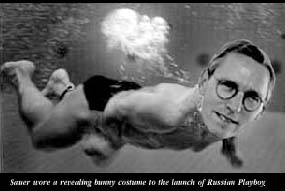
At this point it will be necessary to describe the characters involved a little bit. Sauer's primary characteristics as a person are his height and nationality: very short, and Dutch. His method of imposing his will on his subordinates seems based less in shouting and barking orders than on being a friendly little patriarch when seas are calm and having spasmodic attacks of nerves - which cause his body to expel waves of anguished oblique hints in all directions - when he is unhappy. He obviously enjoys his status of media hotshot in town (at the launching of the Russian editon of Playboy, he even wore an unpleasantly revealing bunny costume), but he never seems thoroughly at peace with his status. This is understandable, because Sauer's company, Independent Media, has had an understandably large share of ups and downs in its history as one of the few for- eign-owned companies to secure a large piece of territory in the Russian media mar- ket.
Occupying Sauer's thoughts in the last year or so have been problems like that tax raid last year, falling revenues in a number of his publications, and outright disasters like his internet project, the ill- fated eStart. Millions of dollars were invested into this ambitious web portal last year, and almost all of that money went straight into the great toilet of history, as the site by late last year was laying off dozens of workers (Independent Media spokesmen told us on the phone that the workers let go were all "temporary employees", but numerous sources we spoke to, including eStart employees, dispute this claim).
Sauer reportedly did not invest his own money in eStart, but the project's failure had serious repercussions for his company nonetheless. One of the main investors in the project was VNU, the giant Dutch media conglomerate which owns a 35% stake in the Independent Media publishing empire. Sauer was therefore borrowing money from the very people who had helped capitalize his print media empire. This was an impor- tant partner, a relationship worth preserving.
That relationship ran aground this year. According to Theo Bouwman, a member of VNU's executive board, his company has put its stake in Independent Media up for sale. Bouwman said the stake is to be sold as part of a larger package involving all of VNU's consumer magazine holdings, a mini-empire in itself which comprises some 160 publica- tions in more than a half-dozen countries. In other words, the sale is part of a larger reor- ganization of VNU's holdings (which include the Nielsen television rating system), and not specifically related to the collapse of eStart or lingering irritation over the endless "Have an Orgasm Every Time" articles in Sauer's version of Cosmopolitan. Nonetheless, in sizing up the state of things at Independent Media, it is significant to consider that its chief corporate partner, VNU, went from throwing millions at eStart to pulling out entirely in less than a year.
VNU is a minority shareholder in Independent Media, but for many years it has effectively been calling the shots behind the scenes. That's mainly because it retains an option preventing the other shareholders - including the majority stake- holder, a consortium headed by Sauer - from selling out without their permission.
This peculiar arrangement has put Sauer in a tight spot. The eXile has no specific intelligence on the matter, but it would seem to make sense that VNU would not be likely to let Sauer sell his stake to anyone if VNU had been covering Independent Media loss- es over the years, a logical thing to assume. Why pick up the bill and let someone else take the money and run?
In this situation, Sauer can't walk away from Independent Media. He has to make it work, or else sell to VNU at an unattractive price. That means that a solution has to be found on the ground, in the current Russian environment, which will make Independent Media profitable. If the previous formula for success was the glossy Cosmopolitan, the new one is in newsprint - Vedomosti.
The Russian- language Vedomosti is, on the surface, a real feather in Sauer's cap. It links him in name with more internationally legitimate and doubtless taller media players at the Wall Street Journal and the Financial Times. It also, by all accounts, makes money. However, the way Vedomosti makes its money is the sticking point. It does it, by and large, by cheerfully reporting on business stories and refraining almost entirely from covering politics - "covering business as though it was on the moon", as one Independent Media writer put it to us. It also shows a conspicuous, some would say shameless, affinity in its editorial articles for companies that advertise in the paper. Russian journalists around town complain almost universally that Vedomosti reporters routinely write zakazukhi, or paid pieces. In sum, Vedomosti is the perfect formula for a financially successful media venture in the Putin era: write about business, write that business is good, and turn your head when the president starts whacking people.
The phenomenon of Vedomosti is ever-present in the thoughts of the people who work at the Moscow Times, and almost certainly never escapes Sauer's thoughts. Repeated redesigns of the Times intended to place a greater emphasis on business coverage show clearly a desire from above to move the paper, if not a great distance, at least significantly in the direction of its more editorially unencumbered Russian partner. Whether or not the Times, after Bivens's departure, will turn into an English-language version of Vedomosti is the big question around the paper these days.
The issue is aggravated by the presence of the Russia Journal, a nakedly probusiness and proestablishment English-language paper whose editor, Ajay Goyal, has been caught playing up his connections to the Kremlin. If the Times would require a serious editorial slide to descend to the level of Vedomosti, the Russia Journal is more or less already there. In a Darwinian sense, it is a more perfect competitor than the Times in this media environment - all it would need is a big name and grammatically-correct English to make it the equal of Vedomosti.
After the shock editorial earlier this week, the columnist Albats even went so far as to write Bivens with her concerns about a potential transformation. "I asked if the Times was going to become something like Vedomosti," she said. "He told me not to worry, that this was not going to happen."
That it was not going to happen as long as Bivens was around was fairly clear. But this became a non-issue when Bivens decided to quit the Times last year. The reasons for his departure are a matter of small controversy around the Times. Bivens maintains that he left on his own will.
"I was not forced out in any way," he says. "I quit. And I quit because I wanted to move on to other things, and not for any other reasons."
Nonetheless, Bivens admits that even some of his own former employees refuse to believe that he wasn't forced out. That Sauer in his best-case scenario would want a more pliable editor, or at least one who writes less objectionable editorials, is also fairly well-documented. The view among many people close to the paper is that Bivens was forced out in a manner of sorts, but in a way he may not completely understand himself. "
I think Matt felt a certain amount of pressure," says Albats. "There was something exerted on him as well."
My own view is that in an environment like this one, the pressure comes from all sides. It comes on a day-to-day basis, when one has to continually edit and give assignments to reporters for sections of the paper that must absolutely exist, if the paper is to survive financially. It comes from being forced to stay within certain parameters as far as language is concerned, again to avoid offending or scaring away advertisers. In the case of the Moscow Times, it comes from knowing that a certain Successful Model, i.e. Vedomosti, exists and is on the mind of one's publisher. And even if one has only the vaguest hint that one's work is not exactly popular with the publisher, the battle lines have nonetheless been drawn in a place where they wouldn't be located if there were no publisher hanging over one's shoulder at all. You might decide not to give in and cross over to your publisher's side, but that also means you might not travel far in the other direction, the key task being to hold your ground against the gravitational pull from above.
And there's plenty of gravity at work on the Times. There's Vedomosti and the Russia Journal, thriving while taking the easy way out. There's the Putin regime, ruthlessly dismantling Russian media outlets critical of the state (it is worth noting that Sauer's fake piece in Bivens's going-away issue called attention to the Gusinsky story as an example of a step away from "bal-anced editorials"). There's the money issue in general, which forces Sauer to find a way to make the Times survive financially in a place where it is not easy to do that and be honest at the same time. And there's the fact that no one will much care if the Times turns into Vedomosti, while plenty of people who really matter will be actively be pleased if it does. These are not small things; they keep the roof on what you can say and can't say-or, more precisely, what you can imagine saying and what you can't imagine saying - very low.
The article the Times wrote about Bivens's departure was actually written by Bivens himself, a fact that will probably come as a surprise to many people who read it. In the context of the usual tradition of writing worshipful paeans to the departing boss in such send- offs, Bivens's piece is strikingly negative, reading not too unlike a Stalin-era self-denunciation:
During Bivens' tenure, the newspaper went through four publishers, an unexpected pace of turnover that sapped leadership on the commercial side. The Moscow Times lost money in 2000 for the first time since 1996, and Bivens ended his days as editor as he had begun them - with staff cuts and cost-cutting.
Now the new regime is in and one thinks to ask - as Sovietologists did after Khrushchev left the scene - what's next? Is a march on Prague in the paper's future? The latest editorial denouncing human rights protesters as enemies of the state sure looks like an advancing column of tanks from this angle. It may not be, but on the other hand, someone had to think that thing up and actually publish it.
The eXile could never stand the Moscow Times - it was dull as hell for the most part, and reminded us of all those newspapers at home that never talked about things that were really on our mind - but given a choice between the Times of old and a Putin-Sauer wet dream of the future, we'll take the old Times in a heartbeat. God help us if it goes the other way. That will mean you can't even be merely dull in this world, and get away with it.