
By Matt Taibbi
This time, it's America's turn
Seven years ago, when the MMM pyramid scheme collapsed in
Russia, the American expatriate community here in Moscow more or less
collectively laughed out loud. If you spent enough time at favored American
hangouts like the Starlite Diner, the Night Flight night club, the Hungry Duck
bar, you could hardly get through a single day without hearing some beered-up
smart-aleck in a baseball hat chuckling over the naivete of the Russian
population.
“Only Russians would be so stupid to fall for a scheme as crude as MMM,” was a typical comment. “Ripping off the Russians is like taking candy from a baby—just too easy,” was something else you heard a lot back then.
The rhetoric became even more hysterical in character when Mavrodi was elected to the Duma. Suddenly the Russians were shown to be not merely too stupid to surivive in a market democracy environment—they didn’t even deserve the privilege of living in one. editorial following Mavordi’s election said it all:
“There is no need for laws to prohibit charlatans such as Mavrodi from running for office. Democracy is predicated on the idea that the voters will weed out these people. But Khimki, at least, has plainly decided to take the quick, easy money.”
Some six and a half years later, the tables have apparently turned. If a number of published reports are to be believed, Sergei Mavrodi has made a comeback— only not in Russia. This time, he appears to have gone after bigger, wiser, richer, more economically experienced fish. Through a shrewd internet pyramid scheme called “Stockgeneration”, Mavrodi (or, at the very least, relatives of Mavrodi, according to interpol reports) has targeted the very baseball-hat wearing American leisure class that six years ago was laughingly flushing the mostly elderly and uneducated Russian victims of MMM down the toilet of history. According to a lawsuit filed by the American Securities and Exchange Commission this past summer, Americans from every geographic region of the country lost millions of dollars through a scheme that appears to prove true the old saying that there’s a sucker born every minute— and that not all of them are in Russia.
The Stockgeneration story will be of great interest to Russians primarily because of Mavrodi’s alleged involvement in the case. But to Americans, this story has a deeper meaning, for a variety of reasons. The Stockgeneration story, a fascinating tale of a nation of dupes fleeced by the high-tech criminal product of a much tougher Darwinian environment, may have revealed America’s ultimate weakness as a superpower: it is too rich to stay smart enough to survive.
Stockgeneration, an internet investment company registered in the tiny West Indian island of Dominica, is, by all appearances, a brilliant modern variation of a very old idea—the so-called “Ponzi” scheme, named after a famous Italian-American swindler from the 1920s.
The classic Ponzi scheme will be familiar to Russians who followed the MMM story. Actually, it will be familiar to anyone who invested in Russian GKOs during the 1990s. The idea is simple. You announce that anyone who invests in your company will make a miraculous guaranteed return— say, 10% a month. As the pool of investors expands, the company’s cash flow increases, and it is possible to meet, for a certain period of time, the promised obligations. But eventually the slowly-widening number of new investors becomes too small to cover the high returns of the proportionally smaller group of early investors, and the triangular structure collapses. Hence the term “pyramid scheme.”
Stockgeneration is a very fancy version of the same old game. In it, participants— courted mainly through hundreds of internet sites devoted to the company— are invited to invest real money in 11 openly fictional companies. Returns on the investments are based upon the amount of investments made in those same companies by other participants. In other words, it is like a minature stock market in which the value of the shares is not based upon any real performance by the companies involved, but instead upon the completely arbitrary confidence of the investor pool.
As in all pyramid schemes, Stockgeneration makes promises of high returns. The American Securities and Exchange Commission (SEC) described the promise in the lawsuit it filed last June:
‘StockGeneration, promising investors a risk-free, guaranteed return of 10% per month, or 215% per year on a compounded basis. SG allegedly described itself as a “virtual stock exchange” offering investments in the stock of several “virtual companies,” including one referred to as the “privileged company” whose shares “only rise” and generate the guaranteed 10% monthly return.’
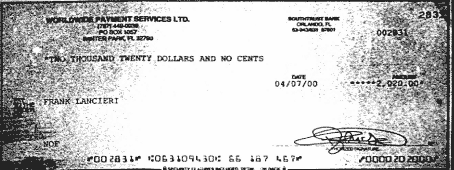
The scheme was clever enough in itself— the attraction of a “virtual stock market” based upon “virtual companies” had a natural appeal to a new generation of internet junkies who lived vicarious “virtual” existences surfing the internet. But what really helped seal Stockgeneration’s success was its flashy marketing and internet savvy. The company’s site featured the full arsenal of successful website hit-generation techniques-websites, message boards, endless chains of link pages, and literally hundreds of mirror sites which featured everything from testimonials from satisfied Stockgeneration winners winners to scanned-in photos of checks made out to the winners.
Experienced American Wall Street investors have had seventy years or so to study the history of the classic stock market investment schemes that led to the Securities Act of 1933 and Securities Exchange Act of 1934 which outlawed such activities. But Stockgeneration’s targets were not “investors”. They were internet nerds, ordinary Americans with some disposable income and a lot of free time, a new class of people who responded to a completely new set of rhetorical strategies. Stockgeneration did not look, to these people, like the classic crude e-mail chain-letter scheme (exiled Nigerian princess needs your help to rescue kidnapped brother! Make $10,000 in two weeks by recovering lost lawsuit damage claims!). Instead, it looked like a very sophisticated and professional internet company, one that lived up to the exalted technical standards of this sheltered but very pedantic group of people.
“We described stockgeneration as a classic pyramid scheme, only dressed up in the high-tech language and aesthetics of the new internet generation,” says Margaret McGrath-Blake, one of the Boston, Massachusetts-based SEC investigators who worked on the case. “What was new about it was its complexity and the style of its appeal.”
The appeal had the additional advantage of being linked to the internet revolution, which in the mid- to late-1990s was racing ahead at a speed that even “legitimate” investors on Wall Street and on the NASDAQ stock exchange could not keep up with. The well-documented proliferation of both internet businesses and, more importantly, investment into internet businesses helped convince even those web surfers who understood the nature of pyramid schemes that Stockgeneration was somehow different— destined to succeed at the same rate as the internet itself.
Dan Brekke, a freelance reporter who wrote about Stockgeneration for Wired Magazine, described this peculiar appeal to its victims.
“Definitely the internet investment bubble helped with this thing,” he said. “People had become quite acustomed to investing, in the legitimate markets, in companies that had no basis to them at all. They looked at a company like Amazon.com, which had done nothing but ever lose money, and its price kept going up.”
The Stockgeneration site itself played up the impossibility of its own failure.
“See it for yourself: no ending in sight! We simply can’t manage to keep up with the Internet.”
Stockgeneration was seemingly legitimized even further by a general tendency in the United States to invest in securities, particularly via internet trading schemes. In 1980, the number of Americans who owned securities, either directly or through mutual funds or indirectly through pension funds, was one out of eighteen. By 1999 the number was one in three. What’s more, by 1999, some 14 percent of all stock trades were made over the internet.
Moreover, massive advertising campaigns understaken by companies like eTrade attempted to convince the general public that the internet was bringing about the democratization of the whole practice of private investment, wresting it from the hands of venal old Wall Street barons like Merryl Lynch and Goldman, Sachs and returning to the “wiser” common-sense stewardship of the individual investor. All over America, everyone from housewives to half-drunk football fans to pimply high-school students began to fancy themselves investment experts. Virtually anyone who had a hundred dollars lying around was soon putting his money into “e-accounts” and spending his afternoon moving his little fortunes from this hot internet stock to the next.
In this environment, Stockgeneration seemed almost rational. And indeed, the difference between the scheme and the actual internet investment revolution turned out to be very slight in practice. The home of most of the technology stocks which had ballooned in the late 1990s, the NASDAQ, more or less literally blew up in the faces of investors in the year 2000, losing an estimated two trillion dollars in value in a single year. To put things in perspective, the NASDAQ losses for last year were roughly forty times the size of the entire Russian state budget.
What had happened was that, seemingly all at once, investors realized that the internet companies they had invested in did not actually generate any revenue. Their stock prices had improved mainly on the strength of six or seven years or so of wild, unrestrained enthusiasm about the internet. The collapsing NASDAQ stocks were therefore very much like the Stockgeneration “virtual companies”, except that they were real. Both grew as new investors arrived on the scene. Neither was based on actual performance.
The chief difference was that the NASDAQ collapsed when investors pulled the plug themselves. The Stockgeneration participants had a little help on their way to ruin— from the Russians.
According to the SEC suit filed this summer, the titular head of Stockgeneration was 23 year-old Oksana Pavluchenko, reportedly the sister-in-law of Sergei Mavrodi. McGrath-Blake would not comment on Mavrodi’s possible connection to the organization.
“But I’m sure you’ve seen the published reports,” she added.
McGrath-Blake was principially referring to the September article by Brekke in Wired, which referred to Interpol reports linking Mavrodi to the case.
“Interpol Moscow dispatches,” wrote Brekke, “noting similarities between StockGeneration and MMM, have alleged that Mavrodi may in fact be the mastermind behind SG.”
There are indeed great similarities between Stockgeneration and MMM. Like MMM, which flourished largely on the strength of a hip television advertising campaign, Stockgeneration thrived on its media-savvy marketing techniques. More specifically, it resembled MMM in the manner of its denouement. Like MMM, it attracted rave reviews from investors for a lengthy period of time. Then, again like MMM, it began to run into trouble when investors complained of slower payments out of the fund. Like MMM, it explained away its problems, blaming them on all kinds of technical issues— bank problems, server problems, and so on. Its ability to continue to squeeze investors during this first bumpy period was aided tremendously by the fact that the internet itself at this time was still working out all kinds of bugs, any one of which could result in a failure of communication between e-businesses and their customers.
To this day, the Stockgeneration sites are a veritable museum showcase of net glitches. The site itself, stockgeneration.com, is virtually impossible to access; in most cases, a message will appear claiming that the site is not accessible from your server. The “message board hall of fame” of testimonials is variously under construction or temporarily disabled. E-mails sent to the company’s e-mail address, info@stockgeneration.com, are inevitably returned, signifying “fatal errors”. Even phone calls placed to the company’s offices in Dominica result in a cheery voice recording announcing that there are temporarily no receptionists available to take calls— as though the entire company went out to lunch at the same time.
Investors in Stockgeneration experienced all these problems and more when delays in payments out first began to appear last year. At one point, the company shut down for a week, saying that it was doing repairs on its server, and would come up again shortly. As was the case with MMM, investors actually believed the company’s announcements and waited patiently for the machine to come up and running again. When it did, the “players” found themselves ruined. On April 1 of last year, after two delays (one connected to the freezing of its bank accounts in Estonia), the company announced a 10,000-1 “stock split” on some of its securities— meaning that some shares were suddenly worth 10,000 times less than they had been worth weeks before.
|
According to Brekke, who relied upon Interpol sources and upon local police sources, the money-chain went something like this. Players in the game put their money in a bank account in Dominica. From there, the money was shipped out to Budapest, to a bank called Kerskadelniy SES Hittlbank. From there, it went out of the country to an Irish company called IKOA Ltd, a company which lists Pavluchenko as one of its board members. From there, the money went back to Budapest, and from there, according to Brekke’s sources, on to Kiev, apparently to an account held by a certain Sergei Bazarevich. Brekke’s Interpol sources allege that Bazarevich was the final bagman for Mavrodi, delivering money to former MMM aide Valery Kopchanov, who in turn presumably had the link to Sergei himself.
All of this information points to a conclusion that Mavrodi, a fugitive since 1998, might now be located in Kiev, or somewhere else in the republics. “It would make sense that he’s somewhere there, where he has some measure of protection,” said one source close to the story.
That there is a Russian presence in the company is fairly easy to confirm. I myself, when I first started looking into Stockgeneration, posted a message on an SG messageboad, asking if any of the players were interested in discussing the game’s reported connections to Mavrodi. Within ten minutes I received a response from the prepostersouly pseudononymous figure “E.D. Na Khui”, calling me a troublemaker and insisting that I did not really work for a Russian newspaper. I wrote this “E.D. Na Khui” back, sending him the site address for Stringer to prove who I was.
Within an hour he had written back, having done some intelligence work on me in the meantime. He discovered that I also edited the English-language newspaper the eXile, and apparently read some of my work. Among other things, he found an article I had written describing an incident last year, when I barged into the headquarters of Goldman, Sachs wearing a gorilla suit. Mr. “Na Khui” went so far as to send me a picture of me in my gorilla suit to prove that I was an amateur, and had no business investigating this kind of story. He then wrote the following threat:
“Taibbi, you are acting like amateur now. Have you learn nothing from your time in Moscow?
How strong is your roof?
“Be careful.
E.D. Nachuy”
I wrote “Na Khui” back that he was welcome to check out my roof and make his own conclusions. He hasn’t answered yet. I will be taking special care when leaving my podyezd, however.
This article was originally published in “Stringer” (www.stringer-agency.ru). As it went to print, two things happened. First, the Federal District Court in Boston ruled that it had no jurisdiction over the stockgeneration case (see box), meaning that, like the organizers of MMM, the stockgeneration organizers will likely get away with their winnings.
The second thing that happened is that, just two hours after Iwrote back to “Na Khui” inviting him to check out my roof, Stringer editor Leonid Krutakov was paid a visit at his Moscow office.
Says Krutakov:“We were paid a visit by a certain someone who was interested in who our backers are. Ican’t be sure, but Ibelieve the visit was connected to our story on Mavrodi— and Mr. ‘Na Khui’. He hasn’t been back. Ibelieve it is possible that Mr. Mavrodi did not think that an American would really be working for a Russian publication.”