AMERICAN HOUSE OF CINEMA
Radisson-Slavjanskaya Hotel
M: Kievskaya, 941-8747
(All films in English; Russian headphone translation Tue.-Sun.)
The Family Man Feb. 22: 19.00; Feb. 23: 20.00; Feb. 24: 16.00, 20.00; Feb. 25: 14.00, 18.00; Feb. 26: 19.00; Feb. 27: 19.00; Feb. 28: 19.00; Mar. 1: 19.00; Mar. 2: 20.00, 22.00; Mar. 3: 14.00, 18.00, 20.00; Mar. 4: 14.00, 18.00
Dracula 2000 Feb. 22: 21.00; Feb. 23: 18.00, 22.00; Feb. 24: 14.00, 18.00, 22.00; Feb. 25: 16.00, 20.00; Feb. 26: 21.00; Feb. 27: 21.00; Mar. 1: 21.00; Mar. 2: 18.00; Mar. 3: 16.00, 22.00; Mar. 4: 16.00, 20.00
DOME CINEMA
18/1, Olympiysky prospekt
M: Prospect Mira, 931-98-73
Quills Mar. 1: 17.00; Mar. 2: 19.00; Mar. 3: 19.00; Mar. 4: 21.30
Meet the Parents Feb. 24: 14.30, 16.30; Feb. 25: 14.30, 16.30; Mar. 3: 14.30; Mar. 4: 14.30
Vertical Limit Feb. 22: 19.00, 21.30; Feb. 23: 19.00, 21.30, 23.45; Feb. 24: 19.00, 21.30, 23.45; Feb. 25: 19.00, 21.30; Feb. 27: 19.00, 21.30; Mar. 1: 19.00, 21.15; Mar. 2: 21.15, 23.45; Mar. 3: 16.30, 21.30, 23. 45; Mar. 4: 16.30, 19.00
KODAK - KINOMIR
2, Nastasyinsky pereulok
M: Pushkinskaya/Chechovskaya, 209-4359
Vertical Limit Feb. 22: 09.00, 11.30, 14.00, 16.35, 19.10, 21.45
35 MM
47/24, Ul. Pokrovka
M: Krasnye Vorota, 917-5492
Die Stille nach dem Schuss Feb. 22: 9.00, 11.00, 13.00, 15.00, 17.00, 19.00, 21.00, 23.00; Feb. 23: 9.00, 11.00, 13.00, 15.00, 17.00, 19.00, 21.00, 23.00, 01.00; Feb. 24: 9.00, 11.00, 13.00, 15.00, 17.00, 19.00, 21.00, 23.00, 01.00; Feb. 25: 9.00, 11.00, 13.00, 15.00, 17.00, 19.00, 21.00, 23.00, 01.00; Feb. 26: 9.00, 11.00, 13.00, 15.00, 17.00, 19.00, 21.00, 23.00; Feb. 27: 9.00, 11.00, 13.00, 15.00, 17.00, 19.00, 21.00, 23.00; Feb. 28: 9.00, 11.00, 13.00, 15.00, 17.00, 19.00, 21.00, 23.00; Mar. 1: 9.00, 11.00, 13.00, 15.00, 17.00, 00.00
Fast Food, Fast Women Mar. 1: 22.00, 00.00; Mar. 2: 9.00, 11.00, 13.00, 15.00, 17.00, 19.00, 21.00, 23.00, 01.00; Mar. 3: 9.00, 11.00, 13.00, 15.00, 17.00, 19.00, 21.00, 23.00, 01.00; Mar. 4: 9.00, 11.00, 13.00, 15.00, 17.00, 19.00, 21.00, 23.00, 01.00
GORIZONT
21/10, Komsomolsky prospekt
M: Frunzenskaya, 245-3143
The Family Man Feb. 22: 09.00, 11.15, 13.30, 16.00, 18.30, 21.00, 23.30, 01.45; Feb. 23: 09.00, 11.15, 13.30, 16.00, 18.30, 21.00, 23.30, 01.45; Feb. 24: 09.00, 11.15, 13.30, 16.00, 18.30, 21.00, 23.30, 01.45; Feb. 25: 09.00, 11.15, 13.30, 16.00, 18.30, 21.00, 23.30, 01.45; Feb. 26: 09.00, 11.15, 13.30, 16.00, 18.30, 21.00, 23.30, 01.45; Feb. 27: 09.00, 11.15, 13.30, 16.00, 18.30, 21.00, 23.30, 01.45; Feb. 28: 09.00, 11.15, 13.30, 16.00, 18.30, 21.00, 23.30, 01.45; Mar. 1: 09.00, 11.15, 13.30, 16.00, 18.30, 21.00, 23.30, 01.45; Mar. 2: 09.00, 11.15, 13.30, 16.00, 18.30, 21.00, 23.30, 01.45; Mar. 3: 09.00, 11.15, 13.30, 16.00, 18.30, 21.00, 23.30, 01.45
Critique of Pure
Monogamy
We often hear complaints of shallowness of thought in our age and of the consequent decline of valid art. But I do not see that the arts which rest upon a pure foundation-such as music, painting, etc.-in the least deserve this reproach. On the contrary, they merit their old reputation for solidity, and, in the case of music, even surpass it.
This same spirit would have become active in the bastard art form of film, if only attention had first been directed to the determination of its principles. Until this is done indifference, doubt, and, in the final issue, severe criticism, are themselves proofs of a profound habit of thought. Our age is, in especial degree, the age of criticism, and to criticism everything must submit. Film through its corporate-backed holier-than-thou status may seek to exempt itself from it. But it then awakens just suspicion, and cannot claim the sincere respect which reason accords only to that which has been able to sustain the test of free and open examination.
And so we turn our unflinching critical eye toward director Brett Ratner's THE FAMILY MAN, a holiday/family film I would refer to as a naively speculative amalgamation of A Christmas Carol and It's A Wonderful Life-had I not been dead nearly a sesqui-century by the time of the latter film's empirical origin. Were I a less transcendental critic, I might be inclined to speculate on the mysterious gap in Ratner's career between the 1990 student film Whatever Happened to Mason Reese (described by many of the few who saw it as "unwatchable") and 1997's Rush Hour. But of course, speculation is an illusory perspective that wrongly uses reason in a hopeless attempt to gain knowledge about something transcendent. Nevertheless, my more rigid Aristotelian colleagues may wish to explore the rumors of Ratner's long-term relationship with Sabrina the Teen Witch star Rebecca Gayheart and close friendship with Def Jam mogul Russell Simmons. Perhaps such connections explain the sudden emergence in Hollywood of the son a famous Jewish socialite from Miami Beach.
In any event, we can now state logically and empirically that Ratner lives in a $3.6 million house in Beverly Hills, has four assistants, and is currently working on the sequel to Rush Hour (tentatively scheduled for release later this year, with Chris Penn joining original cast members Chris Tucker and Jackie Chan).
As for The Family Man, here we have Nicolas Cage as a high-powered businessman who is the toast of Manhattan and "a credit to capitalism" (no doubt he also has his pick of the ladies). He is willing to do anything to close a deal, including forcing his entire team to work late on Christmas Eve then come in for a "strategy session" on Christmas Day. Thus, it would appear that Nick has succeeded in at least partially solving two of the unavoidable problems set by pure reason: freedom and immortality. But even the most simplistic architectonic assessment of Nick's predicament reveals the fragility of its infrastructure. That his lifestyle should have been thus successful is an advantage it owes entirely to its limitations.
What then of the third unavoidable problem, i.e., God? Enter street hustler Don Cheadle, who appears to be an angel of sorts (which would explain why he doesn't simply steal Nick's Ferrari when he has the chance).
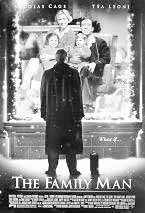 When Nick claims that to have everything in life he needs, the angel decides to prove that's not the case, and transports Jack into an alternate universe where he has been married for 13 years to Tea Leoni, his college girlfriend. Even if our superior empirical perspective tells us that Leoni has in fact been married to David Duchovny since May 1997, we also understand logically that the most important forms of sense-knowledge, the conditions, in fact, of all sensation, are space and time. In other words, this sudden disruption in Nick's time and space perception is understandably jarring-Nick is initially horrified to discover that he is no longer rich, works at a tire dealership, has two kids, and lives in a small town in Jersey. But over time he begins to connect with this lifestyle, which focuses on people and relationships rather than money and possessions.
This ill-informed act of will represents Nick's-and ultimately, the film's-failure to remain on the path of transcendental knowledge. Certainly, "family values" are preferable to selfish materialism if one's goal is the maintenance of our existing society-and, hypothetically, the furtherance of human evolution. Preserving the status quo, however, in now way helps us to deduce a priori forms of thought.
To employ a vulgar marketplace analogy, Nick is merely comparing apples and oranges here. Like all knowing subjects, he assumes certain transcendental truths, yet he refuses to assume the critical perspective necessary to assess the nature of such truths. In so doing, he ignores the essential aspect of all experience-the necessity of completeness in our determination of each question, and exhaustiveness in our determination of all the questions with which we have to deal-preferring instead to shack up with the wife of some other (less commercially successful) actor and raise children in the Garden State.
This being the age of MTV and sound bites, perhaps my thesis could use a bit of paraphrasing. In that case, consider these words from Nine Inch Nails (committed to tape some 180 years after my demise, I might add): "I want to know everything / I want to be everywhere / I want to fuck everyone in the world." Trent Reznor may be a dweeb with no sense of fashion, but he has certainly come closer to a priori understanding than anything we see onscreen in The Family Man. Even if he does see fit to end his song with the pointless self-motivation of "I want to do something that matters."
Immanuel Kant was born in Konigsberg, East Prussia (now Kaliningrad, Russia) in 1724. After studying the philosophy of Wolff and Newtonian physics at the University of Konigsberg, he spent several years working as a private tutor. In 1766, he returned to his alma mater as professor of logic and metaphysics. In the philosophical classic Critique of Pure Reason (1781), he asserted that our perceptual apparatus is capable of ordering sense-impressions into intelligible unities, which, while in themselves cannot be proven, lead us to conclude the existence of through "pure reason"; and that the formation of such intelligible unities are practical necessities for one's life. An admirer of Rousseau, Kant's work gave rise to the Idealist school typified by Hegel and Schopenhauer. Intellectually spent by the age of 70, he nevertheless hung on for another decade of fruitless contemplation, dying in 1804 in Konigsberg.
KANT IN
BRIEFS
BRIEFS
VERTICAL LIMIT
Though our knowledge begins with experience, it does not follow that knowledge arises out of experience. Hence, it is quite foolish to expect that climbing Everest will magically lead one to some transcendental knowledge. There is no substitute for the construction of a sound system of a priori judgment.
O, BROTHER WHERE ART THOU
As a boy, I would frequently masturbate (never to ejaculation, of course) to passages from Homer's Odyssey. Judging from this film, at least one of the Coen Brothers did as well.
FAST FOOD, FAST WOMEN
The loneliness of people and their search for love and identity may be compelling themes for the masses, but they are of absolutely no use in the elaboration of our critical system. Director Amos Kollek should instead have followed the strict method of the celebrated Wolff, the greatest of all the dogmatic philosophers.
DIE STILLE NACH DEM SCHLUSS
If I were alive today, I would NOT be writing for the movies.... However, strictly off the record, cut me a 7-figure deal and guarantee that Volker Schlondorff directs and I might be compelled to make an exception.
MOSKVA
Director Aleksandr Zeldovich would not recognize a categorical imperative if it walked up and swiped his coke spoon. In other words, Russia's unlawful annexation of Konigsberg must not be tolerated. Even from the speculative perspective of traditional metaphysics, the so-called "New Russia" is little more than old (East) Prussia.
MEET THE PARENTS
This kind of knowledge is to be looked upon as given; that is to say, international espionage actually exists, if not as a science, yet still as natural disposition (metaphysica naturalis). Given the near universal recognition of his personage, however, Robert De Niro is a poor choice as representative of this highly secretive sect. It is surprising that costar and prospective son-in-law Ben Stiller has failed to point this out
DRACULA 2000
This latest screen adaptation of the horror classic lacks some of the teleological weight of Bram Stoker's original novel. Specifically, it is difficult to achieve objective purposiveness in our perception of natural organisms when the latter are poorly rendered CGI phantasms. Nevertheless, it must be acknowledged that the city of New Orleans looks mighty good in a miniskirt.