
|
|
Greetings, sports fans! Welcome to round two of the eXile's 2nd annual March Madness Worst Journalist tournament, where the worst man always wins!
If you're not familiar with the tournament format, here's a quick primer: every year, we bracket 32 of Moscow's leading journalists into pairs, and pit them against each other. Whoever writes the worse or more dishonest article between the two of them advances to compete in the next issue. The tournament continues for five rounds until, at the end, only the very worst and most reprehensible and inarticulate journalist Moscow has to offer remains standing. That lucky fellow will then earn the title of Worst Journalist 2001, a throne he will sit on for a full year.
Well, almost a year. In this issue, we watched with regret as last year's champion, The Washington Post's David Hoffman, was bounced from the competition for failing to file. His defeat means Moscow will crown a new king this year, and by the looks of things, there are plenty of candidates worthy of replacing him.
Meanwhile, speculation continues to mount over the mysterious "surprise" the eXile has planned for the winner of this tournament. An obscure Australia-based website for conspiracy theorists even went so far as to publish a photo last week purporting to show the inside of the secret eXile laboratory where the surprise is reportedly being prepared. Little information could be gleaned from the fuzzy image, however, and as a result, all sorts of irresponsible rumors continue to be circulated among readers.
In any case, round 2 is over, and an exhausting round it was. Most of the games were close, with emotions reaching such a high pitch that in a few instances disturbances broke out in the crowd that required the vigorous intervention of security personnel. We can only thank God no one was hurt. Fans, remember: it's okay to cheer, but it's still only a game.
Without further ado, here are the second round results for March Madness Moscow, 2001:
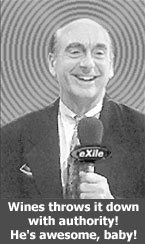
Michael Wines (1), New York Times, def. Jon Boyle, Reuters
In the first round of last year's March Madness tournament, the AP's Anna Dolgov lost out to cookie-pounding columnist Helen Womack of the Independent, who went on to burp and smack her way to the final eight, establishing herself along the way as a legitimate threat to win it all. In the course of Womack's thrilling run at the title, Dolgov's strong first-round performance against Womack was seemingly forgotten by fans and commentators alike. Don't think the coaches weren't paying attention, though. Here's Dick Vitale's call from that first-round matchup, reprinted in the eXile last February 13:
'Anna Dolgov's effort, the Jan. 15 "Russian Soldiers Feel Betrayed", was a perfect example of the kind of fast-food news feature writing that tempts one to call for the mass herding of journalism school teachers into polar internment camps. The lead follows strictly the classic "lead-o-matic" formula:
"EXOTIC CITY, Foreign country (Wire Service)-In the (unnecessary modifiers) (rustic local topographical feature) amid the (exotic local fauna), an (unnecessary modifiers) (authentic local protagonist) is doing (what he does) amid the (unnecessary modifiers) of the (exotic local fauna) next to the (rustic local topographical feature)."
'Dolgov's lead goes like this:
"GROZNY, Russia (AP)-By a tumbledown wooden shack flanked by elm trees, a scraggy 20-year-old Russian conscript clutches a cigarette between his fingers and stares at the snow around his feet."
In that same round, David Hoffman actually advanced with his own skillful use of the "lead-o-matic" in his Jan. 30, 2000 piece, "Putin Steps Out of the Shadows":
'DRESDEN, Germany-In the gray villa at No. 4 Angelikastrasse, perched on a hill overlooking the Elbe River, a young major in the Soviet secret police spent the last half of the 1980s recruiting people to spy on the West.'
It's absolutely uncanny how often even the cream of the international reporting community can be caught resorting to this infuriating cookie-cutter literary parlor trick, a thing as old and worn as the lighthouse-themed water color. The lead-o-matic format is the kind of writing first-year j-school students resort to when they're late for class and willing to settle for a B minus. And yet it's the standard format for most features published in the major dailies.
Even tournament top seed Michael Wines of the New York Times gets into the act from time to time. Usually he shoots for the better-camouflaged B-plus lead, but there was no mistaking the footprints left behind by the intro to his Monday, February 12 piece, "In Russia's Far East, a Region Freezes in the Dark".
"RAZDOLNOYE, Russia-A bitter wind grasping at his pants legs, Nikolai A. Yudin raised one arm outside the boiler room at the O.A.O. Razdolnoye Building Materials Factory, a red-brick husk aged well beyond its 42 years, and pointed emphatically at - nothing."
Just as rigid and unvarying as the lead-o-matic lead formula itself is the character of the two paragraphs following the lead. Always, without fail-in literally 100% of all cases-the structure of the first three graphs is organized as follows: lead-o-matic, followed in paragraph 2 by a quote from the subject (who is usually shown speaking in his earthy, "real" vernacular), capped off in paragraph 3 by a pull-back generalization, written in a frankly expository tone from the point of view of the reporter. Here's the continuation of Wines's piece:
'"There is supposed to be 6,000 tons of coal here," he said, staring contemptuously into a broad, shallow pit beside a rail spur, barren but for a thick coat of snow. "We need 6,000. We got 123."
'Mr. Yudin may be the most unpopular man in Razdolnoye, a desolate town of 13,000 in the Primorsky Region, about an hour's drive from Russia's southeast Pacific coast.'
Lead, quote, generalization. Lead, quote, generalization. See for yourself how many times you can spot that formula. It gives you a headache after a while.
Wines was also guilty in his February 15 piece, "Russia Reviving Dreaded Practice of Anonymous Complaints," of misreporting a story about new FSB rules governing the use of anonymous informants (See reference to Anna Dolgov story on page 22), itself reason enough to advance him. Meanwhile, Wines's opponent, Jon Boyle, apparently did not file in the past two weeks. It is not even an established fact that he actually exists. It wouldn't have mattered anyway, as top seed Wines rolls past to become the first hack to reach round three.
The Motley Hack (8), Moscow Times, def. Ian Traynor, Guardian
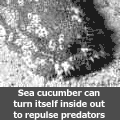
One of the world's most interesting animals is the sea cucumber. Apart from its icky taste, it has no real defenses against predators. When nipped or prodded by an enemy, its first response is to ooze an extra layer of slime, essentially trying to talk the predator out of a bad culinary choice. But if that doesn't work, the cucumber has only one very extreme card left to play. When pushed to the limit, what it does is turn itself inside out and expose all its guts and innards to its attacker, creating a flash cloud of floating sea-organs which bob hideously in the current. Usually the predator cringes from the embarrassing scene, and darts back to the plankton beds. But even when it works, the cucumber's defense is costly. Once out of danger, it has to work for hours, even days, to complete the agonizing reconstitution of its body. Sometimes it even dies.
The eXile observed a similar behavior last week in the wake of its first attack on the Moscow Times mystery columnist, the Motley Hack. The Hack sailed through the first round of the tournament when his column about geese in Prague literally disintegrated in our hands as we first reached to examine it. You should have seen it; the thing literally popped like a water balloon, spilling all over the desk. It was all we could do to clean it up. Then, a few days after the issue came out, the Hack sent us a threatening letter:
'I'm going after you, dude.
'Yo, check it out. Watch your back. Me and you - fight to the death in a cage suspended over croc-infested rapids.'
The letter ended with a cryptic allusion to Christian Caryl's "stippled" alpine foothills, and with a warning: "Check out the next hack column." The column then came out, and while it was packed with ominous references to passages from the last issue of the eXile, the promised sword never leaves its sheath. Instead, the Hack in the column swims in a tight circle between the shores of response and non-response, casually exploring various aspects of the Dread Pirate Roberts theme (the eXile smugly compared the Hack to the fairy-tale character in the last issue) at some length and in deeply ambiguous fashion before suddenly dropping the subject and segueing into his discourse on the Uzbek customs system. Here's an excerpt:
'OSH, Kyrgyzstan-There's a scene in "The Princess Bride" in which it is revealed that the Dread Pirate Roberts, who has been terrorizing the land for generations, is actually not an individual pirate, but a brand name.
'It works like this: An enterprising corsair acquires the name Dread Pirate Roberts; then, bolstered by this heart-stopping sobriquet, he terrorizes the land until, his financial goals met, he retires and passes on the trademark to some other would-be buccaneer. None of the subsequent Dread Pirate Roberts really have to be as dreadful as the first one, since they live off the deeds of the name. With the right reputation, anyone can be a pirate.
'I bring this up because in Osh, Kyrgyzstan, which is nestled in the stippled alpine foothills where the Fergana Valley arches toward to mighty Transalai, I discovered a similar phenomenon: It is called "Uzbek Customs."'
I actually can't tell whether this is a work of genius, a fantastic cop-out, or just pure bullshit. My instincts say that it is probably both bullshit and a cop-out, and almost certainly not genius, but it's impossible to say for sure. Now, normally, this is the point where one would look at this confusing and somewhat unappetizing set of mixed signals and decide that it is not worth sticking around to investigate. However, I feel certain that this is exactly what the Hack is hoping for here. We're not falling for it. The Hack stays alive to give March Madness fans another look; the Guardian's Ian Traynor, whose only mistake last week was an overanxious use of the plural case (he referred to "sinking submarines and burning TV towers" in an otherwise unremarkable political analysis) bows out.
Scott Peterson, Christian Science Monitor, def. Andrew McChesney, Moscow Times
McChesney did not file a story in the last two weeks and I have been out of Moscow, which means that I've had no chance to catch him sneaking into our building. One helpful reader suggested that I catch him by sprinkling a glittery dust outside his door, which would force him to leave a trail of shimmering footprints that I could then point to as incontrovertible proof of his wickedness and perfidy. This is a good idea, and it might even work some day. Unfortunately, however, McChesney is out of the tournament and therefore out of sight for the immediate future, bounced from the draw both by default and by a strong performance by the Monitor's Scott Peterson.
The latter's February 13 piece, the unpleasantly-titled "Georgia Wriggles in Russian Orbit," is yet another of those lengthy geopolitical analyses in which the Western commentator slams Russia for trying to oppose American influence over her neighbors. The very length of the piece inspires irritation, in light of the well-worn theme; in fact, I refuse on principle to read it. Peterson on to the next round; McChesney safe for the time being.
Marcus Warren, Daily Telegraph, def. David Hoffman (4), Washington Post
For once, the Washington Post told the truth. Apparently they were serious when they announced on their website a few weeks ago that longtime eXile villain David Hoffman was "completing" his assignment in Russia and returning home to oversee the release of his upcoming book. Hoffman hosted a Russia-based internet chat for the Post about a month ago, but since then, he hasn't filed. Sources around town confirm that he really did split town and will probably not be coming back.
The March Madness tournament operates under the principle that reporters should always and without exception be encouraged to stop reporting. Therefore, any entrant who does not file over the course of the two-week time period between rounds is automatically
 removed from the draw. Some people complain that this makes it too easy on the local hack community, that this rule means that all any hack has to do to avoid being called a bad journalist is hold his breath and not file for a couple of weeks while Michael Wines races past him in the brackets.
Well, they're right. It is easy. But that's the point. All anyone has to do to avoid being a bad journalist is not practice journalism. There are other jobs in this world. In any case, David Hoffman is to be sincerely congratulated on his decision to leave Moscow. He may end up writing filthy lies somewhere else, but at least he won't do it here.
Marcus Warren, at first glance, does not appear to have done anything to deserve advancing to the final eight. His February 20 piece, "Tax Numbers Spark Devil of a Row in Church," was, with the conspicuous exception of the atrocious play on words in the headline (the incidence of bad headline puns is increasing sharply; it appears copy-editors are now being trained to write them) very solid. The article, about the Orthodox Church's hysterical reaction to the government's plan to introduce personal tax numbers, skillfully portrays Russians as superstitious, meatheaded savages who should be put in wire cages and shot into space. Normally this kind of writing coming from a Westerner should probably be condemned, but when it comes to the Russian Orthodox Church, no rhetoric, in my opinion, is too extreme. Probably no organization in the world is working harder toward the goal of stamping all joy out of the human experience. For the good of the species the entire Orthodox priesthood should probably be pushed into a lava pit. In any case, Warren's tone in writing about the church is exactly appropriate, one of vague visceral disgust mixed with a touch of intellectual bemusement:
"In the Russian provinces, many seem to believe that their individual tax number (INN) really will be engraved on their hand or on their face."
None of this could affect the outcome of this matchup, however. If you're not part of the solution, you're part of the problem. Hoffman did not file, Warren did, and his advance to the next round means we will crown a new champion this year.
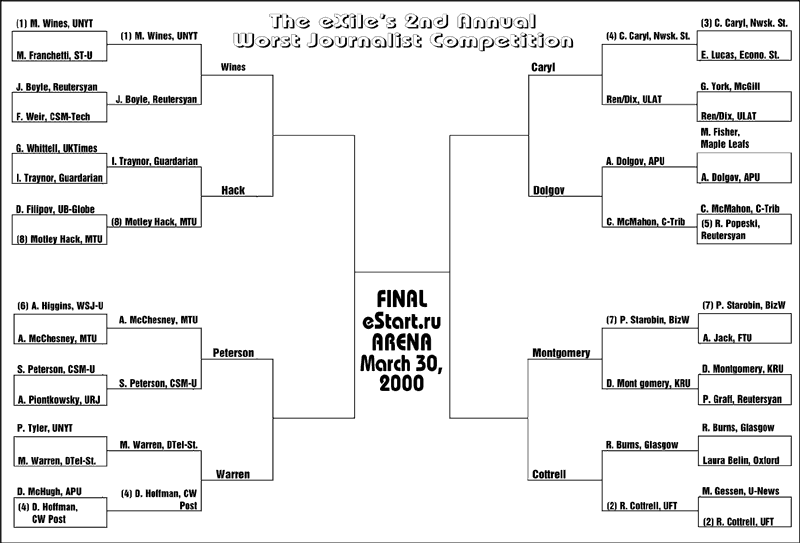
Christian Caryl (3), Newsweek, def. Robin Dixon and Maura Reynolds, Los Angeles Times
This might well have been the most one-sided contest in sports history. Caryl must have been afraid to go out there alone against the high-heeled reporting duo at The LA Times, as last week found him panicking and shielding himself with the bodies of about nine other dreadful Newsweek hacks in a joint-bylined atrocity which ran on February 19. Entitled "A Spreading Islamic Fire," this ambitious stay-in-your-homes Xenophobic manifesto was primarily written by Christopher Dickey and Carla Power, with a helping hack hand from Caryl in Moscow, Melinda Liu in Indonesia, Brook Larmer in Hong Kong, and Martha Brant in Washington. Together, this dream team of literary bureaucrats created what might be the foulest, crudest piece of propaganda published in English this year. The text itself is a chilling self-portrait of the emerging world enemy that is America-mean, dumb, confident, motivated, and completely blind to the outside world except as it sees it through a set of crosshairs.
The article is a roaring outrage right from the start, blasting out of the blocks like a rodeo bull in a baseball cap. The lead alone perfectly captures the central ugliness of the American spirit:
"Americans are nothing if not self-assured, especially about their most cherished values. What's wrong with freedom and the pursuit of happiness? So it's all a bit puzzling. Why should America now be the enemy?"
This is exactly how America-and the vast majority of the reporters it employs for its larger vanity publications, like Newsweek-views itself in relation to the rest of the world. Our country likes to imagine itself as a big, well-meaning dope that scratches his head whenever a bomb goes off on his property, wondering, "But I'm so nice! How can it be that someone doesn't like me?" That's the thing that drives foreigners so crazy about Americans, that while they don't seem to care when you hate them, not being liked gets them genuinely upset. Even when they're bombing you, Americans want you to like them. Even the Nazis never went that far.
The Newsweek team of Caryl & co. cranks the well-meaning dope act up to maximum volume. As is usually the case with this kind of journalism, they guarantee the desired reader response by framing their questions in the right way. It's not "What's wrong with us?", but "What's wrong with freedom and the pursuit of happiness?"
This is what Newsweek is all about, narrowness of field. Another thing Newsweek is all about is scaring the shit out of its cattle-herd readers with visions of all sorts of terrifying threats involving nonwhite poor people. The media has already successfully blamed Osama bin Laden for everything from the NASDAQ crash to male pattern baldness, but this isn't enough for Newsweek: no, they have to present to us, with a straight face, the specter of bin Laden physically exterminating every last one of us (hanging us in our baseball hats!), burning down every last McDonald's and turning the whole of hard-won territory into a grim mosque:
"Counterterrorism officials say bin Laden's grand plan is to drive the United States out of the Muslim world entirely, then replace moderate governments with fundamentalist Islamic states. And ultimately? Well, one bin Laden-inspired cell in Chechnya has posted a global map of Islamist power on the Internet-and it projects a world that in 100 years will be entirely Muslim green (the religion's traditional symbolic color)."
Caryl & co. write that line without a trace of irony, despite the fact that they had to quote unnamed "counterterrorism officials" to make their point, presumably because no sane person would go on the record worrying about such an absurd thing.
Note also the casual quoting of unnamed "counterrorism officials," so typical of the Newsweek reporting style; you get the impression that the entire American law-enforcement community was sitting in the next room while the piece was being written. You get that impression because it's more or less true. It's hard to get through so much as a page of Newsweek without running into whole crowds of "authoritative" government sources, whose opinions the magazine usually gently paraphrases and incorporates into its own narrative before contrasting them with the "wrong" dissenting view of some obviously hysterical interview subject.
Newsweek is at its most embarrassing when it tries to play populist. Here, Caryl & co. make a hideous attempt to explain bin Laden in language they apparently think the average American will understand and identify with:
"Bin Laden operates more like a venture capitalist than the head of a conquering army. Think of him as the chairman of Jihad Inc., together with its subsidiary, Jihad.com."
It used to be that conservative commentators told baseball stories to make themselves seem more like real people. That was bad, but this is just plain nauseating. I'll take being a hounded fugitive in the Afghan mountains any day over living in a world where rhetoric like this actually makes sense. The day I don't flinch when someone tries to explain God to me as being, say, the CEO of life.com is the day I become a deserving victim of a jihad.
 There is not enough space here to completely address even the major outrages in this piece, let alone the minor ones, but there are a few other things worth pointing out. One might, for instance, be tempted to wonder why six bylined journalists are needed to write one 1,400-word piece. This is a good question, but it is not the right one; the right question to ask is how one 1,400-word piece can possibly be created by six bylined journalists. The answer is that it can, very easily, if the piece is for Newsweek. Writing is supposed to be an individual event at the life Olympics, but Newsweek and magazines like it reduce it to an assembly-line process. New hires in the bureaus of such publications complain all the time that they frequently submit whole articles without a single sentence surviving intact into the final version. Teams of editors in Washington and New York do most of the actual writing in Newsweek pieces, taking copy submitted by bureau slaves like Caryl and reworking it into short strips of the same bland, unrecognizable mush that fills the rest of the magazine. The reporters who advance in this system are the ones who learn to toss off the desired mush on their own. By all reports, Caryl's talent for mush-production is causing his star to rise. He reportedly even has a mushy body, which lately has begun to spill unpleasantly into the aisles of places like the Starlite diner when he dines out.
It may not seem fair to criticize a reporter for an article in which he was not the primary writer. But the thing is, no Newsweek reporter is ever really the primary writer on any story. Besides, Caryl has eyes and presumably can read, and he was willing to put his name on this article, which is bad enough. I wouldn't touch this piece with a stick, much less put my name on it. Anyway, it's certainly enough to put him past Robyn Dixon of the LA Times, who bowed out with the February 10 effort, "Besieged Tycoon a Symbol of Russia's Suppressed Media." While it is true that Dixon occasionally describes Vladimir Gusinsky using phrases like "touched by the icy fingers of dread," nothing about her article even approached the level of Caryl's "What's wrong with freedom and the pursuit of happiness?" In this life there is genius, and then there's the rest of us. Caryl moves on to the great eight; the LA Times goes home.
Anna Dolgov, AP, def. Colin McMahon, Chicago Tribune
Dolgov was one of many Western news agency reporters who badly fucked up a recent story about a new FSB directive governing the use of anonymous tips. In an apparent bloodlust for any evidence of a new era of "cold war" relations between Russia and the United States, Western journalists universally jumped on the news that the FSB was once again collecting complaints from anonymous sources as an unmistakable sign that Russia was going back to being the mean, sneaky old Soviet Union we once knew and loved. Dolgov's February 13 piece, "Russia Revives Anonymous Tips," was typical of the alarmist reports:
'MOSCOW (AP)-The successor to the KGB has restored the Soviet-era practice of acting on anonymous criminal accusations, and Russian human rights advocates warned Tuesday that thousands could be put behind bars on the strength of a quiet tip by their foes.
'Under new instructions by the chief of Russia's Federal Security Service, or FSB, Nikolai Patrushev, any letter or telephone call accusing a person of a crime can result in investigation, even if the accusers do not release their identity.
'The policy revives grim memories of Soviet dictator Josef Stalin's era, when anonymous complaints were a favored way of getting rid of an adversary. Millions were imprisoned for crimes they never committed after their neighbors, co-workers, or even relatives contacted the KGB.'
Dolgov was a shade quicker to exhume Stalin (word 89) than the other reporters on this story (Michael Wines did it in his second-to-last paragraph), but this isn't the main problem with her article. The real trouble is that the "new instructions" issued by Patrushev weren't really new at all. The passage governing anonymous tips in his Dec. 4, 2000, order on FSB policy was in no way different from the previous policy, which was established in an internal memorandum by then-FSB chief Sergei Stepashin way back on August 3, 1994.
In fact, the language from the Patrushev order was lifted wholesale from the Stepashin order, which dictated that anonymous tips were to be ignored (and destroyed) in all cases excepting those involving information about a "planned crime or a crime already committed." Tips containing that kind of information were, then and now, delivered to the relevant law enforcement authorities to be investigated. Both orders state explicitly that anonymous tips are "not to be registered" in any other instances, and that a tip is not considered usable unless it contains the full name and address of the complainant.
The 1994 order was the one everyone should have been upset about, legalizing as it did a practice which had been outlawed in 1988 in one of the showcase reforms of the perestroika era. This latest thing was just a bit of bureaucratic paper-shuffling. In any case, Dolgov missed this one badly enough to get her past Colin McMahon of the Chicago Tribune, who nonetheless fought gamely in his February 6 effort, "Russia's Disabled Vie For Acceptance." In the piece, McMahon spends 903 words reminding Chicago that America has many more handicapped access ramps than Russia does. This was solid work that unquestionably had to be done by somebody, but unfortunately it wasn't enough to keep McMahon in contention. Late-night practice sessions at the gym pay off for the AP; Dolgov to take another turn at the Big Dance.
Dave Montgomery, Knight-Ridder, def. Paul Starobin (7), Business Week
Starobin didn't file and isn't in Moscow anyway, so Montgomery's first article was going to be a winner no matter what he wrote. It didn't need to be a doozie. But it was. The highlight-film star of the first round, Montgomery in this one showed off still more Cinderella magic for the crowd, filing on February 8 perhaps the very laziest feature article in the history of American print journalism-a sweeping epic history of the Shakespeare and Co. bookstore, spanning 935 words and entitled "Doing Business, Russia-style."
It would be difficult, perhaps even technically impossible, to conceive of a feature story that would involve less work than Montgomery put into this piece. February 6 was a chilly Tuesday afternoon in the raging furnace of death, sex, and treachery that is modern Moscow, and on that day, the intrepid fact-gatherer Montgomery apparently went shopping. His travels brought him to Shakespeare and co., one of the two or so English-language bookstores in the city. One shudders to think what course history might have followed if he had decided to shop at Anglia, but fortunately for posterity he chose Shakespeare, where he found a Story.
The ostensible aim of Montgomery's piece is to describe the rough-and-tumble world of Russian business, with its savage gangland violence, brutal state intimidation, and high-stakes thievery. Unfortunately for Montgomery, the Shakespeare bookstore is probably the very last place in Russia that one would go to find any of these things; as a low-revenue Western business located in a basement well off the main street, Shakespeare is probably the least attractive target for racketeers in the whole country.
 Montgomery knows this, and his difficulty in making the Shakespeare story sexy is evident from the start. Even the headline tries to be sensational, but ends up limping off the page as it promises tales of such horrors as "exorbitant rent" and "inspectors demanding payments":
'AT HER MOSCOW STORE, AN AMERICAN FACES POST-SOVIET CAPITALISM: THE MOB, EXORBITANT RENT, INSPECTORS DEMANDING PAYMENTS.'
Montgomery could already be describing the experiences of a bookstore on the edges of Harvard Square, and he knows it. By the middle of the piece we find him trying frantically to compensate for the lack of real drama with a zealous list of all the terrible things that could be happening at Shakespeare, if it wasn't so quiet there:
'Many small enterprises, such as groceries, cafes and sidewalk kiosks, are forced to pay extortion or "protection payments" to criminal gangs, who surged into the open after Russia's totalitarian government collapsed. "Knock on wood, we'd never had those problems," Duncan said. "We've never had anybody come in and demand out-and-out extortion. But it's quite clear that if we were selling minks or had a restaurant, we would."'
Yikes! Anyway, Montgomery manages to fill out the entire article with this stuff, the one presumably brief conversation with Duncan his sole source of information. Reporter in Moscow goes to American bookstore; reporter in Moscow chats with American bookstore owner in English; reporter in Moscow files gritty on-the-ground story of life abroad; world buys it. Beats working, don't it? Shakespeare is a great store, a favorite of ours, but this article is a laugher. Montgomery continues to roll through the ranks; that glass slipper is looking like a better fit all the time.
Rob Cottrell (2), Financial Times, def. Robert Burns, AP
At the beginning of last week, a most interesting message appeared in the eXile's e-mail inbox. It was from Rob Cottrell, the tournament's number 2 seed. A convincing winner in the tournament's first round, he was hoping to take us up on our old standing offer to lay off anyone who buys us lunch:
dear exile editors-in-chief
it looks to me as though i have left it too late to negotiate my way out of your worst-journalist awards. but i'd like to buy you lunch all the same, if the offer in your previous issue still stands. i like your paper and i would welcome the chance to meet you.
of the restaurants on your list [eds. note: Cottrell is referring to the list of restaurants we would accept invitations to, published in a pre-tournament eXile ad], i take the scandinavia. but i would prefer uncle guilly's to any of them. your call.
i could do thursday or friday this week, the 15th or 16th; or monday or tuesday of the following week, if any of those dates work for you.
best wishes
robert cottrell.
The arrival of this letter caused great confusion and disarray in the eXile offices. At first, we were thrilled: for the second straight year, a high-ranking British journalist had offered to swallow his pride and publicly kiss our rings in order to get out of this loathsome competition. Last year, the Times of London's Giles Whittell not only bought us lunch, but allowed himself to be photographed with us while waving an American flag. Now it appeared that it was going to happen again-but the hope was short-lived.
Without knowing why, we began almost immediately to feel uneasy about the letter. No one in the office knew what to do about it. As Cottrell himself pointed out, he had had every opportunity to make this offer before the tournament began; we'd posted an advertisement in the preceding issue for that very purpose. But Cottrell hadn't written in then. Instead, he'd sat idly by and allowed us to suffer the humiliation of not receiving so much as one response to our shameless pre-tournament appeal for bribes.
Worse, Cottrell was our number 2 seed. In giving him that distinction, we'd already indicated that we honestly believed him to be among the very worst journalists in the city. This was no Fred Weir-Marc Franchetti-type longshot who'd be doing us a favor by picking up a lunch bill. No, this was a powerhouse in the draw, and if we were to let him off with just a lunch... well, it would look bad.
In the end we decided that lunch was fine, but that we'd need additional compensation to justify removing Cottrell from the tournament:
Dear Mr. Cottrell,
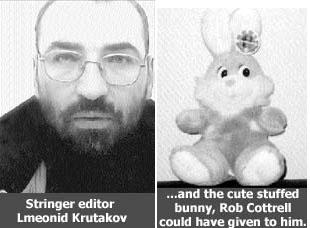
Of course we'd be happy to take you up on your offer-we never say no to a free lunch. But the thing is, you're the number two seed in the tournament, and it is the general consensus of the staff that additional compensation will be necessary in order to make this deal work. I think we'd be satisfied with a three-part plan: one, the lunch, at the venue of your choice; two, a large stuffed animal, preferably a big furry bunny, delivered to the editor of our partner paper, Stringer, as a gift; and three, you have to sing at least two verses of Ricky Martin's "Living the Vita Loca" for us when we meet. If you don't have the lyrics and the tune, I think we can get them for you.
If you feel this is unfair, please let us know.
Looking forward to meeting you. Until then, thanks for writing, and take care.
Sincerely,
Matt Taibbi
Later that afternoon, I called Cottrell at his office. I was excited; deep down, I actually believed that I would in the very near future be able to deliver a stuffed bunny to Krutakov at Stringer, with the explanation that it had been extorted for him from the bureau chief of the Financial Times. But it was not to be. Not only did Cottrell soundly reject parts 2 and 3 of my counter-offer (see box), he spat in my face by insisting repeatedly that he was not trying, and had not tried, to buy his way out of this tournament. This abject tactic shook me so seriously at first that in a moment of weakness I actually began claiming to Cottrell on the phone that I knew how to play the harmonica, a patent absurdity. By the time I recovered myself, Cottrell was wrapping up the phone call with a proposal that we touch base again the next day to set up the offered lunch.
But by the time Cottrell's voice clicked off on the line, I understood that there would be no lunch between us-not now, not ever. Cottrell would have to advance in the tournament. There was no avoiding it. It had been an amazing performance: Cottrell sincerely wanted to do the lunch-for-amnesty deal, he was willing to truly demean his name and his office by bribing the eXile in public, but he was not willing to buy Leonid Krutakov a stuffed bunny rabbit. (Not even a little one-I made it clear that the initial demand of a "giant" stuffed animal was negotiable). He wanted to go in, do the lunch deal, and get out without any funny stuff. Worse-and this gives me the willies just thinking about it-he actually thought we'd go for it.
On Tuesday, having lost all hope for a peaceful settlement, we sent Cottrell a Jack's eXile pizza, our standard gift of ominous congratulation to each issue's featured press review subject. Cottrell quickly wrote back, thanking us for the pizza and asking somewhat nervously if we could send him a copy of this article prior to publication. With told him that to our regret we could not, but that he could still stay out of the paper if he quickly sent over a new 28" color television. (With a receipt and a warranty, of course; we didn't want him boosting one from the back of a van).
He ignored the offer, and here we are. The Financial Times bureau chief tries and fails to buy his way out; we'll see him next issue in the round of eight. Who knows, maybe he'll still come around on the Ricky Martin thing....
Next week:the great eight!