
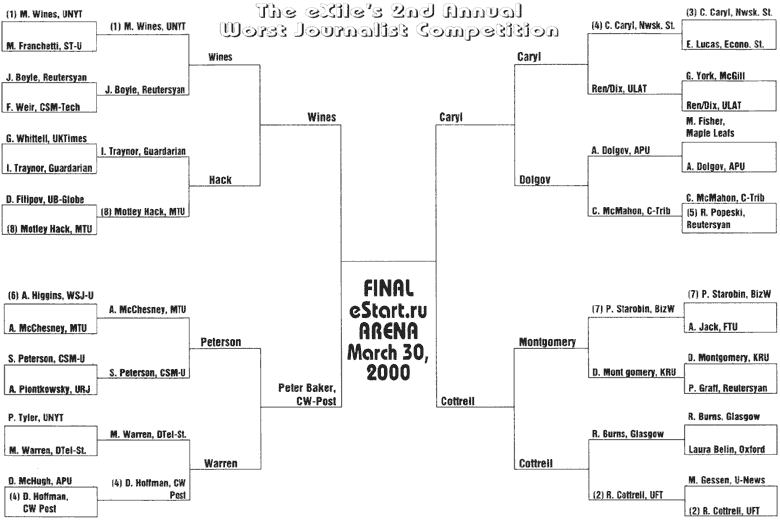
Grief. Shock. Grief and Shock. These are some of the words being used to describe the emotions surrounding the 2nd annual eXile Worst Journalist tournament, which was struck by tragedy this past weekend when a plane containing the Christian Science Monitor team crashed into a public toilet in Vitebsk, eliminating the Final Four hopefuls.
It is too early to tell if the decision by tournament officials to insert “Lucky Loser” Peter Baker of the Washington Post in the slot formerly occupied by the Monitor’s Scott Peterson will help rescue the championship from the gloom and despair to which it seems fated forever to be linked. (See box)
It goes without saying that the thoughts and prayers of all of us here at the eXile go out to the families of the victims of the Monitor crash. At such times we all must pray to find the strength to move on. Perhaps the only thing that unites and consoles us in our grief is our firm faith in the sport that the Monitor victims, to the last, embraced in life. They lived for journalism, and through it, we can remember and honor those that were lost to its cause.
And so the tournament continues, through a mist of tears. Play was held up for a day in favor of a candlelight vigil for the departed, but games resumed this past Tuesday after fans and players alike said their final goodbyes at the stirring morning Memorial service outside the Starlite diner. Michael McFaul led gatherers in a brief prayer, while former Wall Street Journal reporter Steve Liesman and photographer Heidi Hollanger led mourners in an acoustic rendition of “American Pie.” With their help we all understood that, for one day at least, this truly was the day the “music died”.
But in the evening the games resumed. This was, after all, the Big Dance, and the Final Four slots still needed to be determined. The eight remaining entrants would do their very best to display the full majesty of bad journalism. As Peter Baker said, Scott would have wanted it that way. So here they are, four thrilling contests to determine this year’s semifinalists:
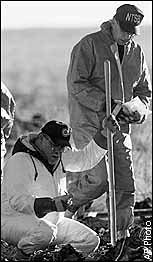 NTSB investigators still don't know what caused the Monitor's plane to crash into a Vitebsk toilet |
|
Michael Wines (1), New York Times, def. The Motley Hack, Moscow Times
Near press time, the eXile learned that the Motley Hack had left the stage for the last time; he has written his last column for the Moscow Times. The Times assured us that we had nothing to do with it, that he had not beaten a hasty retreat at all, but had in fact simply abandoned his artistic mission on his own, citing creative “fatigue.” This decision means that the Hack’s identity will likely forever remain a mystery.
The Hack’s exit also meant that number one seed Michael “Dimeless” Wines of the New York Times would advance to the Final Four. Fans this week tabbed Wines “Dimeless” because it appears that the Times bureau chief was unable to make a single phone call over the course of the six full news stories he filed during the last two weeks, i.e. since the end of the last round.
You can check it out yourself; in a string of stories including “Religious Sect Gains Victory in Moscow Trial” (Feb. 24), “Russia to Investigate Mass Grave in Chechnya” (Feb. 26), “Russian Sub’s Officer Wrote of Torpedo Blast, Izvestia Says” (Feb. 27), “Russia Turns Drug Arrest into Spy Case” (Feb. 28), “Spy Case Ends for American Held in Drug Charge” (Mar. 1), and “Russian Prosecutors Now Say Chechen Field Held 48 Bodies” (Mar. 3), Wines appears not to refer to a single independently-contacted source.
Instead, he refers mainly to spokesmen giving statements to other news services: the “spokesman of the Voronezh arm of the security service” who “told the Interfax news service” that the Russians still believed John Tobbin was a spy, the “lawyer” of Tobbin’s who spoke to Reuters, an “official videotape described by Reuters” that “showed” details of the Tobbin search order, an Izvestia report, a Russian television report, a few unnamed “newspapers in Hartford [Conn.]”, other “news reports”, and so on. Not once in any of these stories (with one exception; more on that in a moment) does a quote appear which did not first appear in public somewhere else, or as part of an officially-released statement.
Two weeks is a long time for a reporter who files every other day or so to go without picking up the telephone. Of course it is not entirely unheard of; in fact, many wire reporters, and some of the lazier bureau representatives, will often go weeks, months, even whole multi-year assignments in Moscow without leaving their offices, or talking to anyone other than their fixers. What is unusual here is that Wines is the resident bureau chief of the proverbial World’s Most Powerful Newspaper, and as such could be expected to at least superficially justify his prized scent-spot on the local fire hydrant.
In fact, however, Wines in the past week or so was clearly outperformed by even the very worst local representatives of the Western media. For instance, even the wretched Dave Montgomery of Knight-Ridder managed to call a few people in his Feb. 22 piece, “Spy Scandal Could Push U.S. further away from Russia.” Wines in the course of the last round went through three spy stories without calling anyone, while Montgomery in just one piece called ex-CIA officer Fritz Ermath, dangerous liar Yevgeny Volk of the Heritage Foundation, and Sergei Grigoriyants of the Glasnost foundation. Though such a thing could never be conclusively proven, it is possible that Montgomery even spoke Russian to Grigoriyants, an act which would put him many leagues beyond Wines’s level of reporting lately.
Wines’s contact with the outside world in the past two weeks was limited to one exchange with an unnamed English-speaking source during one of his Tobbin stories:
‘An American official here said American experts were puzzled by the blowup. “Maybe some F.S.B. colonel is trying to get his stripe,” he said, using the Russian abbreviation for the security service.’
Note the extreme vagueness of the attribution around the quote: an “American official” (In the embassy? In what branch of government, if he is in the government at all? With specific knowledge of the case?) is described as speaking for “American experts” (What kind of experts? Intelligence experts? Political experts? NFL color commentators? All kinds of questions here), and then gives a one-line speculative quote, useless as unattributed information. One should always be suspicious of journalists when there is shaky language around the attribution. It usually means they’re hiding something, the something usually being a lack of work. This quote could have come from a conversation Wines had over lunch with an embassy friend.
The eXile, feeling a duty to help “Dimeless Mike” any way we can, sent on Tuesday a new Moscow telephone directory and a stack of ten payphone cards to the New York Times offices. There’s been no response yet; we’ll keep you informed. In the meantime, Wines moves on to the Final Four. As for the identity of the Motley Hack... only the Shadow knows.
Peter Baker, Washington Post, def. Marcus Warren, Electronic Telegraph
Who among us can divine the caprices of Fate? Only five weeks ago, the Washington Post’s Peter Baker was an unknown, a rookie performer on the Moscow scene who missed a berth in the March Madness tourney when he came up short against Christian Caryl in the Atlantic Coast Conference tournament semi-finals. Today, journalism fans around the world are looking to him for Hope and Guidance as they struggle with the tragic loss of Christian Science Monitor hack Scott Peterson.
Baker’s brave decision to stand in for Peterson in the third round for his departed friend introduced an unexpected X factor into the tournament. Fans had no idea what to expect from this New Kid on the Block, who apparently came to Moscow recently as a replacement for previous Post standout David Hoffman. It would, of course, have been unreasonable to expect Hoffman-grade performances from Baker. After all, it takes some time to develop a truly terrible journalistic technique. Normally the best way to bring young talent along is in the manner of Daunte Culpepper; let him sit on the bench for a year, then ease him in to the starting lineup while the outgoing veteran mans the fort.
No such luxury could be afforded Baker, however. But who could have expected that he would not only not embarrass himself, but wow the crowd from the opening tap with his thrilling March 2 mega-blowjob of Roman Abramovich, “An Unlikely Savior on the Tundra: A Russian Tycoon Adopts Abandoned Arctic Region, but Why?”
No one, that’s who. But he did it, and for all forty minutes, too—or 2,802 lip-smacking words, in this case.
This extremely long feature article is the latest in what is fast becoming a sacred mini-genre all its own among Western correspondents—the blowjob profile of the extremely rich Russian gangster, who is painted as A Man With Whom We Can Do Business, and whose very existence means a flicker of hope for Russian capitalism. From the famous “Baby Billionaire” piece on Vladimir Potanin written by Baker’s Post colleague Fred Hiatt, to Patricia Kranz’s “It’s Part of Our History” piece, also about Potanin, to John Lloyd’s recent Abramovich-as-Santa-Claus piece, to this recent effort by Baker, Western reporters have for many years now shown a strong inclination for doing free p.r. pieces for the very bloodiest Russian gangland figures.
These features all follow a standard format. They tend to be exhaustively long, and written from start to finish in the gushing, worshipful tone of a Euromoney advertorial, eschewing any and all criticism except insofar as to debunk popular “misconceptions” about the figure’s allegedly corrupt past. (Regarding this I can write with some authority—in a more shameful period of my life, I moonlighted writing exactly these kinds of commercial profiles for Euromoney and other magazines).
Baker’s piece follows the format exactly. One scarcely even needs to read beyond his lead to catch the full meaning of his piece:
‘ANADYR, Russia — It is difficult to tell the billionaire from the bodyguards as they step off the helicopter in this farthest corner of Russia’s Far East. Roman Abramovich, after all, favors blue jeans, wool sweaters and Nike sneakers. Several days of whiskers cover his face in a sort of designer stubble.’
Forensic experts I contacted about this paragraph determined that by the end of the third sentence, Baker had already swallowed 6 3/4 inches of Abramovich’s penis, leaving a mere eight for the article’s remaining 2,700 words or so.
In this one short paragraph he has already softened his reader up with a half-dozen messages or so which explain why we should all admire and like Roman Abramovich, and think of him not as a billionaire, but as a regular guy like you and me.
“It’s difficult to tell the billionaire from the bodyguards”—Abramovich doesn’t put on airs, he’s the kind of guy you’d feel comfortable asking for a light at a bar. Abramovich wears jeans and sweaters—just like you, and all your friends from college. Abramovich wears Nikes—he’s Westerninzed, on our side, a Russian only on the surface. Abramovich has “designer stubble” [!]—he’s a fashion plate, cuddly, maybe even a little bit goofy, not at all unlike the “Baby Billionaire” we once learned to love.
Baker follows up the lead paragraph with a disgusting caricature of the cloying Chukotka poor begging the kind stubbly Lord for crusts of bread as he wades through the crowd. The “locals” here are depicted as little more than baby chicks screeching with their mouths open, unable to leave the nest, waiting for the Mama bird to fly back from Moscow with a big fat worm in her mouth. See for yourselves:
‘Yet to the forlorn of Chukotka (“home of the reindeer people”), there is no mistaking the man they hope will save them. Invariably, it does not take long for the anxious pleas to start.
‘Can you get us our back wages?
‘Electricity for our homes?
‘Medicine for our sick children?’
Baker follows up this passage with a description of Mama bird herself, exhausted from flight but peacefully conceding to the benevolent demands of nature:
‘For reasons clear only to him, one of Russia’s wealthiest “oligarchs” has partially exiled himself to one of the most remote and miserable places on Earth, as its newly elected governor. Bored with business at age 34, Abramovich has adopted Chukotka, just across the Bering Strait from Alaska, a place he had never visited until a year ago, and has set out single-handedly to replace a state that stopped providing for its people.’
Baker here neglects to mention that Abramovich also maintains a residence in a palatial mansion on the outskirts of Moscow, a giant mini-Kremlin so far set off from public view, its inner structures hidden so successfully behind high brick walls, that it can be seen by ordinary people only from the air (our colleagues at Stringer, fearing Abramovich’s security services, could photograph its gated entrance only from the safety of a moving car).
Baker adds all kinds of other descriptive flourishes to the emerging portrait of the “decent” billionaire. For one thing, he puts the word “oligarch” in quotation marks, signaling to the reader that he should question any claims that Abramovich is one.
He also makes the preposterous claim that Abramovich is “bored” with business, a tactic again stolen from Lloyd, who once described the deposed Anatoly Chubais as having gone to the 1996 Davos conference to “hang out” because he had “nothing to do”. Again, this is just a case of a reporter traveling the extra mile to humanize his rich, powerful subject, ascribing to him these accessible emotions and motives that the reporter himself could not possibly confirm were ever present.
Baker devotes extensive space to the question of why Abramovich has chosen to relocate in Chukota. “Back in Moscow, some 3,800 miles to the west,” he writes, “few understand why one of the most powerful men in the country has embraced this wasteland.”
Following the usual formula, he goes on to bring up some of the usual guesses by naysayers as to Abramovich’s possible negative motives, but he does so only in order to allow Abramovich to debunk them. Here’s how he phrases the “negative” proposition:
‘In Russia, oligarchs have not been known for their benevolence and little turns out to be as it appears. Is Chukotka an opportunity for progress or just another vulnerable commodity to be exploited? Are Abramovich’s motives to give or to take?’
He answers the charge that Abramovich might be “taking” through a brilliant, almost Shakespearean rhetorical maneuver—first offering the Sibneft head Caesarean laurels in the form of a comparison to “philanthropic” Andrew Carnegie, then allowing the “humble” oligarch to refuse them and claim that his real motive is not philanthropy at all, but the “selfish” desire to experience the pleasure of helping people:
‘His aides suggest a more complicated picture. They point to the American robber barons of the 19th century who later dispensed much of their great wealth through charities. They invoke Andrew Carnegie, rapacious capitalist and legendary philanthropist.
‘Abramovich casts his interest not as financial or even philanthropic. He has come, he says, for the challenge. “Of course there are” hidden motives, he said: “I do it for pleasure. If I didn’t like it, I wouldn’t be doing it. It’s not altruism at all.”’
Virtually every passage in this piece is a crime, and it would be impossible to address every part of the article, but there are some sections that simply cannot be overlooked. Here, Baker again returns to the theme of Abramovich-as-one-of-us:
‘For a man who has thrived in the world of Russia’s gangster capitalism and who loves the movie “Pulp Fiction,” Abramovich in person hardly fits the tough-guy image. Sitting in the prefabricated Canadian house he shipped here to use as his home two weeks a month while his wife and three children remain in Moscow, Abramovich comes across as strangely shy. He sits with legs crossed and arms wrapped across his chest, with a boyish smile that suggests anything but that he is master of the room.’
In case you missed it, Baker here is reminding us that Abramovich likes the same movies we like (“Pulp Fiction”) and appreciates our superior Western architecture. The inclusion of the delicious Canada detail is particularly appropriate, given that Baker is spending so much time trying to convince us of Abramovich’s harmlessness. Like Canada, Roma is “anything but the master of the room” and “strangely shy”—strong on the one hand but on the other civilized and peaceful, just like our hokey, hockey-loving North American neighbors.
Baker continually brings up popularly-discussed criticisms of Abramovich, then goes on to allow Abramovich himself to answer the charges. He mentions Abramovich’s association with Berezovsky—a stain on his reputation in many circles—but allows the cuddly oligarch to respond by disavowing the notorious Berezovsky, claiming that he “did not like him at first” and was merely “enveloped” by him. There is no further discussion of his relationship with Berezovsky after Abramovich’s disavowals.
In another place, Baker dismisses the famous charge by Alexander Korzhakov—who should know—that Abramovich was the “cashier” or the “wallet” of the Yeltsin family. He does so, again, by allowing Abramovich to have the last word and to have it unchallenged:
‘Abramovich befriended Yeltsin’s daughter, Tatyana Dyachenko, widely considered the power behind the throne. But he disputes that he was the “cashier” in charge of the family’s financial support, as alleged by Yeltsin’s disgruntled former security chief and adviser, Alexander Korzhakov, and insists he has never even met Yeltsin.’
In another case, Baker brings up the possibility that Abramovich’s interest in a governorship and a Duma seat from Chukotka might have been connected to a desire to obtain immunity from prosecution, but then fails to ever ask the question of why he would have needed or wanted such immunity:
‘Abramovich had never been here prior to late 1999, when he was shopping around for a seat in the lower house of parliament, the State Duma. At the time, many businessmen sought seats in the Duma, some because it offered immunity from prosecution. Then-Gov. Alexander Nazarov invited Abramovich to represent Chukotka and he agreed sight unseen.
‘As Abramovich tells the tale, visiting after his December 1999 parliamentary election made him realize he had a responsibility to Chukotka.’
Within the space of two sentences here, Abramovich has gone from seeking immunity to “realizing” that he had a “responsibility” to the people Chukotka. He has been allowed to travel the full circle of Christian fall and redemption in the space of about thirty words. Just imagine how much time Dostoyevsky could have saved us all if he’d taken the same shortcut for Raskolnikov!
Baker goes on to give a brief history of Abramovich’s rise to prominence, neglecting of course to mention any of the more serious corruption charges that have been leveled at him over the years. There is no mention, for instance, of Abramovich’s 1992 conviction in a Moscow court for grand larceny. In that case—Moscow GUVD case number 79067, from July 19, 1992, for anyone who wants to check—Abramovich was caught boosting a train, a whole goddamn 55-wagon train, full of petroleum products.
The guy is a convicted train robber. We’ve all watched Clint Eastwood hang guys like this countless times, and cheered every time. That information is out there for anyone to find (in Novaya Gazeta, on compromat.ru, and other sources), but neither Lloyd nor Baker nor any of the others ever come close to mentioning it.
Baker also fails to mention the fact that Abramovich got control of Sibneft in the first place through rigged auctions during the loans-for-shares period, a crucial detail to omit when you plan on praising a guy for taking care of a population “abandoned” by the state. When you rob the state, there isn’t much that’s morally praiseworthy about taking its place.
There are all sorts of sinister reasons why stories like this about Russia’s oligarchs continue to appear in the pages of Western newspapers, but I think that the most general reason is also still the biggest: the biggest newspapers almost reflexively try to prove that, in most every case, the rich and powerful are also good and admirable, that wealth and morality equate. When the rich are demonized in print, as in the recent case of Mark Rich, it’s inevitably because another set of rich and powerful interests (i.e. the Republican party and its supporters) have a score to settle with them. There are all sorts of people worth profiling positively and at length in Russia, but the Washington Post, and John Lloyd, chose Roman Abramovich. Why? Could it be that it’s because he has billions of dollars? As Bugs Bunny would say: eh, could be, Doc.
An additional irritant, as far as this story goes, is the decision by Moscow Times interim editor who ate her horse’s balls Lynn Berry to publish Baker’s story in a giant “Inside” spread this past Tuesday. Surely there had to be other space-fillers on the wires to choose from. For God’s sake, in the worst case, Berry could have just run a couple of house ads instead of this thing. A bad start for the new Femme de Times.
As for Baker’s opponent, the Electronic Telegraph’s Marcus Warren, he never had a chance. His February 27 ‘E-mail from Russia’ is a classic of the British-aesthete genre, full of all sorts of incomprehensible and obscure references. (So incomprehensible, as a matter of fact, that the article in electronic form contains links to sites explaining Warren’s comments). Take this passage:
“Clearly, the story of Russian cooking in the last century is one crying out for the vision of a Thucydides or a Gibbon as well as the learning of a new Escoffier.”
Now, I have absolutely no idea what the fuck Warren is talking about here, and in my book, that is a good thing. I’d rather spend my time chasing down Thucydides online than listen as Peter Baker repeats his same dog-obvious point for 2,800 agonizing words. Sometimes it really is embarrassing to be an American. My “Lucky Loser” compatriot Baker advances to the Final Four to meet Wines; Warren, who never deserved to be here at all, gets a hall pass to head back to the library.
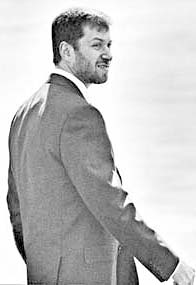 "Where did you find your wonderful stubble? The designer oligarch |
Christian Caryl (3), Newsweek, def. Anna Dolgov (7), AP
I almost felt bad for attacking Caryl in the past issue for having a partial byline on story describing Osama Bin Laden as the CEO of “Jihad.com”. Sure, he signed his name to it, which was bad enough, but it was more than possible that he didn’t write that particular line. For a brief moment I felt like I’d maybe given him a bad rap: maybe he wasn’t the dumb one, after all.
As it turned out, I didn’t need to worry. Here’s an excerpt from Caryl’s latest, single-bylined effort, a piece on the KGB museum in Moscow:
‘The Chekists were the members of Version 1.0 of the KGB, which was originally known, on its founding in 1918, as the Cheka (actually an abbreviation of its long and bureaucratic name, the “Extraordinary Commission for the Struggle against Sabotage and Counterrevolution”).’
“Version 1.0” of the KGB? Jesus Christ! This guy is a menace! In fact, I think there’s a “connection failure” to Caryl’s brain, which you can think of as the “Pentium processor” controlling his neurological system, which itself is like the “mainframe network”. I don’t know what’s more nauseating—Caryl thinking that he’s reaching out to his readers by using a software metaphor to describe a secret police force, or the fact that he’s probably succeeding. This is the “dumbing down” phenomenon in action: a magazine helping breed a generation of half-wits by turning the arena of public debate into a giant sandbox full of squeezable toys. Before long, magazines are going to come with labels: “Newsweek—For Ages 3 and up.”
Caryl always writes like this, however. Observe the lead to the Feb. 24 museum piece, adorned with the yuk-yuk title “No Kandinskys”:
‘You enter the KGB Museum through a cavernous, columned foyer adorned with a huge white bust of Feliks Dzerzhinsky, founder of the Soviet secret police.’
Hemingway used to write like this—quickly and to the point. “You enter the room through a door.” But what next? A mystery to you and me, but not to Caryl, who knew: stairs.
‘THEN YOU WALK up a flight of stairs, past a gold-leaf inscription reading “To the Chekists—Soldiers of the Revolution,” and meet the official guide, himself a long-time veteran of the old KGB, who refuses to give his name to visitors.’
One might be tricked into thinking this is just a friendly feature, but halfway down the piece we learn that there’s a timely aspect to the article in the Hanssen spy story. Caryl half-jokingly interrogates the museum tour guide about the story— which is of course absurd, not significantly unlike probing a White House tour guide for clues about Watergate:
‘When asked about Hanssen, the guide-with-no-name says, deadpan, “I don’t know anything about it and I won’t comment on it.”’
Later on in the article, the folksy door-opening and stair-climbing feature writer turns angry social critic, blasting the museum for not renouncing the violent legacies of Dzezhinsky, Beria, and the purges. He finishes with a passage excoriating the KGB for refusing to own up to its violent past and clinging to an “out-and-out lie”:
‘In short, what matters in the KGB Museum is neither old-style communist ideology nor modern-day democracy and human rights. The FSB and other Russian security services remain unencumbered by the kind of parliamentary oversight that puts at least some restraints on the work of their western equivalents, a point nowhere mentioned in the museum. Ask the guide about the Gulag, and he offers the Orwellian argument that “it bore no relation to us— that was part of the police.”
‘That’s an out-and-out lie, but it’s perfectly in line with the rewriting of history that’s back in vogue under Vladimir Putin, whose own autobiography contains some throw-away remarks about how “gently” the KGB treated dissidents.’
I don’t think there is a CIA museum, but if there is, I’d bet anything that there’d be nothing in there about Guatemalan death squads, massacres in South Vietnam, or any of the many other gentle humanitarian activities our secret services have been involved with over the years.
The thing about Newsweek is that it has no sense of shame; it never fails to write from the perspective of moral infallibility, as though America were intrinsically better than other places, and has no hidden skeletons of its own that it hasn’t owned up to. Imagine the absurdity of a writer for Izvestia angrily denouncing the CIA for its failure to own up for its crimes in Indochina, and then failing to mention the KGB’s own selective view of history.
The scale of the atrocities is different, of course, but a comparison is not totally inappropriate: we did kill millions of people in Indochina, and we are and have been for many years helping regimes like Turkey and Colombia and Guatemala and Indonesia and countless others massacre their own people. You’ll never read about this stuff in Newsweek: but you will get Christian Caryl blasting a little-visited KGB museum for not having enough zeroes in its kill figures.
Caryl’s enthusiasm for patriotic audience-massaging can be seen in virtually every article he writes. Here is a typical passage from another horrific piece he wrote recently, the March 5 “What the Russians Really Want”, about the Hanssen scandal. Here, he describes the happy bourgeois existence of Hanssen’s former KGB control, Viktor Cherkashin:
‘Today, Cherkashin, 69, is a prosperous Moscow businessman. He owns a big house in the suburbs and drives a light blue 1986 Chevrolet, a trophy car in the streets of Moscow.’
They must have taken Caryl straight from Sheremetyevo to his office on Kutuzovsky prospect, and not let him out since. There are more brand-new Mercedes on the streets of this city than there are in Germany. A trophy car in this city is a $600,000 armored Mercedes SUV, and even they are not all that rare. But to Caryl and to his idiot readers, this passage makes sense: of course any Russian would sacrifice his first-born for the chance to drive a 15 year-old Chevy. After all, it’s an American car! And “light blue” to boot! About the only thing better would be a pair of blue jeans, or a pack of Marlboros.
In comparison, Anna Dolgov’s March 1 “Russian Tycoon Quits Jewish Group” was a veritable beacon of truth and reason. She’s out; Caryl moves on to the Final Four with great momentum.
Rob Cottrell (2), Financial Times, def. Dave Montgomery, Knight-Ridder
For every N.C. State, there are a hundred Cal-Fullertons and Bowling Greens. The nature of the Cinderella is to not make it home on time. So much for the darling of the tournament, Dave Montgomery. You can’t ride to the Final Four in a pumpkin.
As noted above, Montgomery put in an unexceptional performance in this round. He failed mainly due to what basketball coaches would call “poor shot selection.” In general, there are three types of articles that the overseas hack is asked to send home. There is the news piece, the feature, and the analysis. Of these, by far the most dangerous pieces are the features and the analyses. In these the reporter is commonly asked to demonstrate both independence of thought and rhetorical skill, which can be a tricky proposition if you have neither.
With news articles, though, one can simply push out a jumble of facts in adjective-free lumps of text and be assured of not being too much farther off from the truth than one’s colleagues.
Montgomery in the last two weeks did exactly that, staying away from joyous romps through the Russian sex trade and visits to dull bookstores and simply filing news pieces about the recent spy scandals involving Russia. As noted in the comment about Wines, he even made a phone call or two in one of those stories, instantly removing him from contention for a Final Four spot.
In contrast, Cottrell of the Financial Times filed yet another ideology-laden analysis of the Russian political scene in his Feb. 21 piece, the elaborately-titled, “In search of a policy: Vladimir Putin’s energetic pursuit of diplomatic relations with a multitude of countries cannot disguise Russia’s lack of a clear sense of its own national interest.”
With such a broad topic and such ambitious aims, Cottrell faced many more potential intellectual pitfalls than did Montgomery, who was basically content for the last few weeks to sit tight and collect his paycheck.
It should be noted that Cottrell sent a seemingly friendly letter following the last issue, congratulating us on the “funny” description of our recent brush with lunch. However, he continued to insist that the lunch invitation was not given with the aim of getting out of the tournament, an insistence which we found, quite frankly, hurtful and unnecessary.
Therefore niceness notwithstanding, we were forced to take a close look at Cottrell’s latest efforts—and an unhappy experience it was. What made it even worse was the knowledge that it didn’t need to be this way. On the one hand, we could have put this all behind us two weeks ago, while on the other hand... well, Cottrell could have written a little bit better, on the other hand.
The crux of Cottrell’s piece is that, while Russia appears on the surface to be a major foreign policy player, with a President making the rounds with visits to the world’s most powerful governments, there is in fact less than “meets the eye”, as he writes here in his second paragraph:
‘But think in terms of foreign policy and there is less to all this activity than meets the eye. It is quantity rather than quality. If Russia does have consistent needs and objectives in the world, it is not explaining them clearly. Indeed, it is debatable whether Russia can be said to have a coherent foreign policy at all. This makes life difficult for the west [Heaven forbid! Ed.]: when Moscow flirts with “rogue states” on the one hand and offers partnership to Europe and the US on the other, which of these actions is to be believed?’
Sometimes it helps, when reading the press, to apply the cliche “five questions” of the reporting business to the articles themselves—who, what, where, when, and why? In this case the chief question that arose in my mind by the time I reached the end of the second paragraph was not what Cottrell was writing, but why he was writing it.
Let’s say, for argument’s sake, that Cottrell is right, that Russia is “not explaining” its consistent needs and objectives clearly, and that it is “debatable whether Russia can even be said to have a coherent foreign policy at all.” The prosecution is also willing in this case to stipulate the rest of the argument, already anticipated and certain to follow in the remainder of the piece, which will demonstrate that Russia is no longer the military or economic equal of the major Western powers, and doesn’t deserve the status of a major state that it currently enjoys. We’re willing to stipulate that as well, for the sake of argument.
So let’s say that that’s all true, that Russia is a backward pretender with no business even being considered a major power. So then what? What does that prove? And why bring it up? Should Russia be kicked out of the G-8? Cottrell never mentions such a proposal in his piece. Should Russia be nuked out of existence? No mention of that idea either. Should Russia just be ignored? Well, he does seem to say that— but then why give them this attention? Why spend so much time and effort to call for a country to be ignored? It doesn’t make sense.
Cottrell does go on to list several concrete examples of Russia’s growing inability to succeed in the arena of foreign policy. There is the following passage, describing Russia “coordination and preparation” problems:
‘The lack of a strong foreign ministry also means that diplomatic opportunities, even when they present themselves, are liable to be wasted through bad preparation or poor co-ordination.’
Then there is this one, which noted that the Russian-German summit avoided disaster only because of the determination of the Germans to make it a success:
‘Chancellor Gerhard Schroder’s visit to Moscow in January was rescued from failure only by the determination of Mr Schroder himself to declare it a success. So embarrassingly public were Russia’s hopes of winning some unilateral promise of foreign debt relief that the German government was obliged to issue a pre-emptive public statement, explaining that this could not possibly be the case.’
Again: why this passage? The piece so far reads like a straight analysis; there are even parts of the piece which suggest that Cottrell’s aim might be to give advice and encouragement to Russia with regard to its efforts to reform its foreign policy apparatus:
‘There are some signs that Mr Putin recognises the scale of the foreign Policy problem. On January 26 he visited the foreign ministry, which was an event in itself. Mr Yeltsin went only twice in nine years. This was Mr Putin’s first visit. He came with some criticisms and some instructions. He told the ministry to put more of its resources into economic matters. He said it should be working harder to improve conditions for Russian business overseas, especially on big projects where national interests were at stake. He told it to improve the quality of its consular work, saying not enough was being done to protect “the diaspora, Russian culture and the Russian language”.
But beyond this vague tone suggesting that Cottrell might be hoping to lend friendly advice, there is a stronger sense already that Cottrell, by describing Russia’s impotence to act and even decide for itself what it wants, is moving the reader in a direction where he will be ready to conclude that Russia has no legitimate foreign policy aims, and that it should be left to the West to fill the vacuum.
 A 1986 Chevy. Drive it in Moscow and you'll feel like a king |
This last suspicion is confirmed in the very last passage in the piece, where Cottrell reveals at last what he was getting at all this time:
‘Even that looks dubious. Mr Putin is a cautious man. He has plenty of other problems. And he has little need now of foreign admiration to shore up his position at home. So, in the circumstances, the new American administration may well be wise in its apparent view of Russia less as a subject for policy in its own right and more as a mere factor [emphasis added] in other policy domains such as weapons proliferation and Nato expansion. This sends the right message to Russia. In its present state it does matter to the rest of the world— but not nearly as much as it thinks.’
Translation: we should ignore whatever concerns Russia might have about NATO expansion and our response to questions of weapons proliferation, and simply proceed with our policies as though Russia was a “mere factor” to be considered in the West’s own internal dialogue, and not a partner who gets a place at the table in discussions about moves that will affect its interests.
The pattern of Cottrell’s piece is by now quite clear. Humiliate the country at great length in the body of the piece; argue away its concerns as being, ultimately, irrelevant or at least contradictory; and then, finally, call for a new policy which again puts the whole country on the other side of the fence, the fence that separates the countries that matter from the ones that simply have to respond to the moves of the world’s real actors, and make do as best they can.
We are going to be seeing a lot of pieces like this in the upcoming year, as a new policy of confrontationalism is gradually articulated by the West’s priests of mass communication. We deal with the Russia “factor” as we see fit; let Russia respond if she likes.
This is hardcore reactionary stuff, particularly given the fact that Russia was forced into many of its “contradictory” policies by the West itself. If Russia sells weapons to rogue states, that’s largely because the West has pushed hard to exclude the Russians from legitimate markets for military sales. It has also, with the aid of World Bank conversion programs, pushed to weaken the Russian military-industrial complex, destroying a large part of the country’s economy. Our own economic dependence on pseudosocialist subsisides of defense industries goes unquestioned, of course.
Furthermore, as far as “coherent” foreign policies go, the West has certainly been guilty of similar incoherence. We bomb Serbia for repressing its Albanian minority, but we support military allies like Turkey when they massacre their own Kurdish populations. We embraced, at least on the surface, Yeltsin’s CIS policy, then went out and romanced Ukraine as a possible NATO member. Which Western policy can be believed?
Cottrell has made an eloquent argument, but it is a bad argument. Its purpose is to dehumanize Russia and lessen its status in order to make an argument for expanded Western influence seem, even with regard to questions concerning Russia, the more reasonable and rational alternative. Homey don’t play that shit; Cottrell moves on to the Final Four as Britain’s only hope.
Next week: the Final Four!