VOTE OR LOOSE!!!
- March Madness continues
Both games were thrillers— instant hoop classics. No one has ever seen or will ever see a Final Four like it. Four journalists at their very worst. Two epic battles. Ten straight overtimes. Ten overtimes and counting, that is. As in— they’re still playing.
The remaining contestants in the eXile’s 2nd annual Worst Journalist Tourney are competing so fiercely that judging them on our own is no longer an option for us. The Final Four matchups were so close that we’ve been forced to turn the reins of the contest over to U, the reader.
 We often ask our readers to judge for themselves. Now we’re asking you to judge for us. The four hacks remaining in our March Madness tourney have been awful enough in the past two weeks— awful enough, in fact, that we can’t bring ourselves to yank any of them from the tournament. So we’ve decided to pussy out. The Final Four results will be determined you, the reader, in a poll taken on our internet site.
Have you suffered through one too many Michael Wines articles? Log on to www.exile.ru and vote for the New York Times bureau goblin. Does reading Newsweek make you reach involuntarily for the knife drawer? Log on and put Christian Caryl’s flabby magazine-writer neck on the chopping block. Think being born British isn’t punishment enough? Vote for Rob Cottrell of the Financial Times and make him play another round.
Here’s how this is going to work. All four hacks are going to be listed in the poll. You vote for the hack you want most to see in the Final. We’ll look at the results and put the top vote-getter in each bracket in the Final, which is slated to be held in the e-Start arena two weeks from today.
Vote freely and without hesitation. Your conscience should not in the slightest be affected by thoughts of the ghastly surprise which awaits the winner and which, to repeat the eXile’s “Service First” guarantee, we have been fiendishly planning for over two feverish months now. Don’t think about that at all. Whatever happens will not be your fault. It would have happened to someone anyway.
Who should you vote for? How did the contestants perform in this round? Ready your mouse and prepare to click; here’s how your candidates fared:
Michael Wines (1), New York Times, vs. Peter Baker, Washington Post (ppd., late)
Jack Tobin, the Fullbright scholar who was busted by the FSB for potsmoking in Voronezh last month and subsequently accused of being a spy-in-training, seems like a stand-up guy to us. at least, that’s what we thought when we met him last fall. Tobin came all the way up to Moscow from Voronezh to attend our shitty 100th issue party at Lexx. He won a t-shirt by naming the first seven prime numbers. He needed a haircut. We observed no listening devices on his person.
Therefore we were personally offended on behalf of a faithful reader when it came to our attention that Wines had screwed Tobin in print a few weeks ago. In his Feb. 28 piece entitled, “Russian drug arrest turns into spy case,” Wines wrote that Tobin had been caught in possession of a half-ounce of pot, and that an additional one and a half ounces were found in his apartment.
The amounts listed by Wines are more than fifteen times the size of the amounts Tobin was actually accused of possessing. In official statements and in most published reports, both in the English and in the Russian press, Tobin was reported to have possessed from 3 to 4.5 grams, not ounces, of pot. Ounces are not a standard measurement in Russia. Wines, whose preferred vice is said to be R-rated DVDs, probably wouldn’t be aware of these nuances.
Wines wrote a few other articles in the past few weeks. Among them was the March 13 piece, “Putin to Sell Arms and Nuclear Help to Iran.” This is a difficult subject to screw up, as even those of us inclined to hate the New York Times will be likely to agree that a military alliance between Vladimir Putin and Iran is probably not a good thing for humanity. The problem is the way Wines approaches the piece. Even with an ex-KGB dictator and a bunch of bomb-tossing towelheads as protagonists, he has to weight things heavily in favor of the American point of view. It starts in the lead:
‘MOSCOW, March 12— Breaking openly with both the United States and his predecessor Boris N. Yeltsin, President Vladimir V. Putin formally agreed today to resume sales of conventional arms to Iran after a hiatus of more than five years.’
Wines informs the reader right away that the most important aspect of this story is the fact that Russia is not only defying the United States, but doing so “openly”. The American reaction is also spliced into the second piece of information in the story, in the second paragraph:
‘At a meeting in the Kremlin with President Muhammad Khatami of Iran, Mr. Putin also reiterated Russia’s intention to help Iran complete a long-stalled nuclear power plant that some American experts contend could advance Iran’s nuclear weapons program.’
Wines cites American “experts” twice. He appears to be referring to the State Department and the CIA, the only two American sources cited specifically. In a later passage in the piece, Wines has his experts dismiss any and all innocent explanations of the nuclear-facility story:
‘The United States has argued that Iran has little need for new nuclear generating capacity and that the reactor could be used to aid what it says is Iran’s clandestine nuclear- weapons program.’
To you and me, it might seem odd that the United States should think itself in a position to determine who does and does not need a nuclear power plant. It doesn’t seem strange to Wines, who appears to find this perfectly natural. There is furthermore the phrase, “...what it says is Iran’s clandestine nuclear-weapons program.” Not what is a clandestine nuclear-weapons program, but what is Iran’s clandestine nuclear-weapons program. The language strongly suggests that the program’s existence is a matter of established fact, when it is not.
Here is another example of Times airbrushing, a passage explaining the history of Russian arms sales to Iran:
‘Russia sold some $5 billion in weapons to Iran from 1989 to 1995, in no small part for defense against President Saddam Hussein of Iraq and his army, which waged war against Iran for much of the 1980’s.’
added.
Wines here neglects to mention that the United States was the primary supplier to weapons to Saddam Hussein during that same period in the 1980s. It also fails to mention that the United States was secretly trading in weapons with Iran during the same time. The Wines version manages to vilify both Hussein and the Russians at the same time, while conveniently ignoring our own role in the arming of both sides of that conflict.
Then there is this passage:
‘Washington has quietly sought to improve relations with Iran but to little avail. Officially, Iran remains on a list of rogue nations that American experts believe could threaten the Middle East with nuclear or chemical weapons and ballistic missiles within a few years.’
You have to look at the whole historical context of the Iran story in order to understand what an extraordinary passage this is. Wines is not factually in error when he states that Iran is on America’s list of rogue states. The problem is with the very concept of our list of “rogue nations... that could threaten the Middle East.” The very idea is insane to anyone outside the United States.
Here you have the United States on the one hand which in 1953 engineered the overthrow of a sovereign Irani government, installing in its place the Shah Reza Pahlevi. For the next 25 years after that, the U.S.-backed Iranian government was one of the most brutal in the world, routinely listed by groups like Amnesty International as one of the world’s worst torturers and oppressors. During that same period, United States business interests milked the country for cheap oil while most of the population languished in poverty.
Then, after the U.S.-backed government was finally ousted in 1979, the United States turned right around and sent hundreds of millions of dollars worth of arms to Iran’s neighboring military enemy, Iraq, which attempted to conquer their country by force.
In the meantime, the United States coerced most of the world into following economic sanctions against Iran as a punishment for its “terrorist” activities, resulting in further poverty and misery for the population.
And at the end of all of this, the United States turns around and declares that Iran, not the United States, is the real threat to the Middle East! Can you imagine what this sounds like to an Iranian? I’m surprised they don’t hijack a plane a day!
Against all this background, Wines writes that ‘Washington has quietly sought to improve relations with Iran but to little avail.’ As though we’re the good guys, and the Iranians are the unreasonable ones, spurning the olive branch offered by enlightened European civilization. He enhances the impression of Iran as the unreasonable opponent of benevolent Western foreign policy aims when he writes, about Iran’s interest in the Russian weapons deal:
‘For its part, Iran finds an ally who shares many of its predilections, among them opposition to Turkey and expansion of NATO, and a desire to limit American influence in central Asia, where American- and Russian-backed oil pipelines are fiercely competing to control the flow of new finds in the Caspian Sea.’
The loaded word here is “predilections.” In the context of the politics of a formerly colonized people this is a very strange word to employ. ‘Predilection’ is a word that implies a habitual, and not necessarily rational, preference: it is the cousin of such words as presupposition, prejudice, and bias. You would never hear the Times describing South Africans as having a “predilection” to opposing white rule, or even the United States as having a “predilection” to opposing communism. Yet Iran is credited with a mere “predilection” with regard to its opposition to the expansion of NATO, the military alliance of its former imperial oppressors, as though it is only maintaining its stance out of habit and religious superstition.
Wines’s flippant treatment of Iran is in keeping with a long tradition at the Times. With regard to this story I would like to quote from a Times editorial published in 1953, after the U.S.-backed coup. The paper wrote then that the overthrow of the Mossadegh government “will be an object lesson to governments that go berserk with hysterical nationalism.”
That’s really what the paper wrote: that governments that get out of line should be taught a “lesson” by the United States. The sanctions and hysteria about rogue nations put forward by the U.S. today are just an extension of that old belief in our right to give “lessons” to whomever we want. Our press gives credence to this attitude by buying into the fear of rogue states on the one hand, while ignoring the mitigating factors of history on the other.
This is the context of Wines’s latest article. It’s garden-variety American press bullshit, but bullshit nonetheless.
Then there’s Peter Baker, David Hoffman’s replacement at the Washington Post, who’s beginning to look like he can really play in this league. He’s been a real bizzy little beever, this guy. In two weeks, he’s filed two “creaky Mir Space Station” stories and one “misguided Russian patriotism” story, in addition to co-authoring an account of the Fuhrer’s internet chat that ran under the excellent headline, “Putin Vows to Preserve Democracy.”
Half that output in the course of a month is normally enough to win a hack scout badge in this town. But Baker did twice the reps in half the time. You’ve gotta like the rookie’s enthusiasm.
Probably my favorite piece of the lot was the Feb. 12 “Russians Feel a Patriotic Push.” It’s hard not to warm up to a reporter who can write like this:
‘In Russia, patriotism has been a powerful force dating back to the early czars. It helped rally a nation to victory over Nazi Germany in what is still called the Great Patriotic War. But it has also been used to justify monstrous evils in the form of pogroms and Stalinism.’
Baker blows his cover here, reporting directly to his alien commanders instead of via the usual coded message sent through the Post’s readers. He sounds here like Mork from Ork in the end-of-the-show monologue:
“Orson, earthlings sometimes indulge in an emotion called ‘patriotism’. Under its influence, the patriotic earthling will begin to love his country so much that he will want to kill earthlings from other countries.”
“That’s very strange, Mork,” booms the offscreen voice of Orson. “Why should love make people want to kill?”
“Unclear, Orson,” says Baker. “That is just the way of these earthlings. Fascinating creatures, capable of love and hate at the same time...”
Mork from Ork returns later in the piece when Baker flashes the “Nano, nano” sign at a group of Russian college students and quizzes them about the earthling “patriotism” emotion:
‘To some cosmopolitan students at Moscow State University,’ he writes, ‘the notion of state-sponsored patriotism training is bewildering. They barely know what their parents went through and stare blankly when it is described to them.’
It doesn’t seem possible, but it sure appears that Baker is claiming here that he was the one who explained to these students “what their parents went through.” It seems too comical to be true: an American journalist shows up on a Russian college campus and takes it upon himself to be the first one to expose the students’ virgin minds to the horrors of their country’s communist past. Amazed by his knowledge, they stare blankly at him in reply, mesmerized by the shocking truth. If you’re not laughing yet, don’t bother reading on, because there’s nothing funnier coming.
To be fair, this is probably not what Baker meant when he wrote that passage. Most likely, he meant that the students he interviewed had no reaction when he brought up the purges. He just wrote it badly, making it sound as though he had revealed to them a previously-unknown truth.
Still, even taking Baker not for his literal meaning but for his intended meaning, he comes across as a lunatic. One can imagine the Russian version of the same report: “American students, unconcerned by the legacy of the Japanese internment camps, shrugged of this reporter’s questions and went on to their Eminem concert...”
Baker’s Mir stuff was your basic meat-and-potatoes exercise in jingoist gloating. The Mir was always the Western press’s favorite story here, and for good reason: it allowed reporters to describe at length the physical process of Russia’s collapse, while we Americans haven’t had a space thing blow up in years.
No Western reporter who ever covered Mir ever failed to explicitly draw out the metaphor for Russia’s societal disintegration, and Baker was not about to be the first exception:
‘The station has also become — particularly in its final days — a metaphor for Russia, the all-too-visible symbol of a pioneering space program humbled by the fall of the superpower that sponsored it. The blow to Russian pride has led to numerous protests in recent weeks, as well as a resolution by the lower house of parliament, the State Duma, begging the government to somehow save Mir, all to no avail.’
Returning to the theme of his “Misguided Patriotism” piece of a week before, Baker then goes on to demonstrate that, as far as Mir is concerned, there was never anything to be proud about in the first place. In the process, he uses the “Mir-as-broken-automobile” analogy, which has also been used by virtually every reporter in town at least a dozen times by now:
‘To others, though, the finale is overdue. U.S. officials have long urged Russia to discard Mir, which in its waning years often resembled a favorite old car that spent more time in the shop than on the road. NASA would prefer that Russia concentrate its meager resources on the international station.
‘“Mir is clearly seen by the Russians as the last remaining symbol of space glory,” said James Oberg, a former U.S. flight control engineer and author of several books on the Russian space program. “But it’s a delusional nostalgia. For all the robustness of Mir, the Soviets never figured out what to do with it outside of feel-good propaganda.”’
Well, hell, what did we do with the moon—put ski resorts on it? Feel-good propaganda is a lot of what space is about. And I’m sure there are plenty of scientists who will be happy to describe at length all the science that came out of Mir. It gave mankind its first long-term exposure to space travel, for one thing. The idea that Russians shouldn’t be nostalgic about Mir is ridiculous. You can bet that if the Mir was, say, British, we’d never the end of what a great thing it was. As it stands, they couldn’t even make a believable-looking model of a space station for Moonraker, let alone build a real one that actually functioned in space.
Then there’s this next bit, a classic piece of Washington Post reporting:
‘Japan and a number of South Pacific islands have expressed concern that a repeat of that experience could mean disaster. U.S. military and civilian space experts dismiss these worries as unwarranted, noting that large objects, from meteorites to spent rocket stages, regularly plow into Earth’s atmosphere unnoticed.’
Translation: “Some smaller countries had some concerns about being battered by space junk, but the United States said these concerns were the superstitious ravings of lesser peoples.”
Baker goes on to call Russia’s economy “decrepit” and gleefully point out that “once-proud Russia” is now taking “a subservient role to NASA.” He quotes a Russian analyst who uses the Mir story to introduce the theme of collapsing Russian industry and deflated morale in the military. He then wraps up his article by painstakingly pointing out how and when Mir is going to fall apart, describing how the station’s “insect-like” wings will burn up in the atmosphere and how the body will be chewed up into 25-kilogram chunks before crashing into the earth.
In short, he has as much fun with the story as the Soviets probably did when Skylab fell out of the sky during the ugly “malaise” years of the Carter administration, when it would have been easy to argue that America was falling apart along with its spaceships. Skyrocketing gas prices, inflation, the Ayatollah, disco... it all must have made a lot of sense to the editors of Pravda.
This matchup, like the other Final Four matchup, turned out to be too close for the eXile judges to call. One had Wines winning on his card, another had Baker, and a third—me—had it an even draw. I had Wines winning the first, second, third, fifth, eighth, and twelfth through fifteenth rounds, but scored two points against him for low blows. The knockdown on Baker’s “barely knew what their parents went through” passage I ruled a slip.
It will therefore be left to U, the eXile reader, to break the tie and determine the outcome of this matchup by voting for your choice. Again, log on to the eXile website at www.exile.ru and cast your vote in the poll section. It’s okay, we took down the Anna Kournikova thing. Winners will be announced one week from today. Vote now, time is running out...
Christian Caryl (3), Newsweek, vs Rob Cottrell (2), Financial Times (ppd., late)
Christian Caryl did not file in the last two weeks. I was prepared to give him, and Newsweek, an automatic pass out of the tournament on these grounds—until I saw the MacPhersons.
“Around the World With the MacPhersons” is a long-running Newsweek.com web feature which is now in its mind-boggling 32nd week. As you may guess from the clever title, it chronicles the adventures of a “typical American family” as it spends a year traveling the world.
The MacPhersons make lots of friends and meet lots of nice people. They see majestic animals and eat lots of interesting exotic food, although they do confess from time to time to missing the food back home. Their trip is not without its hazards: at one stage of their journey, in Africa, Daddy MacPherson’s laptop is stolen, and this casts a pall over the trip for a good three and a half columns. In South America, the family looks up at the sky and considers the hole in the ozone layer, which turns out to be a secondary problem to the issue of little Molly MacPherson’s teeth falling out. Here’s how Mommy MacPherson described that incident:
‘Perhaps the ozone hole had a mysterious influence upon Molly, who lost two baby teeth in two consecutive days. In a note under her pillow, she let us know that this time the jig on the Tooth Fairy was up. “Dear Mommy or Daddy,” she wrote. “For this molar that I have suffered over, I want U.S. dollars, not pesos. American dollars! Five bucks at the most. I will be heartily disappointed if I get three dollars. But four is OK. Love you! Molly.”’
Cute kid, huh? Sure she is. Just look at that picture. A darling little girl.
I literally shrieked out loud when I first saw the MacPherson family portrait. It took about a tenth of a second for my mind to put together the story behind the story, specifically to imagine the editor who pitched this concept to the Newsweek braintrust. I could see him looking at the MacPherson family pictures and clenching his fists in excitement, knowing that he had a winner on his hands, and then running with it straight to Corporate.
No doubt about it, this is the perfect Newsweek concept: beautiful, well-off American family travels the world, posing for big, toothy, portraits in front of all the great and mysterious monuments of foreign civilization. The sands of the Gobi: big teeth, big smiles. The South African outback: lost laptop and frowns. The Kashmiri wilderness: a comfy train ride, big smiles again. Boffo opportunites for product placement: fanny packs and Palm Pilots in every direction, always connected to a tooth-bearing MacPherson (Dad and son in Africa: ‘We have sped past a White Rhino whose proximity was such that we could have checked him for hemorrhoids—”A Kodak moment!” yelled Charlie, half-seriously’), cars, airlines, hotels... It’s ingenious, I don’t dispute that, but that doesn’t mean the person who thought this up shouldn’t have his brains dashed out with a hammer.
These are the people the news desk of Newsweek is making the world safe for. The magazine is apparently intent on giving us 52 consecutive weeks of MacPhersons travelling the corners of the earth to show us how great we have things at home. They remind me of Russians who say that the restaurants in Paris are nice, but they still prefer a good bowl of Russian pelmeni. Only Russians don’t have those teeth. Or those tans. Here’s another MacPherson passage, the family bored on a safari:
‘Molly didn’t even glance up from her book. Clearly, the goings-on in the imaginary world of Mordor were more exciting than the reality of Addo. That day, the final score was Tolkien 7, Africa 1: the baby warthogs were just too cute for Molly to pass by.’
Try this passage—a “Christmas poem” by Daddy MacPherson, about the lost laptop. Note the relentless product placement and the atrocious scanning:
‘Grinched in Cape Town
A poem by Malcolm MacPherson
T’was the night before Christmas
And all through our house
Only one creature was stirring.
And it wasn’t a mouse.
He came in through a window
With a mask on his eyes.
He had robbery in his heart.
Our Sony computer was his prize.
He was gone in a blink,
While we were still at midnight church.
Oh, what a horrid thing to do,
Leaving us like that in the lurch.
The Lord giveth and He taketh away,
We know.
But with no Vaio laptop to use,
We’ve still been dealt a low blow.
We loved our Sony
That we stored our photos on.
So, please, bear with us
Until from Cape Town we are gone!’
Somebody has to pay for this MacPherson business. Ideally, someone should die. I know one thing for sure: Christian Caryl is not getting out of this tournament yet. He has not filed for two weeks, but this foisting upon us of the Newsweek view of the world is a collective effort, and he is definitely part of the problem.
Take his last piece, the March 5, “What the Russians Really Want.” This is a classic piece of MacPhersonism. You see, it turns out that the Russians have been stealing our laptops, too:
‘In Putin-style espionage, ideology is out, and so are most acts of subversion aimed at the United States. What Russia needs now is information: military, technological and economic. Putin wants quick growth for Russia’s defense industry, sensing lucrative markets overseas. But he has written that it would take as many as 15 years for Russia to catch up with even the poorest countries in the West.
‘“Scientific institutes won’t be able to do it; it costs a lot of money,” says Jolanta Darczewska, a Polish expert on Russia’s intelligence establishment. “It’s better to steal—cheaper and faster.”’
There we were, minding our own business, reading our Tolkein and playing with our Sonys, and those Russians had to go and steal our technology because they’re too poor and too lazy to invent their own. There is no mention here of the fact that our own spy population in Russia has almost certainly doubled and tripled over the last ten years for the same reasons, and that our biggest multinationals—like Pratt and Whitney to Boeing—have been actively buying up seats on the boards of Russian defense contractors, in essence buying access to Russian technology.
But the MacPhersons will believe the Caryl version. They’ve lived it. Foreigners can be nice, but they’ll steal your stuff if you’re not careful. They’ll believe it the same way they’ll believe their ‘86 Chevy would be a pussy magnet on Tverskaya ultisa.
I was also amused by Newsweek’s reaction to angry reader response to its Growing Islam Menace piece, which had a partial Caryl byline. This was the the one which asked readers to think of Osama Bin Laden as the CEO of “Jihad.com”.
The magazine was apparently deluged with letters from outraged Muslims around the world, who sensibly argued that equating Islam with the actions of a few terrorists was equivalent to condemning all Christians for the actions of the KKK.
The response must have been tremendous, for Newsweek took the rare step of running not even a retraction, but an entire article which essentially apologized for demonizing the world’s Muslim population. Writer Zachary Karabell, who was the lead correspondent on the first Islam piece, answered readers’ concerns by travelling to Egypt and reporting that there were many nice Muslims there.
He also wrote, in essence, that the devotion to Islam was understandable in this part of the world, as the population devastated by economic problems clearly needs a “balm and a salve’. You’d never catch Newsweek calling Christianity a ‘balm and a salve’ for anything. Most Christians believe in the Bible because they think it’s the revealed Word of God, not because it’s an effective escape. They’re wrong, of course, but it is not currently acceptable in the American mainstream media to say otherwise.
You can, however, say what you like about the false and profane beliefs of other faiths, like Islam. Furthermore, Newsweek ignored the pleas by a number of letter writers to address the question of why so many Muslims think of America as the great Satan, or why there is anti-American terrorism at all in the first place. Instead, they ran yet another piece on the Bin Laden menace, this time providing further “evidence” linking him to the bombing of the USS Cole. Do these guys suck, or what?
Meanwhile, Rob (No Vida Loca) Cottrell of the Financial Times keeps plodding on. This guy is slippery, tough to get a grip on. As a basketball player, he reminds me a little of onetime Denver Nugget Alex English, who until the arrival of Michael Jordan was the perennial scoring leader in the NBA. English kind of loped around the court, never running that fast, practically never jumping at all. You got the sense that your mother could cover him. But you’d look at the box score the next morning, and he had 29 points every time. His money shot was a sixteen-foot drifting fall-away jumper. I can’t say I remember seeing English score even once, but I remember seeing those box scores a lot.
Cottrell’s latest big intellectual effort was his March 13 “Comment and Analysis” piece, entitled ‘Putin’s Daunting Agenda.’ This exact piece has been written at least four thousand times in the past sixteen years, since the beginning of Perestroika. In it, the Western reporter takes the Russian politician the West has placed its hopes on (Gorbachev, Yeltsin, Gaidar, Chubais, Chernomyrdin, Kiriyenko, Putin, Gref) and writes about the “daunting prospects” he faces in his attempts to put through “necessary” reforms. The reforms the Western reporter deems “necessary” are always the same: cut corporate taxes, relax import restrictions, reduce “public spending” (a euphemism for reducing social spending), end subsidies of all kinds, free up land ownership, and make the state “rolls” more “efficient”, i.e. fire unnecessary state workers.
Cottrell’s article is no different, but there are some passages in it which go far beyond even the hard-line neo-liberal rhetoric seen in most of these reports:
“Housing and communal reform is still on the drawing board. Most Russians still pay very little for their housing and utilities. A reform would oblige all households to pay market prices for rent and utilities, with subsidies targeted at the poor.”
This is an incredibly disingenuous piece of writing. As Cottrell surely knows, there is an energy crisis in Russia right now which is causing entire communities, particularly those in the far east, to literally freeze to death. His proposal is to solve the problem by making Russians pay “full market prices” for their energy.
Then he adds the caveat: “With subsidies targeted at the poor.” Which “poor” does he mean? I would estimate that about 95% of Russians cannot afford to pay market prices for heat. A similarly large number would not be able to pay market prices for rent.
Rent is a strange concept anyway in this country. The kvartplata I’m assuming he’s talking about is more like the building fee Westerners pay when they own a condominium. Housing has already been privatized in this country, meaning that the only subsidies involved are reduced rates for general upkeep of the common areas, and the buildings, which the state still owns. The apartments are owned by the residents themselves.
At the same time, Cottrell applauds measures on the table to reduce corporate profit taxes. He also proposes an end to all agricultural subsidies and the freeing up of agricultural land for sale, a reform which he concedes will meet powerful opposition by the people who actually live in these areas:
‘The farm sector will be a powerful lobby against such reform, meaning that Russia’s collective farms will probably cling on to existence, hopelessly inefficient as they are.’
You can substitute the phrase “the people who live on collective farms” for “collective farms”, and you’ll get a better sense of what Cottrell is talking about here. Collective farm workers oppose private ownership of agricultural land because they know exactly what it will mean: virtual serfdom at the hands of whatever Abramovich or Potanin becomes Russia’s land baron under the system. It sure as hell isn’t going to be the workers themselves who’ll be buying that land. You can ask workers at places like Norilsk Nickel why they wish their company had not been taken over by a mobster from the state. That’s if they’re well enough to answer.
We at the eXile may be strong people, but we are not strong enough to decide on our own to bounce either of these reporters from the tournament. For that, we’ll need your help. Neo-liberal mouthpiece Cottrell, or Macpherson advance guard Caryl? We can live with either decision.
Do your duty. Pull the cyber-lever at www.exile.ru. Finalists announced in one week’s time. The tournament’s winner— in two.
Next issue: The Worst Journalist in Moscow!
The remaining contestants in the eXile’s 2nd annual Worst Journalist Tourney are competing so fiercely that judging them on our own is no longer an option for us. The Final Four matchups were so close that we’ve been forced to turn the reins of the contest over to U, the reader.
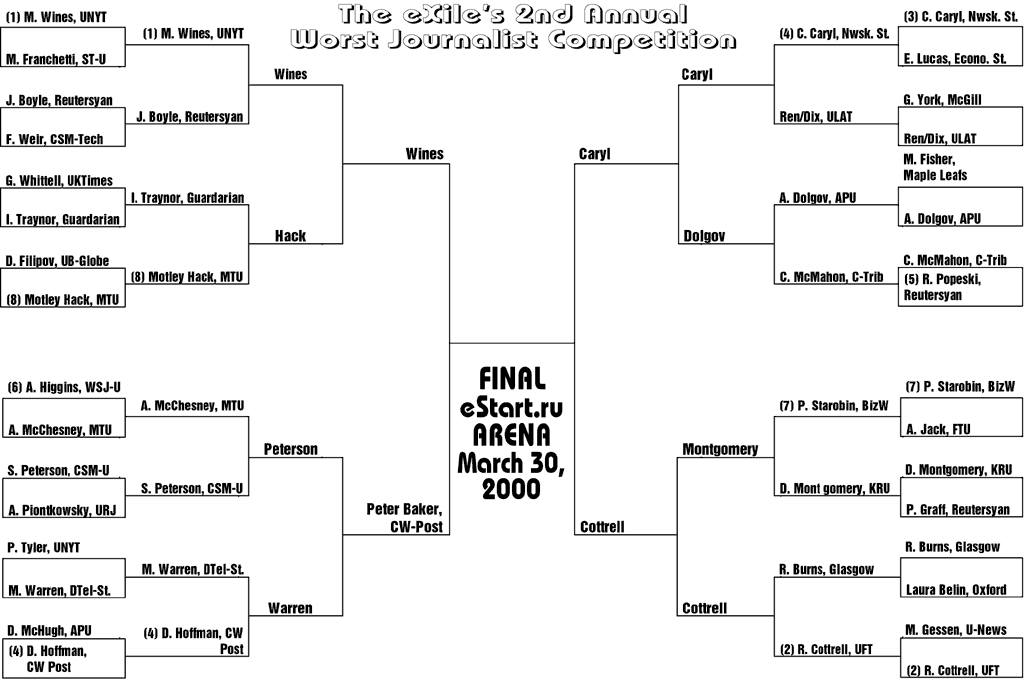 We often ask our readers to judge for themselves. Now we’re asking you to judge for us. The four hacks remaining in our March Madness tourney have been awful enough in the past two weeks— awful enough, in fact, that we can’t bring ourselves to yank any of them from the tournament. So we’ve decided to pussy out. The Final Four results will be determined you, the reader, in a poll taken on our internet site.
 Have you suffered through one too many Michael Wines articles? Log on to www.exile.ru and vote for the New York Times bureau goblin. Does reading Newsweek make you reach involuntarily for the knife drawer? Log on and put Christian Caryl’s flabby magazine-writer neck on the chopping block. Think being born British isn’t punishment enough? Vote for Rob Cottrell of the Financial Times and make him play another round.
Here’s how this is going to work. All four hacks are going to be listed in the poll. You vote for the hack you want most to see in the Final. We’ll look at the results and put the top vote-getter in each bracket in the Final, which is slated to be held in the e-Start arena two weeks from today.
Vote freely and without hesitation. Your conscience should not in the slightest be affected by thoughts of the ghastly surprise which awaits the winner and which, to repeat the eXile’s “Service First” guarantee, we have been fiendishly planning for over two feverish months now. Don’t think about that at all. Whatever happens will not be your fault. It would have happened to someone anyway.
Who should you vote for? How did the contestants perform in this round? Ready your mouse and prepare to click; here’s how your candidates fared:
|
Michael Wines (1), New York Times, vs. Peter Baker, Washington Post (ppd., late)
Jack Tobin, the Fullbright scholar who was busted by the FSB for potsmoking in Voronezh last month and subsequently accused of being a spy-in-training, seems like a stand-up guy to us. at least, that’s what we thought when we met him last fall. Tobin came all the way up to Moscow from Voronezh to attend our shitty 100th issue party at Lexx. He won a t-shirt by naming the first seven prime numbers. He needed a haircut. We observed no listening devices on his person.
Therefore we were personally offended on behalf of a faithful reader when it came to our attention that Wines had screwed Tobin in print a few weeks ago. In his Feb. 28 piece entitled, “Russian drug arrest turns into spy case,” Wines wrote that Tobin had been caught in possession of a half-ounce of pot, and that an additional one and a half ounces were found in his apartment.
The amounts listed by Wines are more than fifteen times the size of the amounts Tobin was actually accused of possessing. In official statements and in most published reports, both in the English and in the Russian press, Tobin was reported to have possessed from 3 to 4.5 grams, not ounces, of pot. Ounces are not a standard measurement in Russia. Wines, whose preferred vice is said to be R-rated DVDs, probably wouldn’t be aware of these nuances.
Wines wrote a few other articles in the past few weeks. Among them was the March 13 piece, “Putin to Sell Arms and Nuclear Help to Iran.” This is a difficult subject to screw up, as even those of us inclined to hate the New York Times will be likely to agree that a military alliance between Vladimir Putin and Iran is probably not a good thing for humanity. The problem is the way Wines approaches the piece. Even with an ex-KGB dictator and a bunch of bomb-tossing towelheads as protagonists, he has to weight things heavily in favor of the American point of view. It starts in the lead:
‘MOSCOW, March 12— Breaking openly with both the United States and his predecessor Boris N. Yeltsin, President Vladimir V. Putin formally agreed today to resume sales of conventional arms to Iran after a hiatus of more than five years.’
Wines informs the reader right away that the most important aspect of this story is the fact that Russia is not only defying the United States, but doing so “openly”. The American reaction is also spliced into the second piece of information in the story, in the second paragraph:
‘At a meeting in the Kremlin with President Muhammad Khatami of Iran, Mr. Putin also reiterated Russia’s intention to help Iran complete a long-stalled nuclear power plant that some American experts contend could advance Iran’s nuclear weapons program.’
Wines cites American “experts” twice. He appears to be referring to the State Department and the CIA, the only two American sources cited specifically. In a later passage in the piece, Wines has his experts dismiss any and all innocent explanations of the nuclear-facility story:
‘The United States has argued that Iran has little need for new nuclear generating capacity and that the reactor could be used to aid what it says is Iran’s clandestine nuclear- weapons program.’
To you and me, it might seem odd that the United States should think itself in a position to determine who does and does not need a nuclear power plant. It doesn’t seem strange to Wines, who appears to find this perfectly natural. There is furthermore the phrase, “...what it says is Iran’s clandestine nuclear-weapons program.” Not what is a clandestine nuclear-weapons program, but what is Iran’s clandestine nuclear-weapons program. The language strongly suggests that the program’s existence is a matter of established fact, when it is not.
Here is another example of Times airbrushing, a passage explaining the history of Russian arms sales to Iran:
‘Russia sold some $5 billion in weapons to Iran from 1989 to 1995, in no small part for defense against President Saddam Hussein of Iraq and his army, which waged war against Iran for much of the 1980’s.’
|

|
 Look no further if you want to know what the New York Times is all about.
 Then there is this passage:
‘Washington has quietly sought to improve relations with Iran but to little avail. Officially, Iran remains on a list of rogue nations that American experts believe could threaten the Middle East with nuclear or chemical weapons and ballistic missiles within a few years.’
You have to look at the whole historical context of the Iran story in order to understand what an extraordinary passage this is. Wines is not factually in error when he states that Iran is on America’s list of rogue states. The problem is with the very concept of our list of “rogue nations... that could threaten the Middle East.” The very idea is insane to anyone outside the United States.
Here you have the United States on the one hand which in 1953 engineered the overthrow of a sovereign Irani government, installing in its place the Shah Reza Pahlevi. For the next 25 years after that, the U.S.-backed Iranian government was one of the most brutal in the world, routinely listed by groups like Amnesty International as one of the world’s worst torturers and oppressors. During that same period, United States business interests milked the country for cheap oil while most of the population languished in poverty.
Then, after the U.S.-backed government was finally ousted in 1979, the United States turned right around and sent hundreds of millions of dollars worth of arms to Iran’s neighboring military enemy, Iraq, which attempted to conquer their country by force.
In the meantime, the United States coerced most of the world into following economic sanctions against Iran as a punishment for its “terrorist” activities, resulting in further poverty and misery for the population.
And at the end of all of this, the United States turns around and declares that Iran, not the United States, is the real threat to the Middle East! Can you imagine what this sounds like to an Iranian? I’m surprised they don’t hijack a plane a day!
Against all this background, Wines writes that ‘Washington has quietly sought to improve relations with Iran but to little avail.’ As though we’re the good guys, and the Iranians are the unreasonable ones, spurning the olive branch offered by enlightened European civilization. He enhances the impression of Iran as the unreasonable opponent of benevolent Western foreign policy aims when he writes, about Iran’s interest in the Russian weapons deal:
‘For its part, Iran finds an ally who shares many of its predilections, among them opposition to Turkey and expansion of NATO, and a desire to limit American influence in central Asia, where American- and Russian-backed oil pipelines are fiercely competing to control the flow of new finds in the Caspian Sea.’
The loaded word here is “predilections.” In the context of the politics of a formerly colonized people this is a very strange word to employ. ‘Predilection’ is a word that implies a habitual, and not necessarily rational, preference: it is the cousin of such words as presupposition, prejudice, and bias. You would never hear the Times describing South Africans as having a “predilection” to opposing white rule, or even the United States as having a “predilection” to opposing communism. Yet Iran is credited with a mere “predilection” with regard to its opposition to the expansion of NATO, the military alliance of its former imperial oppressors, as though it is only maintaining its stance out of habit and religious superstition.
Wines’s flippant treatment of Iran is in keeping with a long tradition at the Times. With regard to this story I would like to quote from a Times editorial published in 1953, after the U.S.-backed coup. The paper wrote then that the overthrow of the Mossadegh government “will be an object lesson to governments that go berserk with hysterical nationalism.”
That’s really what the paper wrote: that governments that get out of line should be taught a “lesson” by the United States. The sanctions and hysteria about rogue nations put forward by the U.S. today are just an extension of that old belief in our right to give “lessons” to whomever we want. Our press gives credence to this attitude by buying into the fear of rogue states on the one hand, while ignoring the mitigating factors of history on the other.
This is the context of Wines’s latest article. It’s garden-variety American press bullshit, but bullshit nonetheless.
Then there’s Peter Baker, David Hoffman’s replacement at the Washington Post, who’s beginning to look like he can really play in this league. He’s been a real bizzy little beever, this guy. In two weeks, he’s filed two “creaky Mir Space Station” stories and one “misguided Russian patriotism” story, in addition to co-authoring an account of the Fuhrer’s internet chat that ran under the excellent headline, “Putin Vows to Preserve Democracy.”
Half that output in the course of a month is normally enough to win a hack scout badge in this town. But Baker did twice the reps in half the time. You’ve gotta like the rookie’s enthusiasm.
Probably my favorite piece of the lot was the Feb. 12 “Russians Feel a Patriotic Push.” It’s hard not to warm up to a reporter who can write like this:
‘In Russia, patriotism has been a powerful force dating back to the early czars. It helped rally a nation to victory over Nazi Germany in what is still called the Great Patriotic War. But it has also been used to justify monstrous evils in the form of pogroms and Stalinism.’
Baker blows his cover here, reporting directly to his alien commanders instead of via the usual coded message sent through the Post’s readers. He sounds here like Mork from Ork in the end-of-the-show monologue:
“Orson, earthlings sometimes indulge in an emotion called ‘patriotism’. Under its influence, the patriotic earthling will begin to love his country so much that he will want to kill earthlings from other countries.”
“That’s very strange, Mork,” booms the offscreen voice of Orson. “Why should love make people want to kill?”
“Unclear, Orson,” says Baker. “That is just the way of these earthlings. Fascinating creatures, capable of love and hate at the same time...”
|

‘To some cosmopolitan students at Moscow State University,’ he writes, ‘the notion of state-sponsored patriotism training is bewildering. They barely know what their parents went through and stare blankly when it is described to them.’
It doesn’t seem possible, but it sure appears that Baker is claiming here that he was the one who explained to these students “what their parents went through.” It seems too comical to be true: an American journalist shows up on a Russian college campus and takes it upon himself to be the first one to expose the students’ virgin minds to the horrors of their country’s communist past. Amazed by his knowledge, they stare blankly at him in reply, mesmerized by the shocking truth. If you’re not laughing yet, don’t bother reading on, because there’s nothing funnier coming.
To be fair, this is probably not what Baker meant when he wrote that passage. Most likely, he meant that the students he interviewed had no reaction when he brought up the purges. He just wrote it badly, making it sound as though he had revealed to them a previously-unknown truth.
Still, even taking Baker not for his literal meaning but for his intended meaning, he comes across as a lunatic. One can imagine the Russian version of the same report: “American students, unconcerned by the legacy of the Japanese internment camps, shrugged of this reporter’s questions and went on to their Eminem concert...”
Baker’s Mir stuff was your basic meat-and-potatoes exercise in jingoist gloating. The Mir was always the Western press’s favorite story here, and for good reason: it allowed reporters to describe at length the physical process of Russia’s collapse, while we Americans haven’t had a space thing blow up in years.
No Western reporter who ever covered Mir ever failed to explicitly draw out the metaphor for Russia’s societal disintegration, and Baker was not about to be the first exception:
‘The station has also become — particularly in its final days — a metaphor for Russia, the all-too-visible symbol of a pioneering space program humbled by the fall of the superpower that sponsored it. The blow to Russian pride has led to numerous protests in recent weeks, as well as a resolution by the lower house of parliament, the State Duma, begging the government to somehow save Mir, all to no avail.’
Returning to the theme of his “Misguided Patriotism” piece of a week before, Baker then goes on to demonstrate that, as far as Mir is concerned, there was never anything to be proud about in the first place. In the process, he uses the “Mir-as-broken-automobile” analogy, which has also been used by virtually every reporter in town at least a dozen times by now:
‘To others, though, the finale is overdue. U.S. officials have long urged Russia to discard Mir, which in its waning years often resembled a favorite old car that spent more time in the shop than on the road. NASA would prefer that Russia concentrate its meager resources on the international station.
‘“Mir is clearly seen by the Russians as the last remaining symbol of space glory,” said James Oberg, a former U.S. flight control engineer and author of several books on the Russian space program. “But it’s a delusional nostalgia. For all the robustness of Mir, the Soviets never figured out what to do with it outside of feel-good propaganda.”’
Well, hell, what did we do with the moon—put ski resorts on it? Feel-good propaganda is a lot of what space is about. And I’m sure there are plenty of scientists who will be happy to describe at length all the science that came out of Mir. It gave mankind its first long-term exposure to space travel, for one thing. The idea that Russians shouldn’t be nostalgic about Mir is ridiculous. You can bet that if the Mir was, say, British, we’d never the end of what a great thing it was. As it stands, they couldn’t even make a believable-looking model of a space station for Moonraker, let alone build a real one that actually functioned in space.
Then there’s this next bit, a classic piece of Washington Post reporting:
‘Japan and a number of South Pacific islands have expressed concern that a repeat of that experience could mean disaster. U.S. military and civilian space experts dismiss these worries as unwarranted, noting that large objects, from meteorites to spent rocket stages, regularly plow into Earth’s atmosphere unnoticed.’
Translation: “Some smaller countries had some concerns about being battered by space junk, but the United States said these concerns were the superstitious ravings of lesser peoples.”
Baker goes on to call Russia’s economy “decrepit” and gleefully point out that “once-proud Russia” is now taking “a subservient role to NASA.” He quotes a Russian analyst who uses the Mir story to introduce the theme of collapsing Russian industry and deflated morale in the military. He then wraps up his article by painstakingly pointing out how and when Mir is going to fall apart, describing how the station’s “insect-like” wings will burn up in the atmosphere and how the body will be chewed up into 25-kilogram chunks before crashing into the earth.
In short, he has as much fun with the story as the Soviets probably did when Skylab fell out of the sky during the ugly “malaise” years of the Carter administration, when it would have been easy to argue that America was falling apart along with its spaceships. Skyrocketing gas prices, inflation, the Ayatollah, disco... it all must have made a lot of sense to the editors of Pravda.
This matchup, like the other Final Four matchup, turned out to be too close for the eXile judges to call. One had Wines winning on his card, another had Baker, and a third—me—had it an even draw. I had Wines winning the first, second, third, fifth, eighth, and twelfth through fifteenth rounds, but scored two points against him for low blows. The knockdown on Baker’s “barely knew what their parents went through” passage I ruled a slip.
It will therefore be left to U, the eXile reader, to break the tie and determine the outcome of this matchup by voting for your choice. Again, log on to the eXile website at www.exile.ru and cast your vote in the poll section. It’s okay, we took down the Anna Kournikova thing. Winners will be announced one week from today. Vote now, time is running out...
|
Christian Caryl did not file in the last two weeks. I was prepared to give him, and Newsweek, an automatic pass out of the tournament on these grounds—until I saw the MacPhersons.
“Around the World With the MacPhersons” is a long-running Newsweek.com web feature which is now in its mind-boggling 32nd week. As you may guess from the clever title, it chronicles the adventures of a “typical American family” as it spends a year traveling the world.
The MacPhersons make lots of friends and meet lots of nice people. They see majestic animals and eat lots of interesting exotic food, although they do confess from time to time to missing the food back home. Their trip is not without its hazards: at one stage of their journey, in Africa, Daddy MacPherson’s laptop is stolen, and this casts a pall over the trip for a good three and a half columns. In South America, the family looks up at the sky and considers the hole in the ozone layer, which turns out to be a secondary problem to the issue of little Molly MacPherson’s teeth falling out. Here’s how Mommy MacPherson described that incident:
‘Perhaps the ozone hole had a mysterious influence upon Molly, who lost two baby teeth in two consecutive days. In a note under her pillow, she let us know that this time the jig on the Tooth Fairy was up. “Dear Mommy or Daddy,” she wrote. “For this molar that I have suffered over, I want U.S. dollars, not pesos. American dollars! Five bucks at the most. I will be heartily disappointed if I get three dollars. But four is OK. Love you! Molly.”’
Cute kid, huh? Sure she is. Just look at that picture. A darling little girl.
|

No doubt about it, this is the perfect Newsweek concept: beautiful, well-off American family travels the world, posing for big, toothy, portraits in front of all the great and mysterious monuments of foreign civilization. The sands of the Gobi: big teeth, big smiles. The South African outback: lost laptop and frowns. The Kashmiri wilderness: a comfy train ride, big smiles again. Boffo opportunites for product placement: fanny packs and Palm Pilots in every direction, always connected to a tooth-bearing MacPherson (Dad and son in Africa: ‘We have sped past a White Rhino whose proximity was such that we could have checked him for hemorrhoids—”A Kodak moment!” yelled Charlie, half-seriously’), cars, airlines, hotels... It’s ingenious, I don’t dispute that, but that doesn’t mean the person who thought this up shouldn’t have his brains dashed out with a hammer.
These are the people the news desk of Newsweek is making the world safe for. The magazine is apparently intent on giving us 52 consecutive weeks of MacPhersons travelling the corners of the earth to show us how great we have things at home. They remind me of Russians who say that the restaurants in Paris are nice, but they still prefer a good bowl of Russian pelmeni. Only Russians don’t have those teeth. Or those tans. Here’s another MacPherson passage, the family bored on a safari:
‘Molly didn’t even glance up from her book. Clearly, the goings-on in the imaginary world of Mordor were more exciting than the reality of Addo. That day, the final score was Tolkien 7, Africa 1: the baby warthogs were just too cute for Molly to pass by.’
Try this passage—a “Christmas poem” by Daddy MacPherson, about the lost laptop. Note the relentless product placement and the atrocious scanning:
|
A poem by Malcolm MacPherson
T’was the night before Christmas
And all through our house
Only one creature was stirring.
And it wasn’t a mouse.
He came in through a window
With a mask on his eyes.
He had robbery in his heart.
Our Sony computer was his prize.
He was gone in a blink,
While we were still at midnight church.
Oh, what a horrid thing to do,
Leaving us like that in the lurch.
The Lord giveth and He taketh away,
We know.
But with no Vaio laptop to use,
We’ve still been dealt a low blow.
We loved our Sony
That we stored our photos on.
So, please, bear with us
Until from Cape Town we are gone!’
Somebody has to pay for this MacPherson business. Ideally, someone should die. I know one thing for sure: Christian Caryl is not getting out of this tournament yet. He has not filed for two weeks, but this foisting upon us of the Newsweek view of the world is a collective effort, and he is definitely part of the problem.
Take his last piece, the March 5, “What the Russians Really Want.” This is a classic piece of MacPhersonism. You see, it turns out that the Russians have been stealing our laptops, too:
‘In Putin-style espionage, ideology is out, and so are most acts of subversion aimed at the United States. What Russia needs now is information: military, technological and economic. Putin wants quick growth for Russia’s defense industry, sensing lucrative markets overseas. But he has written that it would take as many as 15 years for Russia to catch up with even the poorest countries in the West.
‘“Scientific institutes won’t be able to do it; it costs a lot of money,” says Jolanta Darczewska, a Polish expert on Russia’s intelligence establishment. “It’s better to steal—cheaper and faster.”’
There we were, minding our own business, reading our Tolkein and playing with our Sonys, and those Russians had to go and steal our technology because they’re too poor and too lazy to invent their own. There is no mention here of the fact that our own spy population in Russia has almost certainly doubled and tripled over the last ten years for the same reasons, and that our biggest multinationals—like Pratt and Whitney to Boeing—have been actively buying up seats on the boards of Russian defense contractors, in essence buying access to Russian technology.
But the MacPhersons will believe the Caryl version. They’ve lived it. Foreigners can be nice, but they’ll steal your stuff if you’re not careful. They’ll believe it the same way they’ll believe their ‘86 Chevy would be a pussy magnet on Tverskaya ultisa.
I was also amused by Newsweek’s reaction to angry reader response to its Growing Islam Menace piece, which had a partial Caryl byline. This was the the one which asked readers to think of Osama Bin Laden as the CEO of “Jihad.com”.
The magazine was apparently deluged with letters from outraged Muslims around the world, who sensibly argued that equating Islam with the actions of a few terrorists was equivalent to condemning all Christians for the actions of the KKK.
The response must have been tremendous, for Newsweek took the rare step of running not even a retraction, but an entire article which essentially apologized for demonizing the world’s Muslim population. Writer Zachary Karabell, who was the lead correspondent on the first Islam piece, answered readers’ concerns by travelling to Egypt and reporting that there were many nice Muslims there.
He also wrote, in essence, that the devotion to Islam was understandable in this part of the world, as the population devastated by economic problems clearly needs a “balm and a salve’. You’d never catch Newsweek calling Christianity a ‘balm and a salve’ for anything. Most Christians believe in the Bible because they think it’s the revealed Word of God, not because it’s an effective escape. They’re wrong, of course, but it is not currently acceptable in the American mainstream media to say otherwise.
You can, however, say what you like about the false and profane beliefs of other faiths, like Islam. Furthermore, Newsweek ignored the pleas by a number of letter writers to address the question of why so many Muslims think of America as the great Satan, or why there is anti-American terrorism at all in the first place. Instead, they ran yet another piece on the Bin Laden menace, this time providing further “evidence” linking him to the bombing of the USS Cole. Do these guys suck, or what?
Meanwhile, Rob (No Vida Loca) Cottrell of the Financial Times keeps plodding on. This guy is slippery, tough to get a grip on. As a basketball player, he reminds me a little of onetime Denver Nugget Alex English, who until the arrival of Michael Jordan was the perennial scoring leader in the NBA. English kind of loped around the court, never running that fast, practically never jumping at all. You got the sense that your mother could cover him. But you’d look at the box score the next morning, and he had 29 points every time. His money shot was a sixteen-foot drifting fall-away jumper. I can’t say I remember seeing English score even once, but I remember seeing those box scores a lot.
Cottrell’s latest big intellectual effort was his March 13 “Comment and Analysis” piece, entitled ‘Putin’s Daunting Agenda.’ This exact piece has been written at least four thousand times in the past sixteen years, since the beginning of Perestroika. In it, the Western reporter takes the Russian politician the West has placed its hopes on (Gorbachev, Yeltsin, Gaidar, Chubais, Chernomyrdin, Kiriyenko, Putin, Gref) and writes about the “daunting prospects” he faces in his attempts to put through “necessary” reforms. The reforms the Western reporter deems “necessary” are always the same: cut corporate taxes, relax import restrictions, reduce “public spending” (a euphemism for reducing social spending), end subsidies of all kinds, free up land ownership, and make the state “rolls” more “efficient”, i.e. fire unnecessary state workers.
Cottrell’s article is no different, but there are some passages in it which go far beyond even the hard-line neo-liberal rhetoric seen in most of these reports:
“Housing and communal reform is still on the drawing board. Most Russians still pay very little for their housing and utilities. A reform would oblige all households to pay market prices for rent and utilities, with subsidies targeted at the poor.”
This is an incredibly disingenuous piece of writing. As Cottrell surely knows, there is an energy crisis in Russia right now which is causing entire communities, particularly those in the far east, to literally freeze to death. His proposal is to solve the problem by making Russians pay “full market prices” for their energy.
Then he adds the caveat: “With subsidies targeted at the poor.” Which “poor” does he mean? I would estimate that about 95% of Russians cannot afford to pay market prices for heat. A similarly large number would not be able to pay market prices for rent.
Rent is a strange concept anyway in this country. The kvartplata I’m assuming he’s talking about is more like the building fee Westerners pay when they own a condominium. Housing has already been privatized in this country, meaning that the only subsidies involved are reduced rates for general upkeep of the common areas, and the buildings, which the state still owns. The apartments are owned by the residents themselves.
At the same time, Cottrell applauds measures on the table to reduce corporate profit taxes. He also proposes an end to all agricultural subsidies and the freeing up of agricultural land for sale, a reform which he concedes will meet powerful opposition by the people who actually live in these areas:
‘The farm sector will be a powerful lobby against such reform, meaning that Russia’s collective farms will probably cling on to existence, hopelessly inefficient as they are.’
You can substitute the phrase “the people who live on collective farms” for “collective farms”, and you’ll get a better sense of what Cottrell is talking about here. Collective farm workers oppose private ownership of agricultural land because they know exactly what it will mean: virtual serfdom at the hands of whatever Abramovich or Potanin becomes Russia’s land baron under the system. It sure as hell isn’t going to be the workers themselves who’ll be buying that land. You can ask workers at places like Norilsk Nickel why they wish their company had not been taken over by a mobster from the state. That’s if they’re well enough to answer.
We at the eXile may be strong people, but we are not strong enough to decide on our own to bounce either of these reporters from the tournament. For that, we’ll need your help. Neo-liberal mouthpiece Cottrell, or Macpherson advance guard Caryl? We can live with either decision.
Do your duty. Pull the cyber-lever at www.exile.ru. Finalists announced in one week’s time. The tournament’s winner— in two.
Next issue: The Worst Journalist in Moscow!