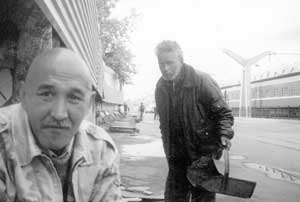
OUT ON BAIL: Timur (left) enjoys a breath of fresh air after escaping the cops.
Boris (right) looks on.
|
OUT ON BAIL: Timur (left) enjoys a breath of fresh air after escaping the cops. |
8:46 p.m... It's Wednesday night here at the eXile and I only have about seven or maybe eight hours to write this lead piece. Finishing any later than five in the morning would be a disaster. Finishing any later than seven would virtually guarantee a missed deadline, which will result in my having to deliver the films for the issue to the printing press in person, rather than go straight home to sleep as soon as we've finished the design.
This is an unacceptable option, because I've barely slept in the past two days. Most of that time I've spent disgustingly drunk and wandering the streets near the "Tri Vokzala" train station area, comprising the Leningradsky, Yaroslavsky and Kazansky stations. My professional clown friend Alexei and I had gone there with the idea of drawing a "map" of the area-- not a geographical map, but a zoological one, a habitat map, describing the natural environment of the dozens of homeless people living in the area. We were after all the crucial intelligence: where to piss, where to sleep, how to scare up beer money, how to get by without either a passport or an excuse for not having one in a place teeming with vicious police, how to get enough out of the most miserable life this city has to offer to make lying down on the train tracks not seem like the best idea you'll have on any given morning. A basic idea: Russia on no dollars a day.
The only problem is, doing this kind of story correctly requires getting into the spirit of things. In other words, beer in massive quantities. The conversations don't make any sense without it, and you need something to drown out the smell and the filth. A sober person does not sit in a puddle at four in the morning and allow a man with six green teeth and two scabby black eyes the size of golf balls kiss him on the forehead. Yet there's no way to understand life in a train station without going through this stuff.
So we did. The problem is that my head now hurts so much that I can barely even look at the screen. I've used every anti-hangover trick in the book in the last few days; I dissolved eight "Efferalgan" tablets in a 0.6 l bottle of Diet Coke and drank it before I went to sleep; I woke up in the middle of the night and puked; I ate chicken soup this morning; but it hasn't been enough. Now I'm staring at this deadline and I know the piece has to get done, but I just can't bring myself to do it. Worse, I just read Ames's article on the Pearl Harbor movie, and it doesn't make any sense at all. I mean, we won World War II. We won it so big that at the end of it we ruled the entire world... But enough about that. At least I'm indoors. Living outside sucks.
Alexei has very little trouble making friends drunk or sober. His permanent job is as a stage actor at the Moscow Clown theater, but he moonlights doing home visits as an on-call clown for the birthday parties of rich children. The parents of these kids tend to by very trying people, impatient owners of multiple jacuzzis who spend most of their time away from home getting fitted for suits or doing business deals in Tel-Aviv, but who'll make an exception for their child's birthday. They hire a clown for the occasion, and for those three hours everything has to be right, because this is THEIR special time with their children, and God help the middle-aged actor if he doesn't earn every ruble of his shitty $50 fee. Everybody has to have a good time, or else. Where he finds the patience to not only deal with these parents, but charm them, and then still have money left over to entertain a pack of screeching little kids-- I don't know how he manages it. Mainly, I think, he drinks a lot in his spare time. But however he does it, he always comes across as the world's friendliest man whenever he needs to, and it doesn't even seem to take a lot out of him.
We arrived at Leningradsky Station for the first time late on a Wednesday evening last week. My plan was to down a few drinks and get nice and comfortable before settling down to the business of finding a place to stay for the evening. I don't really like to talk to anyone sober, not even my own parents. Alexei was having none of this. No sooner had we cracked open our first beers than he started chatting up a very severely beaten man in his mid-fifties. His name was Slava and, like a lot of the homeless people at the station, he was a veteran-- Afghanistan, Angola, Chad. He said he was a marine who had worked in Army intelligence. He wore a camouflage jacket-- his own-- and gray pants that were covered in piss stains on the front. Between his eyes was a massive bruise; the whole bridge of his nose was covered with congealed blood. Both his eye sockets were jet black. The police had beaten him the day before.
"You want a beer, commander?" Alexei asked.
There are some questions which one doesn't need to wait for an answer to. We got him his beer and started to talk. He explained his situation. We were standing right next to the outdoor public toilet on the northeast corner of the Leningrad station-and area right between the last tracks from the Leningrad station and the first on the Yaroslavsky station. About 200 meters down the imaginary border between the two stations is one of the most important places on the whole territory for homeless people-- the 24-hour bottle return stand. There are bottle return centers all over the station during the day, but only one works all the way through the night, and if you park yourself outside it, you will see virtually the entire homeless population of the three stations approach in turns throughout the night.
The problem is that in order to get to the bottle return center, you have to walk through a small alleyway that contains, on one side of it, a small police station. At any time throughout the night, there is always one and usually two policemen standing in this small alley between the station and the bottle return center. The alley is only fifteen feet wide at the widest point. The result is a natural phenomenon not unlike the Alaskan salmon runs that pass through narrow river junctions packed with Kodiak bear. The homeless-- in Russian bomzhi, or people of undetermined place of residence-- have to pass through in order to make enough money to stay drunk. But if their documents are not entirely in order, which is the case for most of the homeless here, they risk being thrown in a cage every time they pass.
Slava's documents were in order-- he had a registration and a military ID-- but he was also such a hopeless street case that for him there was no such thing as a meeting with the police without risk. The beating the previous day was proof of that. He claimed that that happened "just because"-- he was walking around late at night, minding his own business, he said, when two cops jumped on him and started working out on his face. The phrase he used to describe the reason behind the attack was one I'd hear a lot in the upcoming days. "It's like training for them," he said. "Just practice."
Another common expression used when describing police attacks was they they were done, "dlya profilaktika"-- as a prophylactic. "They beat you in advance, for what you haven't done yet," one man explained to me.
I ended up having more contacts with the police in my few days at the train station than I have in total in Russia in the past few years. The reaction among police to my presence in a drunken group of homeless people was always the same: "What, you don't have any bomzhi in America? Had to come over here?" To which I'd always answer by making some kind of joke, trying to keep the situation light. Then one night I was asked by a tall cop what the police were like in America. Did American cops beat people? Sure, I said, just to say it, all the time. They beat everybody left and right, I said. Nightstick first, questions later. Asserting the opposite would have invited an argument, I knew. The answer satisfied the cop.
"Yeah, that's what I figured," he laughed. "Here, it's the opposite. We ask questions first, then we go for the nightsticks."
Har, har. In any case Slava, before we came along, was plotting his move to the bottle return place. He had a bag with about ten bottles in it already and the sun hadn't even completely gone down yet. The common 0.5 liter beer bottles bring a ruble apiece, which means that a decent day's work can bring a good twenty or thirty rubles, if not more-- more than enough to get a bottle of some kind of liquor (off the territory of the train station, of course-- hard alcohol is no longer sold at the stations), a big roll or a loaf of bread, and maybe even some sour cream.
The homeless aren't the only ones who collect bottles. Throughout the train station you will come across tidy-looking old women carrying plastic bags full of bottles. Most of these women are pensioners who are out earning extra money for their families. Two women Alexei and I met actually came into Moscow regularly on the elektrichki commuter trains from far out of town to scrounge around for an extra thirty rubles a day. Considering that the pension in Russia now is only about 800 rubles, the bottle-collecting can turn into a relatively good haul for these elderly people. But it's hard work and they have a lot of competition.
All the bomzhi have different strategies for finding places to sleep. Slava's is very simple. With his veteran's ID he can travel on the elektrichki for free. So what he does is hop on a train to anywhere once a night, ride supine all the way to the end, and ride back. Everybody has his own racket. For instance, on the other side of the Leningradsky station, that is to say on the West side, there is another long alleyway beyond the station parking lot. Along one edge of the driveway there is a space where porter-carts are parked at the end of the day. Next to these carts are a pair of makeshift wooden benches that are typically surrounded by huge garbage piles-- places where the station janitors dump their trash.
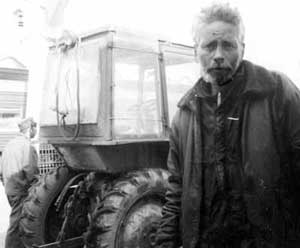
QUID PRO QUO: Boris cleans up while trash collector chills |
The benches and the area around them are a popular sleeping spot. They wouldn't be, if not for the fact that they are obscured from public view at night by the tractors which pull the garbage-dumpster bins. These tractors park at a diagonal to the wall of the neighboring Customs building, leaving a space behind them for the benches.
This set of affairs is the result of a series of unspoken agreements that exist between the police, the garbage collectors, and the bomzhi. The police as a rule tend not to care where the bomzhi sleep, so long as they don't do it out in the open. The tractors take care of that problem, and so the tractor-operators, who purposefully park their tractors so as to provide a shelter for the bomzhi, are square with the police on that score. The garbage collectors, meanwhile, allow the bomzhi that shelter because the bomzhi do a service for them. Technically, cleaning the garbage on that street is their job. But instead of picking up the garbage themselves, what they do is park the tractors in the middle of the driveway late every afternoon and take off for a break. In the meantime, the bomzhi pick up the garbage on the street, using brooms and dustpans provided for them by the garbage collectors.
Boris, shown in the photo on this page, has been sleeping on these benches for eight years. He seldom moves very far from his sleeping spot. He cleans the garbage every day, and in return gets his spot at night. In the winters he sometimes sleeps inside the tractors.
"Send me a copy of the newspaper when it comes out," he said to me.
"Sure," I said. "To what address?"
"Just write 'Hell' on the envelope," he laughed.
Another popular place to sleep is under a pipe beyond track number one at the Yaroslavsky station. Go along there at any time during the day and you'll find three or four people asleep there. The area is always covered with garbage. The main advantage of "the pipe" is that it's far enough away and out of sight--partially covered by trees-- that the police don't bother people there.
A luxury spot is a berth in a parked train. There is a rail yard about two kilometers north of the Leningradsky stations where both long-distance trains and elektrichki park for the night. Bomzhi who can make it there and who have a little money to spend can sleep in a still, clean, quiet, warm vehicle for 50 rubles a night. According to Boris, it was 20 rubles until last year, when the price suddenly shot up.
Only two types of bomzhi sleep outdoors-- those who have no papers, and those who are so far gone that their very presence is unacceptable inside any building. The bomzhi in Moscow who have registrations and who don't look or smell too bad can actually make their way into metro stations or even the waiting rooms at the Leningrad stations and spend the night there without being hassled by police. Leningradsky is the only of the three stations where you can get away with this, however. Kazansky is the strictest of the three stations by far-- the bomzhi don't even like to stand there. As for spending the night, no way.
Slava at first was deeply suspicious of the both of us, but rapidly softened up. After about a half-hour or so we offered to buy him a meal. His first reaction was to stare at us in shock.
"Guys, my beaten face doesn't bother you?" he asked.
"Not at all," Alexei said. "It's not your fault, right?"
I won't get into the pathetic scene that followed that much, but suffice to say that it had been a long time since anyone at all had talked to Slava outside of other bomzhi and the cops. He asked, with the utmost politeness: "Matt, do we have the possibility to buy a bottle of vodka?"
"We have that possibility," I said.
We left and went around the corner of the Leningradsky station, in the direction of the Hotel Leningradskaya. At a store on the street we bought a bottle of Gzhelka, a baton of Kielbasa and a loaf of black bread. Then we disappeared to a park around the corner. On the way, we found out something amazing: Slava had worked at the same Sanaksarsky monastery in Mordovia that Aleksei and I worked at last summer. He had been there for two years, leaving some six months before we came there. Even stranger, he had been on the same detail as we'd been on, working construction with a guy I'd known as Sasha Starshiy, and under the grim Genghis-Khan lookalike otets Nikolai.
We finished off the vodka bottle in about forty minutes. Slava told us some very strange war stories, claiming to have been a double-agent for the GRU and fighting alongside Unita and the CIA in Angola, shooting at his own men. He lifted his shirt and showed us a tattoo-stars and stripes and an American bald eagle. Then he broke down crying. "What sins I committed!" he shouted. "Shooting at other Russians! How many people I killed! Oh, God!"
Aleksei and I sat staring at him in silence. The stories were so fantastic, it was impossible to know what to believe. Obviously something terrible had happened to him, but what? He claimed that he'd ended up on the streets after contracting pneumonia and finding himself unable to work. He had no family, he said, to support him. From where I stood there were three possibilities: he was telling the truth, he was lying, or else he didn't know the difference anymore and was lost somewhere in between. The third possibility seemed most likely and was the saddest to consider. Slava, not a stupid man by any means, clearly picked up on what we were thinking, and his crying stopped quite suddenly. For a moment I could see that he was taking in the utter hopelessness of the situation, realizing that he would not be able to communicate whatever it was he wanted to communicate in the time it took to get drunk.
After that moment he turned cold, although he remained polite, and despite the quite extraordinary coincidence of our all having worked at the same remote monastery, we found ourselves without much to talk about. After leaving the park, he quietly asked us to buy him another bottle, which we did. Once he had that, he hurried away in a different direction.
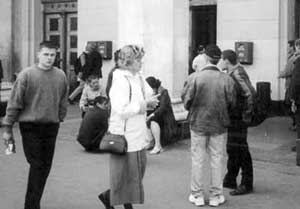
HARD UP?: The “tochka”. The one in the white costs 800 r. |
There are three basic ways for a train station bomzh to make money: bottles, begging, and stealing. In a place so heavily infested with cops-- there are up to a hundred on the grounds of the three stations at any given time-- the stealing necessarily has to be of a certain type. Lifting food and alcohol out of the back of kiosks and pickpocketing are relatively high-risk activities. The bomzhi explained to me that if you get caught stealing from a viable business on the territory of the station, you will get a very severe beating at the very least and real jail time at the most. The same goes for pickpocketing, though to a lesser degree. Pickpocketing victims carry less weight with police for the obvious reason that they are not there every day, and also not paying the police off. But mugging a respectable citizen still carries serious penalties.
Therefore the kind of thievery that's most common involves drinking heavily with someone with money and robbing him once he passes out (although helping your drinking partner to unconsciousness is not uncommon either). This was something several bomzhi explained to me quite openly, despite the fact that in each case I was very conspicuously a potential victim-- a stranger with money who was drinking with them. One young girl who was walking arm in arm with her boyfriend, a fellow bomzh who was a dembel, or recent army discharge, told me a story about how she got picked up by the police with a friend and had to pay a 700 ruble bribe to get her friend out of jail. I interrupted her.
"Where did you have 700 rubles from?" I asked.
"Oh, ya eto yebanula," she said. She meant she'd stolen it.
Therefore this was something I had to consider whenever I met anyone at the pianny stulik, or drunk table, which is the like the bomzh nightclub at the station. The pianny stulik is a series of stand-up tables outside a row of kiosks on the northeast end of the Yaroslavsky station. Dinner on the town at the station generally means a rancid chicken leg here, washed down with a bottle of Baltika 9 beer. Baltika 9 is the beer of choice among the bomzhi-- extra strong.
One afternoon I went to the station with Sex Machine Jake Rudnitsky. Aleksei had left town to visit his family in Nizhni. We went to the pianniy stulik and met four guys standing at a table. I offered them a round of beers. They took them and a long afternoon began.
Two of the four-- a Kazakh named Timur and a Russian named Tolya-- were ex-cons. The other two were a 35 year-old named Igor, who'd been thrown out of his apartment by his wife, and a 24 year-old named Dima, a kid from the Sakhalin islands who was also having some tough times after getting out of the army.
These four, who actually called themselves "Timur's gang", were only bomzhi in the technical sense that they had no papers. In fact, they had a sort of place to live-temporarily, at least. They'd made a deal recently to share a room together in a dormitory not far from the Kursky station. The room was going to cost them 100 rubles apiece, and they could pay at the end of the month. Timur, an Afghan war vet, hinted very strongly that they might not be paying at the end of the month.
"We'll see how it goes," he said.
The obvious question to ask these guys was what they were doing at this station, if they didn't even live near there. I asked Timur why anyone with no documents-- and none of them had anything like legitimate Moscow documentation-- would bother coming to the most cop-infested piece of property in Moscow to drink beer and share a loaf of bread in broad daylight. He answered by quoting the old Russian saying:
"He who doesn't risk, does not drink champagne," he said.
What champagne? I pressed him, but he didn't answer. That and the fact that Tolya claimed he'd just gotten out of jail in Tver for murder (in fact he and Timur had done time together, Timur for assaulting a superior officer) put me on guard. But it was still light out and I was fairly clear-headed, so I kept buying rounds until the police came and took them all away.
Here's the way the police roundup works. If you come to the Tri Vokzala in the daytime, at any time, in fact, you'll often see a big blue bus parked in front of the Komsomolskaya metro station. This is the bomzh bus. The cops—menti or "musori", trashes-- make the rounds, hauling people with suspect documents into the bus until they fill it to capacity. Then, once the bus is full, they drive it around the corner to the big Krasnoselski precinct house, located behind the Kazansky station.
There, at the station, they run everybody's name through a computer. If anything comes up, they stay in there. If nothing comes up, they keep them in there for a while-- say, three hours. The three-hour period is totally arbitrary and commercial in nature. If you have any money, you can get out right away. If you're a woman, you can take a trip into an interrogation room and get away for a blowjob. If you have no money and aren't appealing as a blowjob option, you sit for three hours before they kick you out. They don't want you there anyway-- they just have the three-hour rule to provide an incentive for the payoffs and the blowjobs.
About ten minutes after the cops picked up Timur's gang, Timur himself found me on the opposite end of the station. He claimed he'd gotten out because the Lieutenant on the bus was from his home town of Saratov and felt sorry for him. Whether this was true or not was hard to say, but the fact that Timur was out was hard to dispute. We talked and it was agreed that I should go up to the bus to try to bribe the crew out before they were driven off to the station. Timur, not wanting to risk another pass with the cops, watched this scene from a distance.
I got there and found the Lieutenant in question. I explained the situation and quite openly offered to pay the "fine" for the crew, who I could see sitting in the back of the bus. After examining my documents, he chortled.
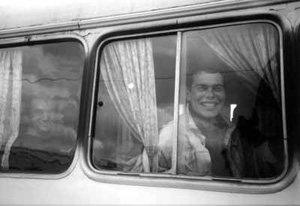
SEE YOU IN AN HOUR: Igor (l) and Dima (r) in the bomzh bus. |
"What's your excuse?" he said. "Why are you hanging around with these guys?"
"We're just relaxing," I said, "having a beer, and I thought..."
"They'll cut off your fucking head, you know that?" he said. "They'll cut off anything you've got that's sticking out." Then he refused my bribe. "No," he said. "I'm not in the mood today to collect fines. I just can't see how that would benefit society." Then, sticking his nose in the air like King George, he disappeared back into the bus.
Police humor is a strange phenomenon. It's obviously a highly developed personality trait in most of the station cops. Not that their jokes are funny; more often than not, they inspire nervousness and unease rather than actual laughter. There are obviously not that many spiritual benefits involved in this kind of police work; a life of bashing heads and extorting money from helpless people can probably even be said to cause a sort of intellectual boredom. Developing an individual style of venomous delivery in one's various ultimatums, threats and interrogations is probably the only creative outlet for these kinds of cops.
And it must be said that they're good at it. On my first night at the station, Aleksei and I decided to sack out in the waiting hall at the Kazansky station. On our way in to this heavily-policed area we were stopped by a tall policeman with a face like a young Martin Landau. "Documents," he said.
I showed him mine. He made some crack about America which I forgot instantly. He flipped the passport back to me and took Aleksei's clown theater ID. Aleksei's actually registered in Nizhni Novgorod, so what he carries around is his theater card-a silly little red badge with a clown-face stamp over his photo. The cop looked it over and chuckled.
"It says here you're a 'dramatist,'" he said. "I think we should clear this up. Are you an actor, or a dramatist?"
Aleksei frowned. He was tired, drunk, and wanted badly to go to sleep. No such luck-- the victim's strong aura of not wanting to be there is what gives cop humor all of its power. It's like a built in first-class straight man to this two-man show.
"Technically," Aleksei said, "I'm a dramatist."
The cop scratched his chin.
"Dramatist," he said. "Interesting. Now, would you call that a profession, or a calling? It says here 'profession', but it seems to me to be more like a calling."
Aleksei said nothing and just stared, clearly thinking: "Friend, give me a break." I raised a finger.
"It's a calling," I said, "and a profession. Like police work."
"Have a nice night," he said, handing Aleksei his ID and walking off.
Having failed to bribe the crew out of the bus, I was forced to follow them down to the Krasnoselskiy precinct to have a try there. By the time Timur and I walked there (although Timur stayed across the street from the station, again not wanting to get too close), the three men were in the "monkey cage" with about thirty others, most of them dark-skinned. The major on duty generously accepted my bribe offer as soon as I explained the situation to him, but apologetically said he wouldn't be able to get to the paperwork any earlier than an hour.
"I'm sorry, really, but look at this," he said, pointing a thumb behind him at the "blacks" in the cage. "You see what a Nagorno-Karabakh I've got here. Come back in an hour."
So I did. By then, they were gone already. "I'm sorry, I let them out early," the major said. "They said they'd be back at the Pianniy Stulik to wait for you."
I came out to tell Timur the news.
"They won't be there," he said. "Too many cops. We'll just have to walk around."
They weren't there. Timur bummed money off me for a hot dog, and we parted.
Homeless women have a place to go at the Tri Vokzala. The good-looking ones have no reason to stay-- the street meat markets on the ring road and around the Metropole hotel are much better-paying destinations for young women willing to hook for rent money.
But not all homeless women are an easy street sell. A lot are homeless because they drink, and women who drink, like men who drink, tend not to look so good. But the beauty of capitalism is that even these laborers can find their niche. The "tochka" or spot at the Tri Vokzala is in front of the Komsomolskaya Metro station. It doesn't look like a normal prostitute market because the prostitutes, like Amazon basin amphibians, blend effortlessly into the landscape. You can stare at the front of the station all day long and not once see anyone you'd think is a prostitute-- or a pimp. Nonetheless, Aleksei and I were approached as we passed by the station. A man in an orange street-cleaner's vest stepped up to us, rubbing his hands.
"You want a girl?" he asked.
"Sure," Aleksei said.
"Normal or abnormal?" he asked.
Aleksei and I looked at each other. "Let's try for normal," I said.
The janitor pimp walked back behind the pillars at the station entrance and pulled out three "women". All three looked like centerfolds from "Fangoria." One was tall and wraithlike, literally elderly, her skin doughy and gray. Another was about fifty-five and had the puffy face of a hardcore alcoholic-in fact, she looked quite a lot like the Boris Yeltsin of 1995-96. The other was just a flat-out beast, late thirties, orange hair, horror-mask face. I could not imagine anything alive, human or otherwise, voluntarily entering into intercourse with any of them.
"How much?" I asked, gulping air.
"800 rubles," he said.
We told him we'd think about it. As I later found out, the whores take their johns across the street to the "Leisure Rooms" in the Kazansky station. One whore I talked to told me that the Kazansky rooms were the best because "they had sheets." Other legends include trysts in stalled train wagons and quickies in dark corners. The latter option was said to be frowned upon because any place on the territory of the train station dark enough to get a blowjob from an elderly hooker was also likely to be dark enough to take a piss, and the demand for the latter kind of space was much greater. It was, indeed, hard to find a good place to go to the bathroom in the stations. Public urination is a thing one can be arrested for, so it is necessary to stay out of sight if you don't want to pay 5 rubles for the public toilet. I counted six good spots on the Yaroslavsky/Leningradsky side of the street, one of which was near the bottle return place and necessitated a trip past the police. When one has to urinate badly enough, a 5-minute holdup to have your documents checked can be catastrophic. So most bomzhi go for the slash-and-burn method of the urination: any surface anywhere on the station, dark or not, which is out of the immediate view of the police. Piss and run quickly.
I ended up favoring the public toilet inside the Leningradsky station. On the ground floor level, it has a row of urinals that have open windows at head level just above them. There are one or two spots where you can go to the bathroom at a leisurely pace while watching pedestrian traffic pass by under your nose ten feet away. I noticed that these spots are always taken when there are any people at all in the bathroom.
On my last night there I stood at the window spot and looked outside. The blond, bucktoothed girl who'd told me the story of the 700-ruble fine was standing there with her dembel boyfriend. He was drinking a beer; she was trying to climb on his back. They spotted me and waved. Then a porter walked by pushing a cart.
"Hey," the girl shouted. "Give me a ride on that!"