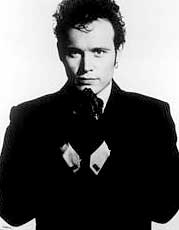
Amid all the negative news to befall us good citizens of the world in the last year or so—the humiliating electoral mess in Florida, the seeming collapse of the Kosovo peace agreement, the end of the tech stock rally, the disturbing trend toward violent anti-globalist protests—there is one uplifting story that we can all find comfort in: the triumphant comeback of British pop star Adam Ant.
Only a few years ago, Ant was little more than a tiny piece of buried treasure in our cultural consciousness, a ghost of a long-forgotten smile on our collective societal face. We remembered him vaguely as the spiky-haired leather-jacketed pop icon with the boyish good looks who gently chided us for our “Goody-Two-Shoes” lifestyles. Addressing that great portion of us who “don’t drink” and “don’t smoke,” he asked us, poignantly: “What do you do?” It was food for thought for all of us to learn that we couldn’t really answer the question: we learned from him that it “must be something inside” that we lacked.
Later on in his career, when he found himself struggling to maintain the bond he’d built with us through his earlier albums, Ant won our hearts again by frankly offering an emotional quid pro quo. “If I strip for you,” he offered, in his seminal album Strip, “will you strip for me?” In his live performances and in the video for the song, Ant coyly bared his chest for us, a symbol that he was willing to open up to us, if we would only offer our hearts in return. The ploy worked and we rewarded Ant with yet another gold record. He had helped us realize that our dog-eat-dog corporate 1980s lives had indeed become too complicated, and that we really did wish at times, as he did, that we had “not so many clothes.”
After that album, Ant seemed poised for super-stardom. He had already hinted at his enormous screen potential in the slick and sassy Honda Scooter ads, co-starring Grace Jones. With just one unforgettable line—”Hullo, Gray-ce!”—Ant announced to Hollywood that he was more than ready to make the next big leap. Those of us who had already suffered the disappointment of Sting’s coming-out party after his flat performance in the otherwise excellent “Dune” had hopes for a new multimedia star, one who had not only looks and style, but wit—the former front man for Adam and the Ants, now simply known as “Adam Ant.”
But like that of Jones, his soul mate-in-emerging-stardom, Ant’s screen career suffered from poor management and bad luck. In what was seemingly a bold move, Ant debuted on the American screen with a cameo in the innovative television action series, “The Enforcer.” Despite a cautious but effective performance as a down-on-his-luck British immigrant in New York, the show itself was a dud, weighed down by stale direction and the continual on-set disruptions caused by the worsening alcoholism of the show’s star.
Worse, the episode had the misfortune to run opposite a heavily publicized special on ABC that featured an exclusive interview with Michael Jackson by Barbara Walters. That show, which captured a height-of-his-powers Jackson dancing for Walters in his home (shown in a daring narrationless segment lasting over seven minutes, epic length by network television standards), blew Ant’s “Enforcer” segment out of the water with an unheard-of Nielsen rating of 19.7. Ant was scheduled to appear on the show again in the following season, but NBC canceled the series before the young star could get his second chance.
Ant, who had suffered worse disappointments in his musical career, seemed unaccountably devastated by the setback. He began to drink beer, spoiling his signature streamlined abdomen. At a callback for a supporting role in what would ultimately become the George Lucas flop “Howard the Duck” (then operating under the working title “Howard”), Ant showed up drunk and badly mangled his lines. Not only did he lose the part, but word spread around Tinstletown that “the Honda guy was slipping,” and Ant was taken off the short list. In despair, Ant turned to his childhood friend, Thomas Dolby, and begged for a part in a video Dolby was filming for the hit, “One of Our Submarines.” Dolby, whose penchant for remaining loyal to friends instead of his career helped sink his last PolyGram album deal, gave Ant the chance... and regretted it. Stoned on pills, fat, and unable to work, Ant had to be removed from the set in mid-production, only to be replaced by a young unknown boy actor named Jude Law.
After that, Ant’s life—and his career—fell into a tailspin. After being hit in the neck by a cricket ball in a casual weekend game at his mansion in the Scottish highlands, Ant lost his voice, cutting off his one remaining steady source of income, live musical performances. He tried acting on stage, but directors, afraid that Ant’s presence would be a distraction to audiences, shied away from giving him even bit parts. Finally, in an extreme step, Ant took a job as a VJ for MTV Britain, but quit after just six weeks following what he called an “artistic disagreement” with management—he had refused to call new Brit-pop sensation Oasis “the most exciting British act since The Human League.”
After that debacle, Ant disappeared for more than three years, not reappearing in public until 1995, when he was featured in an inside spread in the Liverpool-based “Darts” magazine. The onetime pop star had turned to hustling pubgoers at the game that was his first love. “Music had always been a fallback profession to me,” he told the magazine. “My first love was always darts.” But Ant, who by then had changed back to his original name, Adam Hirschberg, failed at several attempts to turn pro in the popular national pastime.
It was not until 1998 that Ant’s fortunes began to take a turn for the better. Contacted by the British Home Office with an offer to appear in an public service announcement promoting the military intervention in Kosovo, he jumped at the chance. By then, he had been in AA for two years and had thoroughly cleaned up his act, having found a job as a piano teacher in the Lycee for the French Embassy in London. He had only one line in the spot—”Ethnic cleansing: it’s bollocks!”—but he delivered it with flair.
Having reached for the stars once and missed, Ant was not about to give up this second chance. On the urging of Freedom House, the American-sponsored foundation for the furthering of democratic ideals, Ant co-authored a children’s book about international terrorism. To write the book, Ant traveled extensively throughout the Islamic world, even visiting Kabul, and became a true authority on the terrorist threat to the West. His passionate condemnation of Osama Bin Laden in a speech before the United Nations was considered a turning point in America’s effort to bring its Western allies on board in the fight against the elusive embassy bomber.
Finally, last week, Ant’s accomplishment’s were formally recognized. President Bush’s decision to make him a Special Advisor to the President on Youth marked the end of a long journey back to respectability. In the ceremony marking his hiring, Ant announced his plans for an elaborate campaign to revive the consciousness of America’s youth—plans that included a series of educational TV spots and even, he said, an album.
“I’ve been away from music for a long time,” he said. “It took something this important to bring me back.”
We at the eXile are happy to say this week that we hope he succeeds. Too many of our celebrities squander the opportunity to do good that their status confers. Ant nearly squandered his, but turned himself around just in time. His triumph is an inspiration to us all.