
Issue #12/93, June 22 - July 6, 2000 

 |
 |
 |
 |
 |
 |
 |
 |
 |
 |
 |
 Of
Clowns And Men
Of
Clowns And Men
The crowing of a pissed-off rooster has to be very high on the list of sounds the human organism can least bear to hear the morning after drinking a bottle of home-brewed hard liquor. Feline screeching isn’t far behind. This past Tuesday I had both; my hosts in the village of Diveyevo kept both cats and chickens, with the chicken coop right next to my bathtub-sized guest room. Without looking, I knew what was going on behind that wall. I’d seen it the day before.
The roosters were strutting around, provoking the cats from behind the safety of their chicken-wire. They’d walk back and forth and peck at the air in the cats’ direction. One particular rooster back there, a big, dumb-looking son-of-a-bitch with a big vain hump of purple plumage around his head, was better than the rest at driving the cats crazy. He had only one joke to tell, but— like all men— he was more than willing to tell it over and over again, sure each time that people would come running with book and film deals at the sound of him: “Cock-a-doodle-doo! Cock-Doodle-doo!” And then louder: “COCK-A-DOODLE-DOO!”
Burying my aching sweat-covered head under my pillow, I quickly did the hangover math. Was it possible to tolerate this for any length of time at all, even a minute, in exchange for the privilege of not having to move? Answer: Yes, of course it was possible. Just as long as it didn’t get worse. If it didn’t get worse, I was sure I could go back to sleep...
Just then the door flew open. “Matt!” a voice said. “Wake up! Time to make hay!”
My friend Alexei Dindikin, who had brought me to this godforsaken place, is a professional clown. We met three years ago in Moscow, at the Moscow Clown Theater. Alexei actually looks like a clown. He’s always got an exaggeratedly-friendly smile on his face, wedged between a pair of absolutely gigantic dimples, eerily like a made-up clown’s dimples. Without the makeup the effect is a little bit scary, something like the face of Cesar Romero. The chin, a fun-house mirror upside-down trapezoid, is exactly Romero’s.
Romero-Cesar-Alexei was waking me up, in theory at least, so that we could be on time for the traditional first day of haymaking, or the senokos, as it’s called in Russian. On Sunday two days before, the natives here in Diveyovo—a largish village in the Nizhni Novgorod region which is home to a nunnery and an enormous Orthodox temple-celebrated “Troitsa”, the Russian orthodox holiday in honor of the holy trinity. For many hundreds of years, including some 440 now in this town, Russian farmers and peasants have begun clearing the fields two days after the Troitsa. They wait until the day after the holiday, when it is said that the Holy Spirit descends over the town at nightfall.
This village buzzes somewhat before nightfall on that day. Priests and nuns in black gowns can be seen walking to and fro around the temple, busy with something, and even if you can’t see them you can hear them, because this is the kind of place where the sound of a single person walking on a gravelly road can be heard for a fair distance around.
Alexei and I hadn’t come to Diveyevo for the senekos. In fact we’d arrived 5 days earlier, with a plan to work, for purely anthropological reasons, as lumberjacks in a nearby forest. We’d known each other for years and thought this might be fun, to head out to the provinces for a while and do some hard labor, go boozing with laborers, etc.
But it didn’t work out that way. Within an hour after arriving in Diveyovo we were being poured shot glasses of 70-proof samogon, and within a few hours after that, we were stumbling around the town like village idiots. We tried to work the next day but were rained out, which led to our being poured, in still another house, still more shot glasses of 70-proof home brew. After a few more days of this we stopped bothering to even try to head out to the forest. By then we’d realized that just by staying in Diveyovo, we’d already joined the staff of the city’s largest work force-the “beniki”, or drunks who travel door-to-door doing odd jobs for liquor.
It was therefore only a coincidence, albeit a poetic one, that the first bottle we were to earn was for clearing a field on the traditional first day of the senekos. A young woman whose door we’d knocked on, a single mother, offered us a half-liter to bring her back some animal feed. She put us up for the night, which we spent drinking the rest of our remaining stash back in the shed, next to the Lev-Tolstoy era scythes we were to use the next morning.
Now, after all of this, Cesar-Alexei-Romero was trying the next morning to talk tradition with me—and expecting me to buy it! In my agony I was already thinking about having another drink, and he was talking about work. Worse, so that it could be heard above the cats and the chickens, his scary clown face was now just inches from my head.
“Come on, we’ve got to get up,” it said. “Haymaking starts today. You know what time people usually get up to clear the fields around here? Five a.m., that’s when. And here we are-seven a.m. already. We’re blowing it.”
I groaned. “We’re not blowing shit,” I said. “Maybe a hundred-fifty years ago, the peasants here got up at five a.m... This is the year 2000. No one gets up to make hay anymore. No one does anything at all.”
He hesitated. I had him.
“Anyway,” I said, “why don’t you go back to bed and get some sleep? We’ll get up and get our goddamn hay later.”
He paused. The dimples relaxed for a moment, revealing the hidden hangover, the bored, tired man behind the clown.
“Logical,” he said, nodding.
Then, not smiling, he left the room to go back to sleep.
Nature’s bounty does not grow out of the ground in places like Diveyovo anymore. It comes in on trucks and is sold in cubical 1-kilogram packages. It’s called drozzhi—yeast.
Everybody who’s spent any time in Russia at all knows at least a few of the folk sayings about the central role alcohol plays in this society. “Everything is done through the bottle,” is something you hear a lot. About 90% of the jokes in this country are about drinking. Hit comedies in Russia involve a bunch of guys going into the woods to get drunk on camera. For ten years, Russia had a president who acted like he was lost at an Irish wake... In short, everyone knows Russians drink.
But not everyone knows the other thing—which is that in the past ten years or so, the economies of entire populations in this country have come to revolve around alcohol. It sounds like a facile witticism to say so, but in the provinces, absolute liquidity has literally become the bedrock rule of finance. In Diveyovo, the bottle has actually turned into currency. They even call half-liter bottles “dollars”. No kidding: offer someone a dollar for something in this town, and they’ll think that’s what you mean, a bottle of 70-proof.
And what happens when you can’t even get real money? When all the collective farms are collapsed, the factories hold up salaries for months at a time, and pensions come late? When the ruble might devalue at any moment, and you can’t plan ahead anyway, because you never know when you’ll be paid— or when, in the case of a small businessman, your “investor” might be killed or demand his money back?
You start minting your own money, that’s what you do. That’s what Alexei and I found out when we came to town. The Central Bank of Diveyovo has a branch in virtually every house. Walk into any house here, and you’ve got better than a fifty-fifty chance of finding a still on the stove. Our boss, Tamara Fedotova, is college-educated and religious—she works as a tour guide at the monastery—but looks can be deceiving. Samogon, which she calls “the only reliable occupation in town,” is her lifeline. As proof, she pointed to a new concrete guest house in her back yard which she’d just had built and fitted with a giant brick oven.
“That whole house was built on samogon,” she said. “I cooked that house in my kitchen. I paid for some of the materials with money, true, but all the labor I paid for with liquor. The whole thing didn’t cost me more than a thousand dollars.”
Later on, Tamara took out a piece of paper for us, and did the math to prove her case. To make ten liters of 60-70 proof samogon, you need to buy a kilo of drozzha and 10 kilograms of sugar. A kilo of drozzha costs about twelve rubles. Sugar costs about eight rubles a kilo here, so ten kilos runs you about 80 rubles. Your overall expenses, then, roughly speaking, are about 92 rubles, give or take a few here or there.
Ten liters of samogon translates into a full case of alcohol—twenty half-liter bottles. A good half-liter in this town sells for twenty rubles. You therefore can easily make 400 rubles out of 92 in this town for just a few hours’ labor on your stove—a 300% profit, resulting in a crop that is more or less absolutely liquid, only slightly less universally useful than money.
Compare that to the prospect of working in the fields, or in the woods operating dangerous heavy machinery, for eight or ten hours a day, for a whole month, for fifty or sixty bucks which may or may not come on time, or at all. Which would you choose?
In fact, samogon is even more valuable than money, in some cases. For instance, while the tariff varies for different kinds of labor, the basic going rate for help in Diviyevo is a bottle per day. It follows that a worker’s services for a whole month can be had in this town for 92 rubles, with a few scraps from the table thrown in. So if you can come into some wood or cement for cheap, you really can do like Tamara did and build yourself a whole house for nothing. After all, it’s not as though there aren’t out-of-work carpenters and electricians prowling around. There are.
Clowns and journalists are a different story, of course. Neither a clown nor a journalist can build you shit. But both still need a drink every now and then. It presented a dilemma for a couple of drifters who came to town, looking for work.
When we first came to Diveyevo we arranged, through an old friend of Alexei’s who ran a small glass-blowing factory here, to stay with an elderly woman named Nadezhda Ivanovna at the edge of the village. Nadezhda Ivanovna worked at the factory and we were given to understand that she was a quiet type who would cook our meals, wash our dirty work clothes, etc. When we finally met her we noted the standard Russian-babushka build—the Nebraska wishbone-formation lineman’s shape, fat fists, glass-splitting voice—but we didn’t see anything that seemed out of the ordinary. Seeing that we’d had a few beers and stayed up late the night before on the train, Alexei even thought it fit to warn her that “we like to have a drink every now and then”, and might stay up late. Nadezhda Ivanovna said this was no problem.
She took us home. Her house was more or less like all the other houses in town, the kind you see in the thousands through the window if you travel by train in this country. Warped wood, slanted roof, not a right angle in sight, multicolored (muddy sea green, muddy sky blue) peeling paint job, white window-panes, overgrown yard, and clotheslines and potato gardens in back, next to the woodshed. Inside, an ancient linoleum floor, mildew-colored wallpaper, three hundred flies in every room, jars full of creepy things everywhere, and most importantly, no real plumbing. There was a sink, with a functioning faucet, but the cupboard door underneath it revealed no further plumbing under the drain, just a bucket. Wash the dishes once, take the bucket out. Wash your hands, take it out again.
The kitchen stove was fueled by gas, but it was gas from a tank. Nadezhda Ivanovna had to buy the tanks. Only a few areas in town had gas piped into the houses.
The rear of the house was divided between the living area and the “functional” area. This area featured a giant shed full of chopped wood—her house, like most others in town, was wood-heated. Next to the woodshed was the bathroom, which was something between an outhouse and a toilet. It had the standard hole for crouching over, but inside the hole was a tenuously-placed bucket. Take a shit, take the bucket out to the compost heap. Take another shit, take it out again. Everything had to be conserved.
The only thing odd about the place was the number of beds. There were beds and mattresses literally all over the house. Even the kitchen had two fold-out couches in it. Mysteriously, Nadezhda Ivanovna had told us she lived alone.
When we sat down to have a cup of tea Alexei made the mistake of sighing. Every gesture Alexei makes is noticeable, even from a distance. At 40, he is a ten-year veteran of professional histrionics, having moved to Moscow from the closed city of Sarov to join the clown theater way back in 1990. When he hands you something, anything, he smiles and gesticulates in such an exaggerated way that you feel like you’re four years old and he’s presenting you with a balloon on a stick. When he does something wrong, he winds up and hits his forehead with an audible “Smack!” designed to be heard in the thirtieth row. A few years ago, he wrote a clown stage version of Don Quixote. His youth he spent working in upper management in a secret nuclear facility.
Alexei was sighing because of a mild hangover from the night before. Too much beer, too little sleep, a pause in the conversation, and so—a prolonged intake of air, a closing of the eyes, a violent arching of the back, and then, finally, a deep, long sigh with a groan-”Yo, my-yo!”
Nadezhda Ivanovna had better seats than the thirtieth row. She rushed to the table. “You two look a little tired,” she said. “Here, let me help you.”
Instantly there were two glasses on the table. Then she produced a clear 3-liter glass jar from the windowsill, and poured. The smell was horrendous, like turpentine. Alexei read my reaction and you could almost see the annoying faux-tears of sympathy painted over his invisible clown makeup. If this keeps up, I thought, I’ll strangle him by the end of the weekend. We drank.
Samogon is a funny thing. It’s not like vodka; you barely taste the alcohol. But after about thirty seconds you literally begin to feel dizzy, like you’ve been hit with the proverbial baseball bat. My eyes crossed.
“Damn,” I said.
Alexei, for once, had no expression on his face.
After a minute, we poured another. Nadezhda Ivanovna left to go back to work. We drank some more. We went outside and had a smoke, and passed out briefly in the sun. Then we came back in and drank more.
But a funny thing happened. People started appearing in the house. We caught two little boys, about eight years old apiece, running out of the bedroom. Then a hefty track-suit clad couple in their thirties, both with identical wind-blown Maxell commercial haircuts, appeared at the kitchen table with shot glasses. Two old ladies came by and sat drinking on the steps. A businesslike man with a moustache and a troubled expression drove up in a red Zhiguli, came in for a few drinks, and left without talking.
Alexei and I left around nightfall to get some air. When we came back, the crowd had multiplied. We had to step over the bodies to get to our beds. People were spread out in messy piles, laid out on the floor in the violent postures of people who had collapsed to the ground. The snoring and smacking was beyond anything I’d ever heard before. It dawned on me: we were in a Russian crack house.
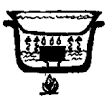
No one was up except Nadezhda Ivanovna, who was in the kitchen, working a still. She was spreading bits of bread around the pot, to keep the vapour from escaping. It was too late to find a new home that night, so we gave in and drank more of her stuff. We drank it hot, straight from the still. Samogon gives you a painless, stuporous drunk, something like medical anesthesia. When we finally stumbled off to sleep Nadezhda Ivanovna was still up. She was up when we woke up the next morning. Most of the people were gone, though.
Our lumberjacking boss, Ivan Utkin, was expecting us the next morning at eight. Despite what had happened the day before, we arrived on time. But the skies threatened (see insert), and after waiting an hour or so, he canceled work for the day, sending the attendant clowns, journalists and lumberjacks scrambling to brew another batch of samogon. As for losing the day’s income, he shrugged, saying it didn’t seem worth the trouble.
Utkin is in his early forties and now in his eighth attempt in the last ten years at building his own small business. He is hardworking, diligent, frugal, and well-liked and respected by his ten employees. The story of how his previous businesses failed provides a great insight into why so many people in town prefer to brew their own money rather than earn it.
“Everything in business comes back to time,” he said. “All start-up businesses need time to develop. But nobody in this country has time.
“Take my bosses,” he went on. “I’ve now had seven investors in the past seven years, each time in a different kind of business. I raised pigs, raised chickens, did construction, opened a store, and now I have a sawmill.” He leaned forward. “Guess how many of my investors are still alive?” he asked.
Alexei and I shrugged. “All of them?” I asked.
He shook his head. “None of them,” he said. “Every single last one of them is dead. A few died of natural causes, but mostly they just shoot each other. I had a store project that was going on schedule last year. We’d just started to turn the corner, and then—they found my guy dead in the front seat of his jeep.”
He went on:
“But it wouldn’t have mattered if these guys had lived. They’d have bled the businesses to death anyway. Everybody who invests in this country wants a return in ten minutes. Here’s the way it works; they give you a bunch of money and say, make this at this price, and sell it at this price. You come back the next day and announce happily that you’ve sold half your stuff and made so-and-so amount of money. They take all the money and all the stuff, and you’ve got to wait until they give money again to make more. Meanwhile, you can’t pay anyone anything. The idea of allowing anyone to invest the return back into the business—that simply isn’t done here.”
Utkin’s current sawmill business is unfolding according to the same storyline. It opened about three months ago with a $30,000 investment, which he used to buy equipment for the mill. The investors are a Moscow construction company which makes dachas and homes for mobsters. Their interest is cheap wood. According to the terms of the deal, Utkin’s company-”Energiya”-has to deliver four truckloads of plank wood per month to Moscow. For three of those truckloads, they receive a miserly 700 bucks apiece. The fourth load they deliver for free, to pay off their debt.
Fair enough. But this month, just a few months into the deal, Moscow balked. Just a week ago, Utkin’s boss started to demand cash repayment of the principal. And the last truckload of wood they sent, one Utkin was due to be paid for, the investor took for free.
Part of the initial $30,000, incidentally, went to another business. They earmarked $4000 to convert an abandoned school across the street into a woodworkers’ shop. With that $4000, Utkin brought in a professional woodworker from Moscow named Kositya Pankratov to run the show.
Pankratov, who competes in motocross races in his spare time, is now similarly fucked. He used the four grand to buy woodcutting equipment and brought in a whole boatload of local drifters and alcoholics, and made a deal with them. Work for me on credit, he said, and I’ll give you a percentage of anything you sell. In the meantime, I’ll teach you how to cut wood, make furniture, etc.
Most of the drifters balked, but some bought the idea on faith. While they awaited payment—and suffered through the creation of countless unsaleable wooden statuettes, benches and utensil sets—Pankratov paid his workers in Diveyevo “dollars”. Then, after about a month, the shop finally started to produce a few things worth selling. They had cut down old rotting tree stumps and made giant chair-stands out of them. Pankratov did the details himself on one, a double-swan head that grew out of the twisted tree branches on the back of the chair. It wasn’t art, but it was pretty cool—I saw it myself.
The investors now want the chair for free. They are also asking for the four grand back. Pankratov’s liquid staff is beginning to flag. Some are going back into the village and doing odd jobs—chopping wood, building sheds. Better to know when you’ll get your “dollar” than not know. The school probably isn’t going to make it.
“No one can build a business in two months,” Pankratov said. “But anyone can make a case of vodka in ten days. We can’t compete.”
Pankratov asked us what we did for a living. We told him and explained that we were thinking about writing a book—”Of Clowns and Men.” He laughed.
“Clowns and men, that’s good,” he said. “The whole country is divided up into clowns and men. There are about six men, all in Moscow. They’re turning the rest of us into clowns.”
By the early afternoon, one of the lumberjacks—another man in his early forties, also named Kostiya—had helped one of Pankratov’s men, an ex-con named Sasha, cook up a batch of samogon. We all sat outside on a table next to the conspicuously quiet sawmill, ate shashlik, and drank heavily. Later, everyone split up, and somehow we made it back to town.
In the evening Alexei and I went to the “disco”, the only thing of its kind in Diveyevo. It was the usual provincial setup—a converted “Palace of Culture” with free entrance and a lone DJ. Virtually everyone under twenty-five in the town was there. The place sucked. The same Boney-M they played fifteen years ago, only you could at least hear it fifteen years ago, when they first bought the equipment. A scrawny little cop about eighteen years old came up to Alexei and me and gruffly ordered us to stop smoking; we did. A girl there later told Alexei that that same cop had only just a week before shot a seventeen year-old kid dead for riding a bicycle without a helmet. Stunned, we asked: was he reprimanded?
“Of course not,” she said. “He was with the chief of police. They were all drunk. What reprimand do you want?”
We were about to go home when Utkin, the sawmill owner, showed up unexpectedly at the disco. He whispered in Alexei’s ear that he needed a car. Alexei gave him the keys. We didn’t see the car for 36 hours, later finding it parked at a diagonal in the street in front of Nadezhda Ivanovna’s.
Now carless and jobless, we started off on the walk home. On the way some weirdo with a speech impediment and a boxing fixation—he kept erupting in spasms of shadow-boxing-led us to the “bar”, apparently the nightspot for the local elite. We went inside and the place fairly froze at the sight of two strangers being led inside by the village idiot. But just then we saw a familiar face—Kostiya the lumberjack, collapsed nearly dead drunk at a table with three cheap and not very young-looking women.
“Brrh-mmm...” he said at the sight of us, but we couldn’t make out anything else. We stayed for ten minutes and went home.
There is one sure way to instantly sober up anyone in Diveyovo: mention Boris Nemtsov’s name. Nemtsov to the locals here is something like a cross between Count Dracula and the Grim Reaper. He is roundly blamed for having completely destroyed the local economy.
Three of the main collective farms around here—Cherbatovsky, Diveyevsky and the Sarovsky—have been closed since 1993, when Nemtsov first became governor. It was Nemtsov’s “Agricultural Program” which resulted in the mass privatizations of local collective farms. All agricultural subsidies stopped; the directors of the farms all made a fortune and left town; and the farms themselves were left to rot.
When we were rained out for the second straight day in our attempts to work as lumberjacks, Alexei and I decided to go native. The sawmill didn’t seem all that reliable anyway. So we went door-to-door, asking anyone if they needed any work done.
There are armies of people like this in Diveyovo. The local term for them is “beniki”. They walk up and down the streets offering to work for bottles. If you need something, anything done, you don’t have to look far—help comes to your door.
My accent would have made us suspicious in this endeavor, so we reverted to a Lenny and George routine when going door-to-door. I played the big dumb moron, while Alexei put on his dimples and charmingly begged for employment. Exactly this sort of contrived literary act was what he’d had planned for this trip from the start, but by the third day it was getting kind of old and no longer seemed all that interesting.
Alexei and I didn’t know each other very well. We met three years ago, when I took a job as a clown at his theater as a subject for an eXile article. He dressed me up in a giant Turkish clown costume for the day, and we went around whacking each other on the head with rubber mallets for kids outside the theater. Afterwards we went back to the costume room, drank a bottle of pertsovkaya vodka, talked about our favorite comedies, and celebrated a new creative friendship.
But that was basically it. In the three years since then, we’d met just a few times. Then, about a month ago, I came to him with this idea of travelling around the country getting jobs as laborers. He was bored at the theater, had the summer season off, and after a couple of beers came to like the idea. A couple of phone calls later and we’d bought tickets to the Nizhni oblast, where Alexei was from, and before we knew it, we were in Diveyovo.
But now that we were here, the cracks were showing. Alexei is ten years older than I am and has two kids, which he can barely afford to feed on his theater salary. He has heavy things on his mind. By the third day of the trip I could see that he was looking and me and thinking just the opposite, that I was this jerk-off American who was just fucking around, while he and all the other people around me had real problems. And now here we were going door-to-door in the middle of all this mess begging for bottles... well, he was going to ride it out, but I could see he wasn’t all that comfortable about it.
“Good evening,” he said, knocking on Tamara’s door. We’d been directed to her house by a neighbor of Nadezhda Ivanovna’s, who told us there was a woman down the street who needed some yardwork done.
“Good evening,” Tamara said. “What can I do for you?”
Alexei explained: we wanted to work, for whatever she could pay. “Of course, we don’t know how to do anything. But we’ve got a car. Lift something from here to there, you know.”
She pointed at me. “What’s his problem?”
Alexei laughed. “Oh, nothing,” he said. “He’s just an idiot. Pay no attention to him. A nice enough guy.”
She frowned. “I heard you two talking on the street. He’s no idiot. He’s got some kind of accent. What’s the deal?”
“I’m an American journalist,” I blurted out. “We’re here on this stupid project which we’re already tired of. Give us some kind of job, please, so we can get the hell out of here.”
Everyone laughed. She demanded a full explanation and got it, agreeing that it was funny. Then she said that, in fact, she could use some hay, if we wanted to cut some. Negotiations ensued. Alexei offered her a day’s work for a bottle.
She paused. “Too much,” she said, laughing.
“That’s half the going rate,” Alexei interrupted.
“That’s what you’re worth,” she said.
We caved in, went inside, and proceeded to get drunk in her woodshed. The next morning we grabbed our scythes and went out searching for hay.
Tamara had told us that she could remember a time, not fifteen years ago, when even finding a hay-field for private use was a problem. “All the good land belonged to the collective farms,” she said. “If you wanted hay for your own animals, you had to go far out of town, to God-knows-where, in the swamps, in the woods. You’d be cutting patches of hay on slanted riverbanks, in between trees, etc. And in order to get it carted back to town, you had to wait until late at night, after the collective farm workers got out, to bribe a local driver to haul it for you.”
She paused. “Tomorrow, you’ll find out,” she said. “Now you can drive five minutes in any direction, and you’ll find fields as big as God, and they’re all yours. That land used to belong to the collective farms, but now it just sits there. And as for hauling it, any driver in town is yours forever, for a bottle.”
Tolstoy’s Levin, you recall, discovered his manhood on the senekos. He went out into the fields with the muzhiks and spent the whole day making hay with his scythe, trying desperately to keep up. At first he hated the work, but then he found his working rhythm and, in the manner of intellectuals, believed he’d discovered philosophy and truth at the same time. Life meant getting back to the fields, working simply as men do, while also believing in Christ simply, as those same men do.
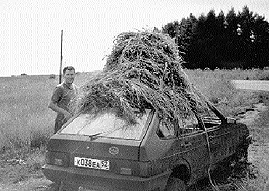
Tolstoy now is long dead and even the replacements for those great fields of working men he briefly lost himself in those lines of peasants with scythes rhythmically slicing through the tall grass—even they’re gone. The peasants were replaced in the 20th century with great mechanized threshers, and in the 21st with—nothing. At ten in the morning on the first day of the senekos, Alexei and I went out to the fields and found no one there, absolutely no one. Just two clowns in a car the color of a clown’s nose.
We dove into the first field we saw and hacked it to pieces. By early afternoon, I was pissed. I’d found the rhythm with the scythe all right, but that rhythm was killing my back. I found myself cursing Tolstoy. I’d always loved his books, but this was too much. “Fucking writers!” I thought, catching the scythe on a rock; there were no such rocks in Anna Karenina.
We brought the hay back in loads, strapping it to the roof of Alexei’s ridiculous clown-mobile. We looked so stupid that the GAI didn’t even bother to stop us, just laughing as they waved us through into town. After the last load we drove to the store at Tamara’s request and bought a packet of drozzhi and and ten kilos of sugar. Tamara already had some braga ready that she would distill for us that night, but she wanted to cook up a new 10-liter batch, and needed some ingredients.
Sugar and drozzhi turned out to be hard to find. Someone had beaten us to the punch most everywhere in town. Finally we found a store with eight kilos of granulated sugar; the remaining two we bought in cubes. The store cashier, a bored-looking blonde in her thirties, just laughed.
“Ten kilos of sugar, huh?” she said. “You guys need some drozzhi?”
“As a matter of fact, we do,” Alexei said.
She handed us a kilo. “Say,” Alexei said. “How many of these have you sold today?”
“Drozzhi?” she said. “Today-let’s see. Three cases, plus five... 35 kilos.”
Alexei asked her if it was all going to make bread and cakes. You can make enough bread to feed Sweden with 35 kilos of drozzhi. And this was just one counter out of dozens in town.
“Yeah, that’s right,” she said. “Bread. And cakes.”

|
 Making
Samogon
Making
Samogon
 |
 |
 |
 Cards |
 Links |
 The Vault |
 Gallery |
 Who? |